Sun SPARCstation 10
Sun Microsystems Computer Corp. released the SPARCstation 10 workstation, a dual- and quad-processor system based on the SuperSPARC RISC processor, with configurations priced from $18,495 to $57,995 in 199216.
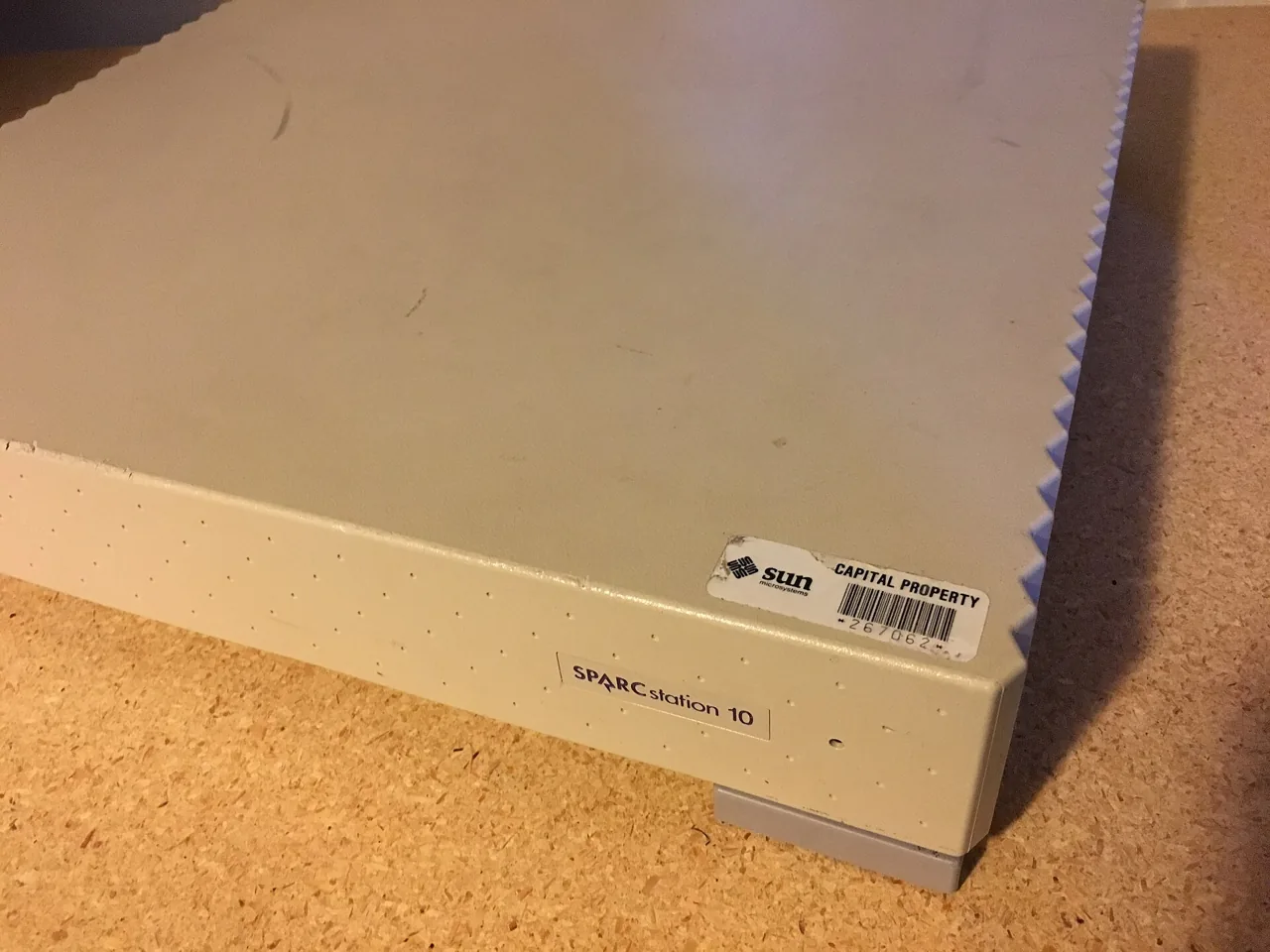
At launch, the SPARCstation 10 offered aggressive scalability within a single desktop chassis, supporting one, two, or four SuperSPARC processors, a configuration uncommon among workstations of its class at the time516. The base Model 30 shipped with 32 MB of memory, 424 MB of disk storage, and a 19-inch GX gray-scale monitor, while the top-end Model 54 included quad SuperSPARCs, each with a 1-MB external cache, 64 MB of RAM, 1 GB of disk, and a color GX monitor165. All models featured a built-in ISDN port, a forward-looking inclusion in 1992 that indicated Sun’s early commitment to integrated digital networking16.
Performance claims emphasized the SuperSPARC’s ability to issue three instructions per clock cycle, enabling throughput two to four times that of earlier Sun systems8. This capability was paired with the SBus architecture, though every documented configuration of the SPARCstation 10 used exactly one SBus slot3. The reason for this limitation is not explained in surviving documentation, but it suggests a system optimized for internal bandwidth rather than peripheral expansion, a design trade-off favoring compute density over modularity.
Software shipped varied by configuration: uniprocessor models, including the single-CPU Model 40, came with Solaris 1.1, while all multiprocessor variants shipped with Solaris 2.05. The machine maintained compatibility with SunOS 4.1.X, Solaris 1, and Solaris 2, and supported X11 R4, R5, and OpenWindows, positioning it as a transitional platform during Sun’s shift from SunOS to full Solaris adoption3.
Pricing reflected its high-end positioning. The dual-processor Model 52 listed at $39,995, and the quad-processor Model 54 at $57,995 (both including color monitors and ISDN), making it one of the most expensive desktop workstations of its era16. For comparison, the Model 41, differing from the Model 30 only in its 40-MHz SuperSPARC CPU, carried a $6,500 premium16.
Sun discontinued the SPARCstation 10 after introducing its successor, the SPARCstation 20, which offered enhanced graphics and I/O capabilities47. The SPARCstation 10’s legacy lies in its demonstration of multi-CPU desktop feasibility at a time when most vendors treated multiprocessing as a server-only feature. It was neither the fastest nor the most expandable workstation Sun ever made, but it was among the first to bring true SMP to the engineer’s desk, with all the thermal and cost implications that entailed.
Specifications
| Processor | SuperSPARC RISC8 |
| Clock Speeds | 40 MHz (Model 41)16 |
| Processor Configurations | Single (Model 30, 40, 41), Dual (Model 52), Quad (Model 54)16 |
| External Cache | Four 1-MB caches in quad-processor Model 545 |
| Memory | 32 MB (Model 30), 64 MB (Model 52/54)16 |
| Disk Storage | 424 MB (Model 30), 1 GB (Model 52/54)16 |
| Display | 19-inch GX gray-scale (Model 30), 19-inch GX color (Model 52/54)16 |
| Networking | Built-in ISDN port across all models16 |
| Expansion | SBus slots used: One3 |
| Operating Systems | Solaris 1.1 (uniprocessor), Solaris 2.0 (multiprocessor), SunOS 4.1.X53 |
| Graphics Support | X11 R4, X11 R5, OpenWindows3 |
| Compatibility | Graphics accelerator products compatible with SPARCclassic, IPC, SPARCstation 2, and SPARCstation 103 |
References
- 801-2482-10 SunSparcstation10 HardwareSetupRevA Aug92
- 801-2543-10 SunSparcstation10 HardwareSetupRevA Aug92
- SunExpert-v04n12-1993-12 (1993)
- SunExpert-v05n06-1994-06 (1994)
- SunExpert-v03n06-1992-06 (1992)
- SunExpert-v03n11-1992-11 (1992)
- Byte V19N9 Sept1994 (1994)
- SunExpert-v03n09-1992-09 (1992)
- SunExpert-v03n07-1992-07 (1992)