ENIAC
The Electronic Numerical Integrator and Calculator, developed at the University of Pennsylvania, was the world's first general-purpose electronic digital computer, built around 18,000 vacuum tubes and programmable only by manual rewiring.
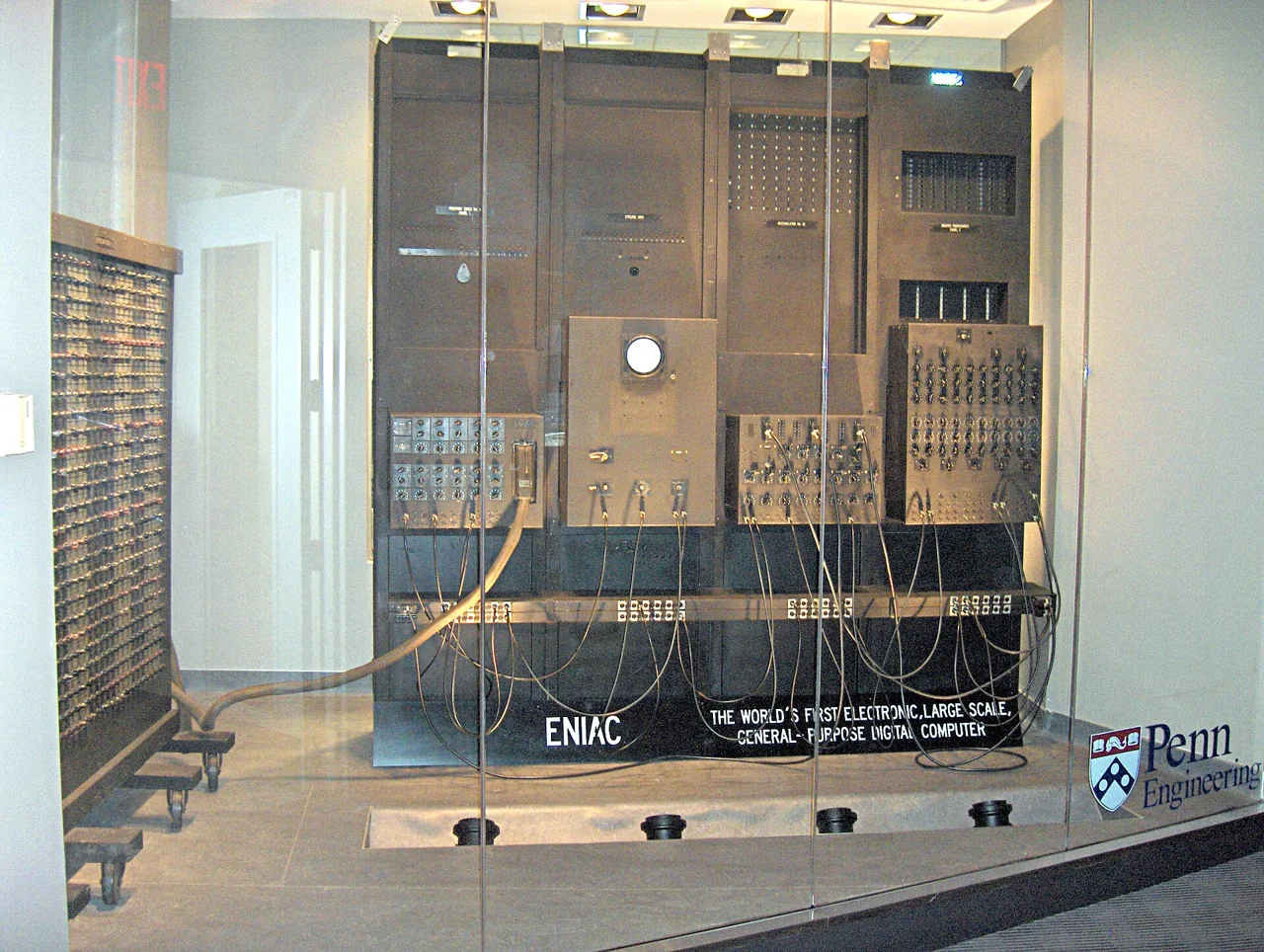
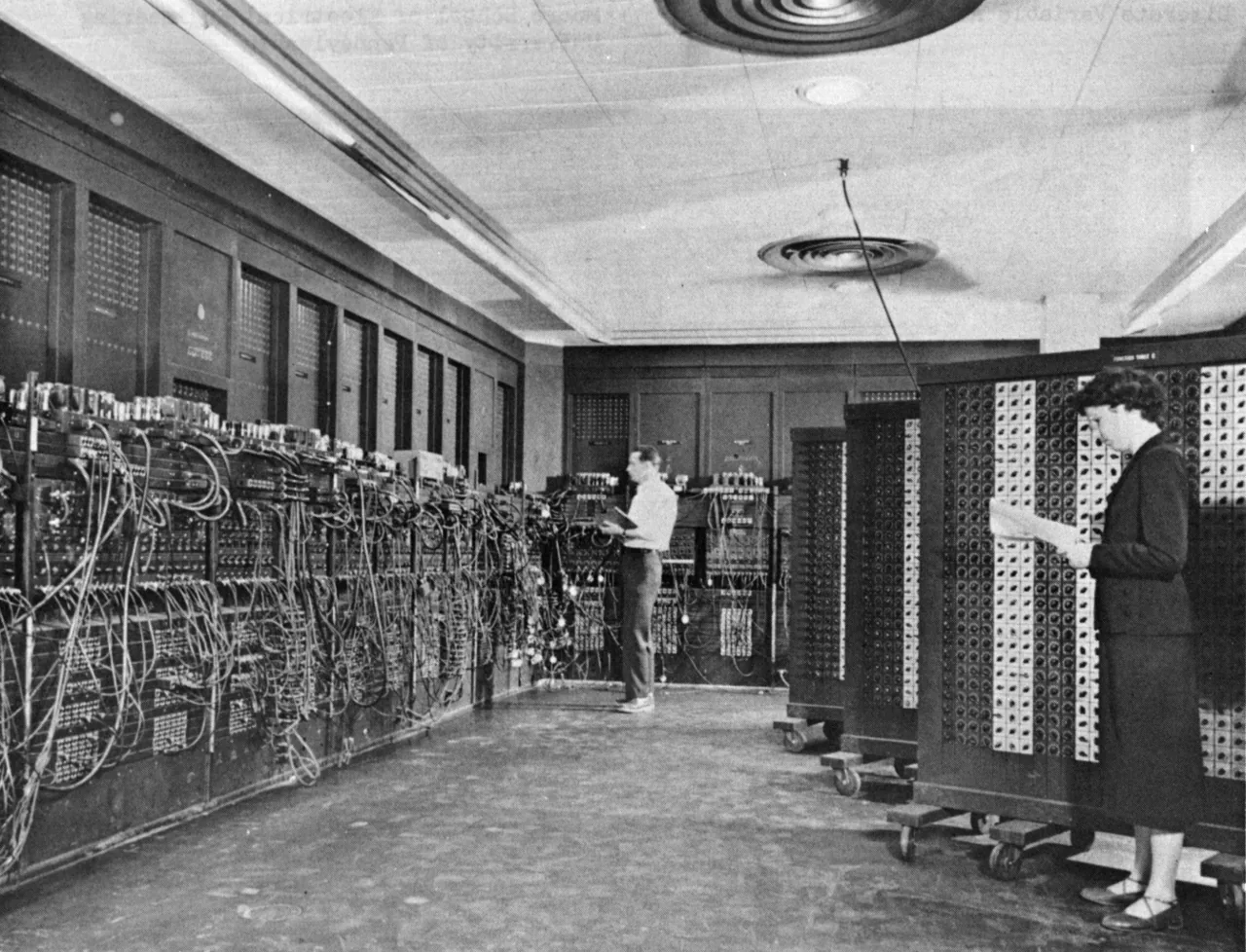
ENIAC was not a machine one simply turned on and used. Programming meant reconfiguring a forest of patch cords and switches, 6,000 of them, by hand, a labor-intensive process that could take days to shift from one problem to another2. Designed by J. Presper Eckert and John W. Mauchly, it was physically immense: 40 panels, each man-high, spread across 1,800 square feet and weighing over 30 tons268. Its 17,000 to 18,000 vacuum tubes, sources vary, demanded constant attention, with reports that valves required replacement every six hours to prevent burnout due to heat157. Cooling systems were essential, not optional57.
Despite its bulk and fragility, ENIAC’s performance was unprecedented. It executed about 100,000 operations per second and completed a multiplication in 200 milliseconds111. This made it roughly 1,000 times faster than the electromechanical relay computers it displaced368. Input and output were handled via punched cards, and internal storage relied on registers that doubled as adders and fast-access memory locations268. The architecture had no stored program; instructions were physically embodied in wiring and switch settings68.
The machine’s first test problem, a shakedown run in 1946, was formulated by Dr. Nicholas Metropolis and Dr. Stanley Frankel for the Manhattan Project10. By the time it was operational, however, it was already considered nearly obsolete, overtaken conceptually by the stored-program model later formalized by John von Neumann, who had consulted on the Manhattan Project and in 1945 outlined a simpler, fixed-structure computer design108. A 1973 court decision invalidated the ENIAC patent, ruling that its design derived from John Atanasoff’s earlier work, a judgment that retroactively credited Atanasoff as the inventor of the first electronic digital computer after 34 years of obscurity13.
Its legacy is both monumental and ironic. While ENIAC is widely credited with launching the electronic computing age1, later comparisons highlight its limitations: a $5 pocket calculator from the 1980s could match its speed, and a $100 programmable model could surpass it2. The CS-9000, a desktop computer of that era, performed a multiplication in under 2 microseconds, 100,000 times faster than ENIAC11. Eckert and Mauchly went on to design the UNIVAC I, the first computer widely used in business and government, capable of handling both numeric and alphabetic data with equal facility3. ENIAC, EDVAC, BINAC, and UNIVAC are often cited together as the foundational lineage of early electronic computing12.
| Vacuum tubes | about 18,00068 |
| Relays | 1,5002 |
| Floor space | 1,800 sq ft (167 m²)68 |
| Weight | over 30 tons1 |
| Power consumption | 180,000 watts68 |
| Performance | 100,000 operations per second1; 200 ms per multiplication11 |
| Input/Output | Punched cards268 |
| Programming method | Manual rewiring and switch setting168 |
| Storage | Registers used as adders and read-write storage68 |
References
- The Intel Microprocessors - Eighth Edition - 2008 (2008)
- PERSONAL COMPUTING JULY 1983 (1983)
- IBM PCjr For Students
- WithoutMeYoureNothing FrankHerbert
- Archive item #VBC1603
- URP 11th edition
- VB-VIC20-03
- URP 12th edition
- Computers ShirleyThomas 1965 (1965)
- 1984 06 BYTE 09-06 Computers and Education (1984)
- 1983 04 BYTE 08-04 New Chips (1983)
- Ada95ProblemSolvingProgramDesign MichaelFeldmanElliotKoffman