HP 3000
The HP 3000, introduced by Hewlett-Packard in 1972, was a line of minicomputers built around the MPE operating system and designed for business data processing, with models spanning from entry-level desk-sized systems to high-performance machines capable of one million instructions per second.
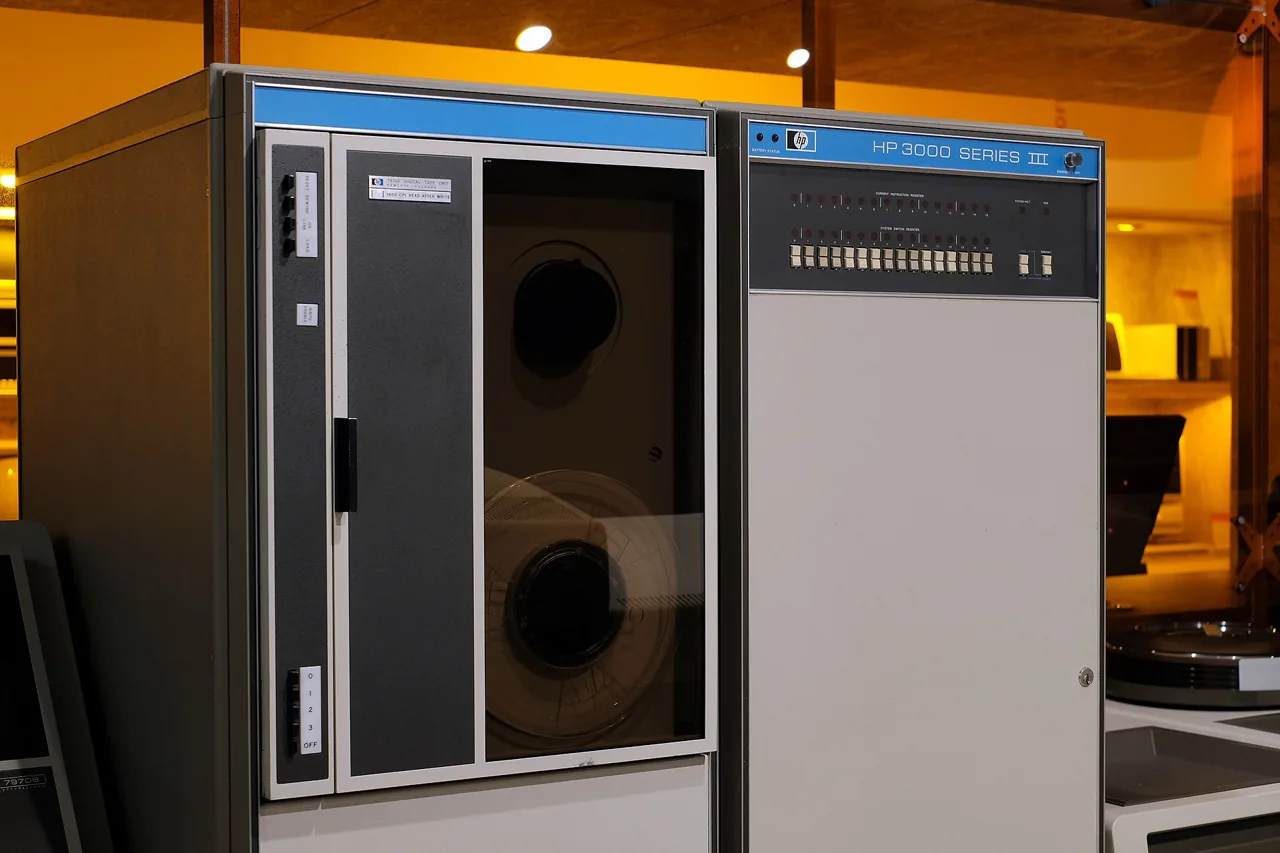
From its 1972 debut, the HP 3000 was positioned not as a scientific machine but as a dedicated business system, a distinction reinforced by its operating environment and software stack1. The earliest documented configuration, the Model 100CX, shipped in 1974 with 48K of memory, two 4.7-megabyte disk drives, a card reader, a magnetic tape drive, and a line printer, hardware tightly scoped for transaction processing and batch reporting11. Its sibling, the Model 200CX, upgraded to 64K of memory and added a 47-megabyte mass-storage disk drive, indicating an early emphasis on scalable data handling11. These models ran MPET, a variant of the Multiprogramming Executive operating system, which by 1979 had evolved into MPE III with virtual memory support, enabling a total memory space that far exceeded the one-megabyte physical limit of the Series 331.
The Series 33, described in a 1979 HP Journal as the "entry-level" system, exemplified HP's strategy of annual price-performance improvement: by that year, HP claimed to have delivered equivalent performance at approximately 25% lower cost each year for five consecutive years1. The Series 33 itself accelerated this trend, offering a desk-sized mainframe package made feasible by SOS circuits with low power consumption and minimal heat dissipation1. It housed one card cage and power supplies in a single system desk, included a built-in isolation transformer, and supported up to 31 terminals plus the system console1. Storage was provided via a 19.6-megabyte 7906 disk drive and a 2-megabyte flexible disk drive, both with controllers1. Six spare I/O slots allowed for expansion, though the maximum main memory remained capped at one megabyte1.
Software defined the HP 3000 as much as its hardware. MPE III provided multiprogramming for concurrent transaction processing, timesharing, and batch operations, along with stack architecture that separated code and data and supported variable-length segmentation1. The base software suite included EDIT, FCOPY, SORT, QUERY/3000, KSAM/3000, and HP VIEW/30001. IMAGE/3000, a database management system, was a cornerstone application, offering a network data structure for cross-referenced data access down to the smallest unit and executed under MPE/3000 control12. Programs could be written in COBOL, RPG, FORTRAN, or SPL (the Systems Programming Language, a higher-level language designed specifically for systems programming and used to develop nearly all HP 3000 software)412.
HP expanded the line with incremental models that maintained software continuity. The Series 37, introduced by 1985, was conceived to fill a low-cost niche while delivering Series III-level performance5. It was the smallest and lowest-priced HP 3000 to date, built using VLSI technology to achieve exceptional price-performance5. Designed for four to eight terminal ports and an MTBF exceeding two years, it underwent environmental testing including high and low temperatures, humidity, and drop tests5. All contemporary HP 3000 systems could run the same version of MPE, ensuring backward compatibility across the family5.
At the high end, the Series 64, introduced by 1982, delivered over 2.5 times the processing power of the Series 44 and crossed into the one-million-instructions-per-second class7. Though fundamentally a 16-bit-word machine, it could emulate 32-bit behavior in many applications7. Later, the Series 930 transitioned to HP Precision Architecture, running MPE XL and relying on emulation software, the HP 3000 Emulator and Object Code Translator, to maintain compatibility with earlier MPE V applications8.
Networking was integral to the platform’s utility. DS/3000, a communications system, enabled bidirectional communication between HP 3000s and with HP 1000 and HP 2026 systems via coaxial cables or modems2. By mid-1984, one customer site installed an X.25 switch to allow direct interconnection of all HP 3000s6. IML/3000 extended connectivity to IBM mainframes, using an Intelligent Network Processor (INP) interface to let HP terminals log on to host IBM systems as if they were 3270 terminals, supporting access to CICS, IMS, and TSO at speeds up to 9600 bps3. DS/3000 and IML/3000 could operate simultaneously, enabling combined HP-to-HP and HP-to-IBM communications3. By 1986, local networks were evolving toward IEEE 802.3 standards6.
The HP 3000 was never a flashy machine. It was engineered for reliability, incremental improvement, and business pragmatism. Its architecture favored consistency over novelty, its software stack prioritized transaction integrity, and its expansion path respected prior investment. That it persisted in production for decades, evolving from the 1974 Model 200CX to the Precision Architecture of the late 1980s, speaks less to dramatic breakthroughs than to a sustained commitment to a niche: the unglamorous, essential work of corporate data processing.
References
- HP Journal 1979-09 (1979)
- HP Journal 1978-03 (1978)
- HP Journal 1980-11 (1980)
- HP Journal 1973-01 (1973)
- HP Journal 1985-09 (1985)
- HP Journal 1986-09 (1986)
- HP Journal 1982-03 (1982)
- HP Journal 1987-12 (1987)
- HP Journal 1986-10 (1986)
- Archive item #260029
- HP Journal 1974-12 (1974)
- HP Journal 1974-07 (1974)
- HP Journal 1978-12 (1978)
- 8BIT MART 8BIT 11[OCR]