HP 1000
The HP 1000 family, introduced in 1974 as the 21 MX Computer and later renamed, was a line of 16-bit minicomputers built around user-microprogrammable CPUs and designed for real-time engineering and manufacturing applications, with performance and expandability that evolved across M-, E-, and F-Series models into the 1980s.
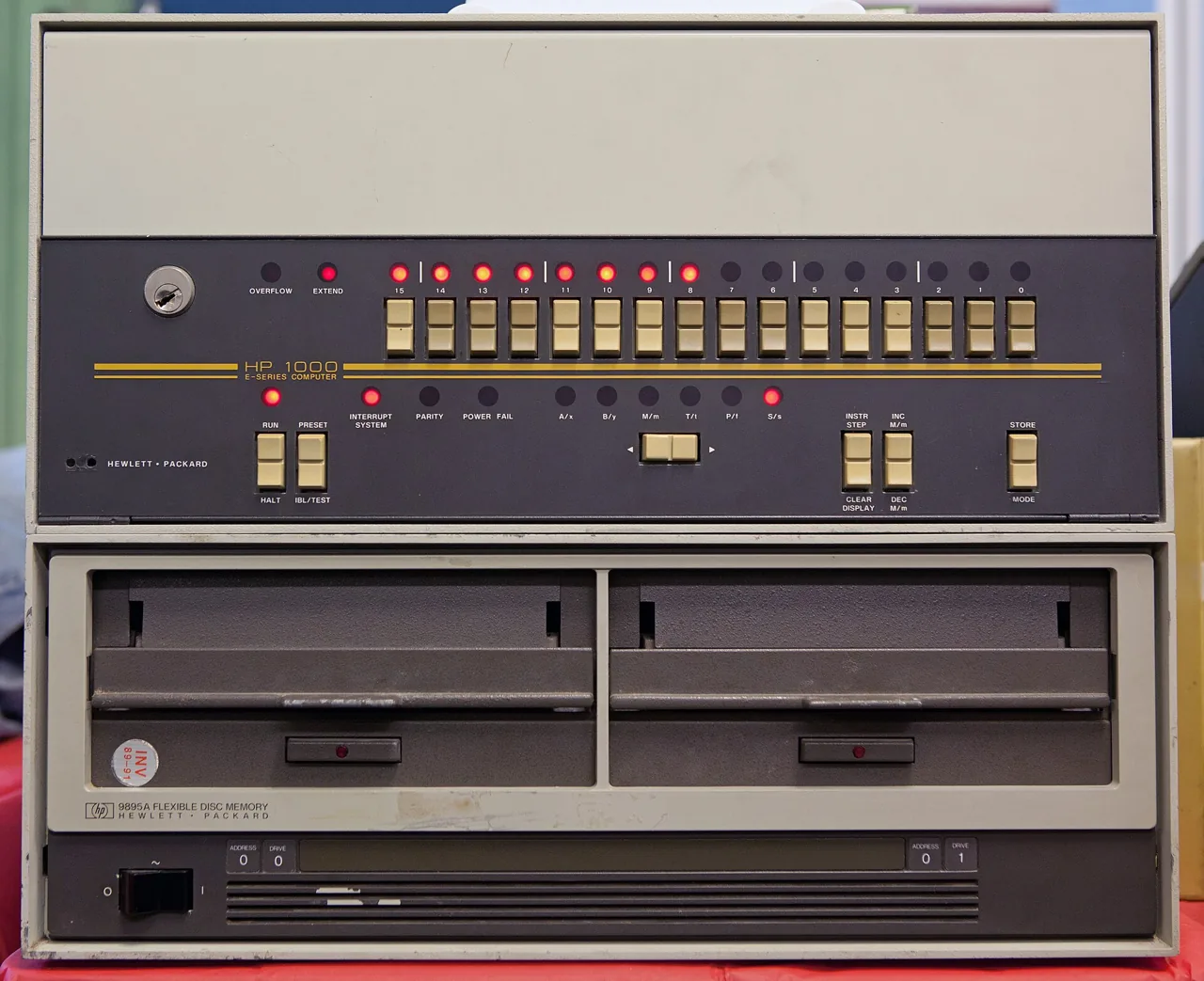
The HP 1000 was never a single machine but a modular architecture that spanned nearly a decade of iterative design, beginning with the M-Series in 19743. Its core distinction lay in the user-microprogrammable CPU, a feature that allowed engineers to extend the instruction set via firmware, effectively tailoring the machine to specific real-time tasks like automatic test systems and laboratory control3. This was not a theoretical capability; HP offered a catalog of firmware modules such as the HP 13197A Writable Control Store Board and HP 12824A Vector Instruction Set Firmware, which could be installed to accelerate FORTRAN, enable floating-point operations, or support networked operations2.
Performance gains between series were substantial and explicitly engineered. The E-Series, announced in 1976, used a dynamically variable machine cycle and 30% faster technology to deliver twice the computing power of the M-Series despite a modest clock increase3. This performance leap was enabled by the introduction of 16K-RAM-based memory boards, the result of a three-year development program at HP’s Data Systems Division in Cupertino3. Memory capacity followed: M-Series models like the HP 2105 supported up to 64K, while the HP 2108 and HP 2112 scaled to 640K and 1.28M respectively1. E- and F-Series models matched or exceeded these figures, with the Model 45 system supporting up to 2M bytes of standard or high-performance memory and 1.8M of fault-controlled memory3. An optional HP 12990A Memory Extender could add up to 1.152M bytes of additional space1.
I/O architecture was equally specialized. The E- and F-Series featured microprogrammable block I/O transfers, achieving rates as high as 11.4 Mbytes/sec in burst mode for 16-word transfers1. The E-Series further included a Microprogrammable Processor Port (MPP) with the same burst ceiling, enabling tightly synchronized communication with peripherals or other systems1. This made the HP 1000 a natural node in distributed systems. DS/1000 network firmware linked HP 1000s together, and the 91741A software enhancement enabled communication with HP 3000 systems4. By 1985, the PC-10 used DS/3000-1000 to integrate HP 1000s as real-time nodes in SPN HP 3000 networks7.
The Model 45 system, incorporating the F-Series, represented the peak of the line. It combined 2M-byte memory support with a 19.6M-byte cartridge disc and up to 400M bytes of total disc storage3. It ran RTE-IV and was paired with a high-performance graphics terminal featuring dual mini-cartridge units, suggesting use in visualization-intensive engineering tasks3. Software distribution relied on disc cartridges for the OS and mini-cartridges for diagnostics and supplemental tools5. Supported languages included FORTRAN, PASCAL, real-time multi-user BASIC, and assembly56, with the HP 13306A and HP 1000 F-Series Fast FORTRAN Processor Firmware accelerating numerical workloads2.
Despite its longevity, evidenced by a mention of the HP 1000 Model A900 system in a 1994 HP Journal article on new product manufacturing9, the architecture remained strictly 16-bit, and the surviving documentation is silent on clock speeds, bus widths, and physical dimensions. What is clear is that the HP 1000 was not designed for general-purpose computing but for embedded, real-time roles where reliability, expandability, and firmware-level customization outweighed raw speed. Its modular design and microcode flexibility gave it a niche that outlasted many contemporaries, even as the broader minicomputer market shifted.
Specifications
| Word size | 16 bits1 |
| Memory (M-Series) | HP 2105: to 64K; HP 2108: to 640K; HP 2112: to 1.28M1 |
| Memory (E-Series) | HP 2109: to 640K; HP 2113: to 1.28M1 |
| Memory (F-Series) | HP 2111: to 640K; HP 2117: to 1.28M1 |
| Memory extender | HP 12990A, adds up to 1.152M bytes1 |
| Memory cycle times | HP 2102C: 5.125 μs and 6.031 μs; HP 2102E: 3.050 μs and 3.681 μs1 |
| I/O transfer rate (burst) | 11.4 Mbytes/sec (16 words or less)1 |
| I/O transfer rate (block input) | 2.28 Mbytes/sec (256 words or less)1 |
| I/O transfer rate (block output) | 3.18 Mbytes/sec (256 words or less)1 |
| Storage (Model 45) | 19.6M-byte cartridge disc; up to 400M bytes total3 |
| Display (Model 45) | High-performance graphics terminal with dual mini-cartridge units3 |
| Operating systems | RTE-M, RTE-II, RTE-III, RTE-IV, RTE-A345 |
| Programming languages | FORTRAN, PASCAL, real-time BASIC, assembly language, microcode6 |
| Networking | DS/1000, HP 1000 to HP 3000 via 91741A47 |
| Interface | HP-IB (IEEE 488-1978)6 |
References
- 02109-90006 HP1000MEF InterfacingGuide Sep-1980 (1980)
- 12791-90001 HP1000MEFSeriesFirmwareInstallationReference Mar80
- HP Journal 1978-10 (1978)
- HP Journal 1978-03 (1978)
- HP Journal 1977-03 (1977)
- HP Terminals Brochure 0980
- HP Journal 1985-07 (1985)
- HP Journal 1994-06 (1994)