IBM System/38
IBM’s midrange computer introduced in the early 1980s featuring an object-based architecture and integrated relational database, designed to insulate users from hardware changes while running the CPF operating system.
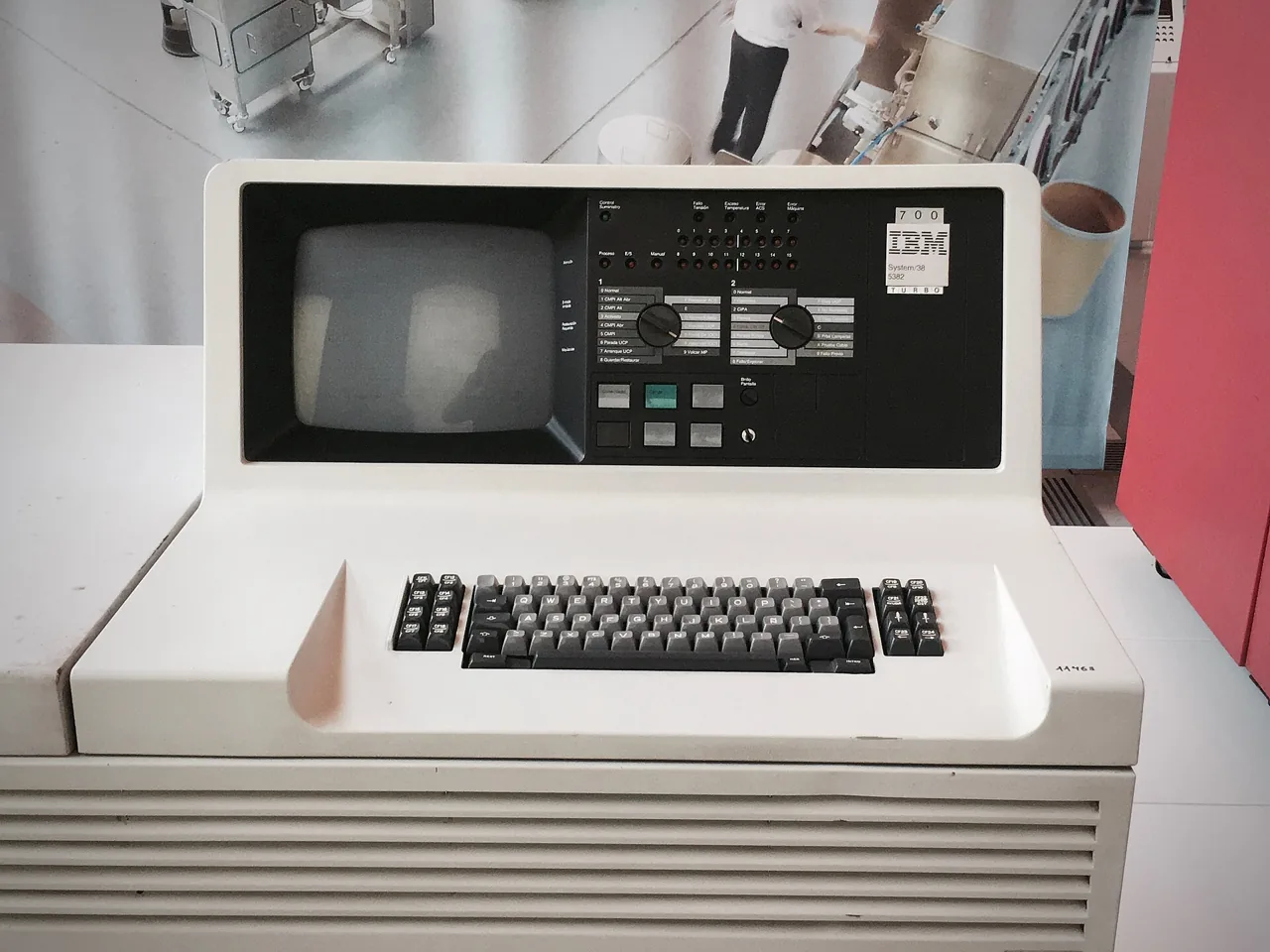
The System/38 introduced an object-based architecture that predated widespread industry adoption of object-oriented principles by nearly a decade, marking a significant departure from IBM’s other midrange offerings1. Though superficially resembling conventional minicomputers of the era, its internal design enforced strict separation between hardware and software, allowing IBM to modify underlying components without requiring application changes. This promise was only partially fulfilled due to unforeseen scalability constraints1. The machine shipped with CPF (Control Program Facility) as its operating system, a tightly integrated environment that included journaling, a relational database-management system, and a security model advanced for its time15. Despite these innovations, the System/38 was not included in IBM’s Systems Application Architecture (SAA), limiting its alignment with broader corporate software initiatives5.
Hardware specifications from the Fujitsu Sales Prospector of 1986 list model numbers including the SYSTEM/38 5381 MDL 7 and SYSTEM/38 5382 MDLS 20/40, with relative performance ratings of 175 (Model 7) and 250 (Models 20/40)9. The entry-level model supported two disk units (capacity unspecified, but likely in the gigabyte range), while the Model 40 offered 16 units9. Memory is listed only as “32,” with no clarification whether this refers to kilobytes, megabytes, or another metric9. Communications options varied by model: the Model 7 included CB, F, and R interfaces, while Models 20 and 40 added B and PL links, all operating over SDLC lines with support for APPC (Advanced Program-to-Program Communication) using the LU6.2 protocol915. Performance was rated as “M” (medium), a classification reflecting its intended role between low-end System/36 installations and larger enterprise systems9.
Market Position and Internal Rivalry
Despite its technical sophistication, the System/38 occupied an awkward position within IBM’s midrange lineup. It attracted primarily new customers rather than displacing existing System/34 users, most of whom opted for the more straightforward upgrade path to the System/36 when it launched in May 19831. The System/36 ran SSP, a different operating system lineage, and offered easier migration for legacy applications15. This internal competition diluted the System/38’s reach, even as IBM promoted its hardware independence, a claim later acknowledged to hold only up to certain architectural limits1. The machine’s price, described as “fairly pricey for midrange computer customers,” further restricted adoption1.
Terminal and Peripheral Integration
Interfacing with the System/38 relied heavily on 5250 terminal emulation, a standard that allowed IBM personal computers to function as online terminals. Software such as Remote 5250 Emulation enabled PC-based access at speeds up to 19,200bps, emulating the IBM 5294 Remote Control Unit2. The IBM Personal System/2 could connect via the System 36/38 Work Station Emulation Adapter, supporting the Arctic protocol over twinaxial cabling and enabling up to four concurrent display or printer emulation sessions4. Display Station Pass-Through (DSPT) extended connectivity by allowing sign-on from one IBM system to another, including the System/386.
Legacy and Succession
The System/38’s most enduring contribution was its influence on the AS/400. Development of that successor began in 1985 under the code name “Silverlake,” with the explicit goal of carrying forward the System/38’s architectural ideals into the next generation1. Mr. Henry, an IBM Fellow who managed hardware and software development for the RT PC and contributed to the System/38, received a corporate award in 1982 for his work on the platform7. While the System/38 itself faced limitations in growth and market penetration, its integration of database, security, and object-based design established a template that IBM would refine for decades.
References
- UnderstandingAS400SystemOperations DawsonHohly
- G360-2669-04 Personal Systems Reference Guide Nov88
- 72X6169 S36 38 Wkst Emul Adap Quick Ref 198901 (1989)
- M6198C Macintosh Multivendor Network Solutions Guide 199008 (1990)
- S01F-0301 OS2 Extended Edition V1.3 Problem Determination Guide for the Service Coordinator Sep90
- SA23-1057 IBM RT Personal Computer Technology 1986 (1986)
- Fujitsu Sales Prospector 1986 (1986)
- PC Seminar V05 N05 198705 (1987)