IBM System/36
Introduced in 1983, the IBM System/36 was a departmental minicomputer designed for small to midsize businesses, offering backward compatibility with System/34 applications and a tightly integrated hardware-software architecture centered on the System Support Program (SSP) operating environment.
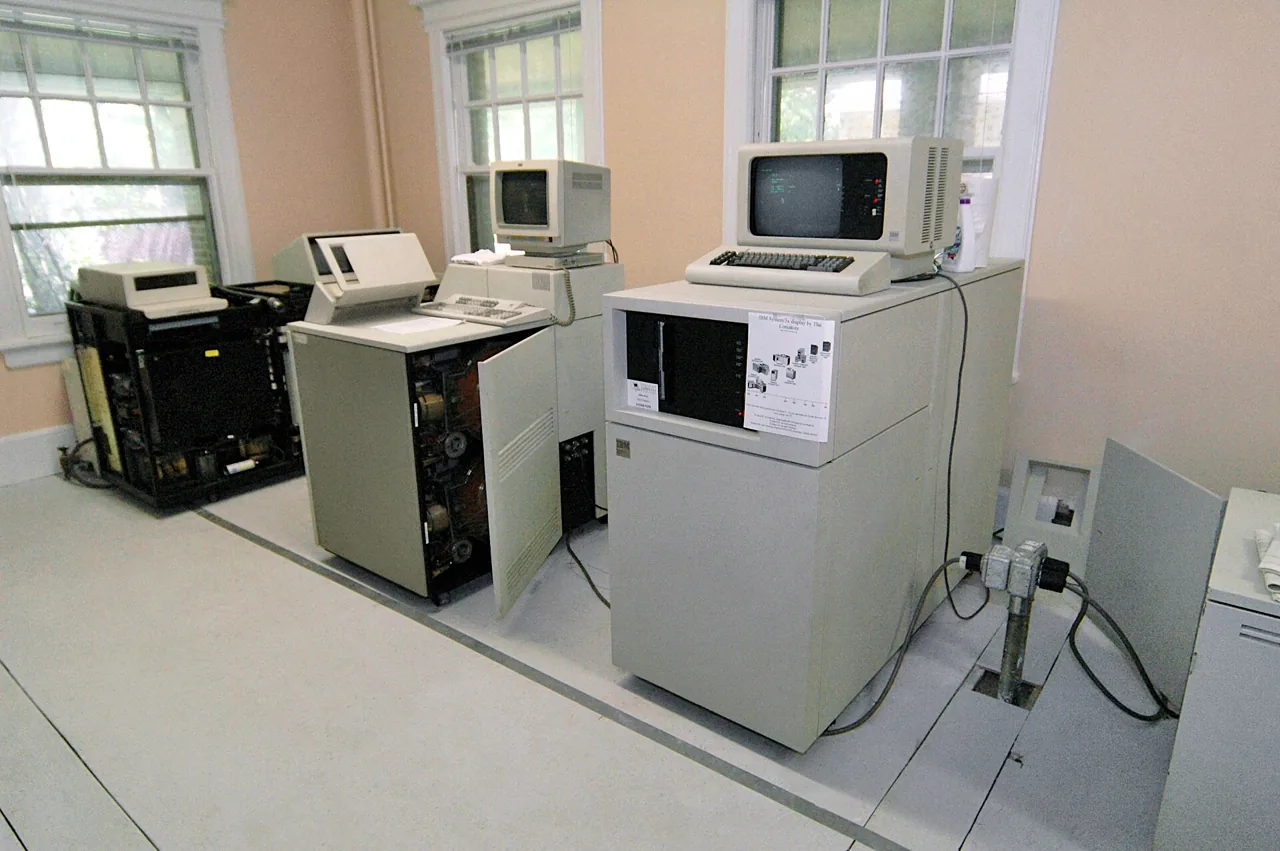
IBM positioned the System/36 as the keystone of its departmental-computing strategy, a machine engineered for reliability and ease of use in business environments where technical staffing was limited8. It was not a database machine in the modern sense2. The system’s architecture relied on multiple internal processors to offload control of workstations, communications lines, printers, and storage devices from the main processing path, a design choice that improved responsiveness and fault isolation1. Error checking and recovery were built into the system unit at the hardware level, and extensive self-diagnostic features allowed for rapid problem determination without requiring field engineer intervention1. IBM claimed it was one of the most thoroughly tested and reliable systems it had ever produced1.
Memory configurations ranged from 128K to 7,168K, organized as eight-bit bytes, with discrete capacity points including 256K, 512K, and 1,792K14. Disk storage options included units with capacities of 30 million, 60 million, 200 million, and 400 million characters, with an optional expansion unit offering up to 600 million (source text cuts off)1. A diskette magazine drive capable of processing up to 20 diskettes unattended was available, reducing operator burden for batch jobs1. The system supported between one and eight communications lines, enabling connectivity to remote terminals or other systems1.
The physical footprint of the system unit measured 1,125mm wide, 750mm deep, and 1,175mm high (44.50" × 29.50" × 46.50")1. Weight varied significantly by configuration, from a minimum of 279kg (614 lbs.) to a maximum of 418kg (920 lbs.)1. A separate component, possibly a terminal or expansion unit, was recorded at 650mm in height and a maximum weight of 79.3kg (175 lbs.)1. Heat output reached 1,340 watts (4,577 BTU/hr), a figure that dictated ventilation requirements in office installations1.
The operating environment, System Support Program (SSP), was an IBM-licensed program that provided task-oriented menus and context-sensitive HELP text, making the system accessible to non-technical users1. SSP managed all system resources and presented a consistent interface across models. Application compatibility was a key selling point: programs written for the IBM System/34 could run on the System/36 with minor modifications, easing migration for existing IBM customers1. Users of the Datamaster, System/32, and System/3 were also encouraged to "step up" to the System/361.
Connectivity with IBM’s PC line was deliberately engineered. The IBM Personal Computer could attach locally via twinax cable to all models7. Remote attachment was possible using the 5294 Remote Control Unit with Expansion Feature A and Feature 360 I, specifically for the 5360 and 5362 models7. The Enhanced 5250 Emulation Program Version 2.1 enabled IBM PC, PC XT, Portable PC, and PC AT models to function as System/36 display stations7. Later, the IBM System 36/38 Workstation Emulation Adapter (model 69X6279) allowed PS/2 models 50, 60, 70, and 80 to emulate twinax-connected workstations, supporting up to four simultaneous emulation sessions for displays or printers59.
Despite its reputation for reliability and low total cost of ownership, the System/36 faced criticism over its long-term roadmap2. End users expressed concern about the lack of a clear upgrade path, and IBM’s own representatives sometimes pointed to the System/38 as the successor, despite its fundamentally different relational architecture, Control Program Facility (CPF) operating system, and reliance on RPG III, all of which complicated migration8. The 5250 emulator market, then projected to grow from 200,000 units in 1984 to 2 million by 1990, was seen as directly dependent on continued System/36 and /38 sales8. IBM eventually addressed the succession question with the 1994 announcement of the AS/400 Advanced 36, an AS/400-based system running 64-bit RISC technology that could support System/36 workloads2.
A surviving Fujitsu Sales Prospector document from 1986 lists an IBM System/36 priced at $36,000, though the configuration is unspecified11. The 5360, 5362, and 5364 were among the documented processor models, with dedicated support programs (Feature 608 for the 5360 and 5362, Feature 609 for the 5364) ensuring firmware and utility compatibility7. The system also supported 3270 device emulation in SNA networks, allowing it to interface with mainframe environments7.
References
- IBM System36 Brochure
- UnderstandingAS400SystemOperations DawsonHohly
- IBM Personal System 2 and IBM Personal Computer Product Reference Ver 4.0 Sep88
- Desktop Guide to System-36 Beckman Kratzer Pence
- 72X6169 S36 38 Wkst Emul Adap Quick Ref 198901 (1989)
- PS2 and IBM PC Product Reference Version 4.0 Apr87
- Archive item #G32008490198603
- 5250 Emulators MMS 198605 (1986)
- G360-2838-00 IBM Micro Channel Hardware Products 198811 (1988)
- SC23-0788-1 Bibliography and Master Index 2ed Jun87
- Fujitsu Sales Prospector 1986 (1986)
- TWbook Ver 214 200201 (2002)