HP 2100
Hewlett-Packard’s 2100-series minicomputers unified laboratory instrumentation control and real-time data processing through a microprogrammable architecture that preserved backward compatibility with the 2116 line while shrinking the cycle time to 980 ns.
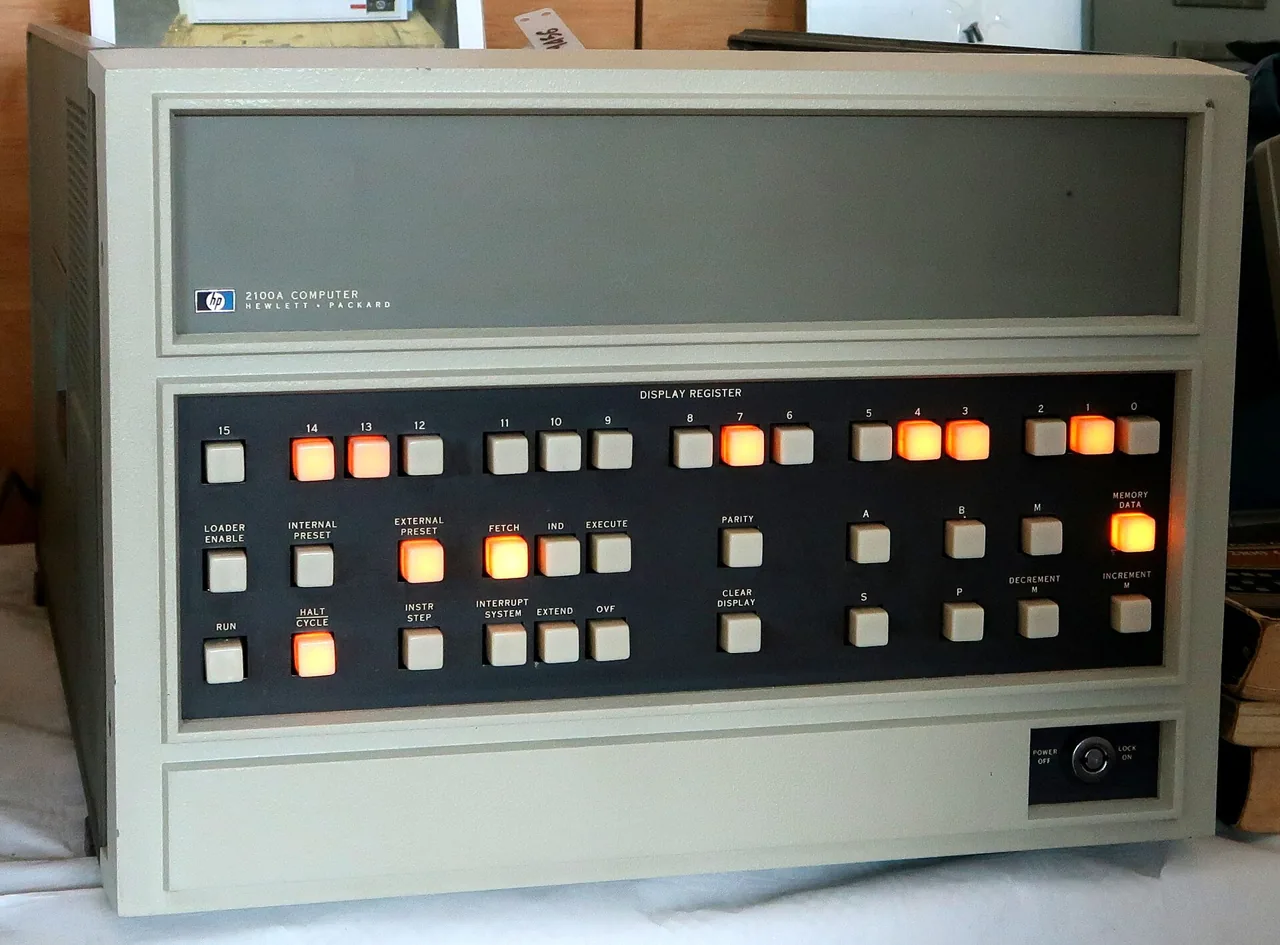
The HP 2100-series computers, including the HP 2100A, represented an entirely new design that retained full compatibility with the instruction sets and I/O structures of the earlier HP 2114, 2115, and 2116 models4. This continuity allowed the 2100A to interface with all existing HP peripherals and run the substantial library of pre-existing HP software without modification4. The machine shipped with standard features previously offered as options, reducing system integration overhead for laboratory and industrial users4.
At the core of the 2100’s flexibility was its microprogrammed control store. The Microprogramming Guide for the HP 2100 details a 256-word module 0 microcode that emulates the full HP 2116 instruction set and extends it1. Engineers could develop custom microcode using a papertape reader and a small WCS (Write Control Store), then burn it into PROMs using the HP 12909A PROM burner1. A built-in breakpoint register on the control panel facilitated low-level debugging, a necessity for microcode development1.
Memory configurations ranged from 4K to 32,768 words of core memory, with specific systems documented at 4K, 16K, 24K, and 32K-word capacities45216. The 12-inch-high mainframe provided space for 14 I/O interfaces, enabling dense peripheral integration4. Notable peripherals included the HP 2752A Teleprinter, HP 2748A Photo Reader, HP 7900A Dual Disc Memory with replaceable disc packs, HP 2767A Line Printer, and HP 2895.A Medium Speed Punch16. The HP 2155A Input/Output Extender allowed remote expansion16.
For high-speed industrial communication, the HP 12889A hardwired interface card supported asynchronous data transfer at 2.5M bits per second over distances up to 1,000 feet, or 1.25M bits per second up to 2,000 feet7. The HP 59310A I/O card provided HP-IB (Hewlett-Packard Interface Bus) connectivity, foreshadowing the later IEEE 488 standard11. The HP 30300A Programmable Controller enabled central station communication with the HP 30005.
Software support spanned real-time and batch environments. The disc operating system DOS-III hosted IMAGE/2000, a scaled-down version of the IMAGE/3000 database system3. Real-time operations relied on variants of the multiprogramming real-time executive (RTE), including RTE-C (core-based), RTE-B (with real-time BASIC), and RTE-2/RTL-352. The basic control system (BCS), inherited from the 2116A, remained available for simpler applications513. Development tools included HP Assembler, HP-ALGOL, FORTRAN, COBOL, SPL, and an 8080 cross-assembler for microprocessor projects2313. The ACP Activity Profile Generator was used with the 2100 computer1.
The 2100A’s 980 ns cycle time delivered tangible performance gains for data acquisition loops and control algorithms4. While the surviving documentation does not state an exact price, it confirms the 2100A was priced below HP’s previous lowest-cost model, positioning it as an accessible upgrade path4. Its blend of speed, expandability, and software continuity made it a fixture in scientific labs and automated test setups through the 1970s, even as the broader minicomputer market shifted toward newer architectures.
References
- HP Journal 1975-02 (1975)
- INSITE pgmLibrManVol2 Aug79
- HP Journal 1974-07 (1974)
- HP Journal 1971-10 (1971)
- HP Journal 1974-11 (1974)
- SID Journal V11N03-1974 MayJun (1974)
- HP Journal 1976-02 (1976)
- HP Journal 1975-12 (1975)
- HP Journal 1973-04 (1973)