Apple ImageWriter II
Apple’s 1985 dot matrix printer, Order No. C0090LL/A, replaced the original ImageWriter with faster speeds, color capability, and an optional 32K buffer, retailing at $595
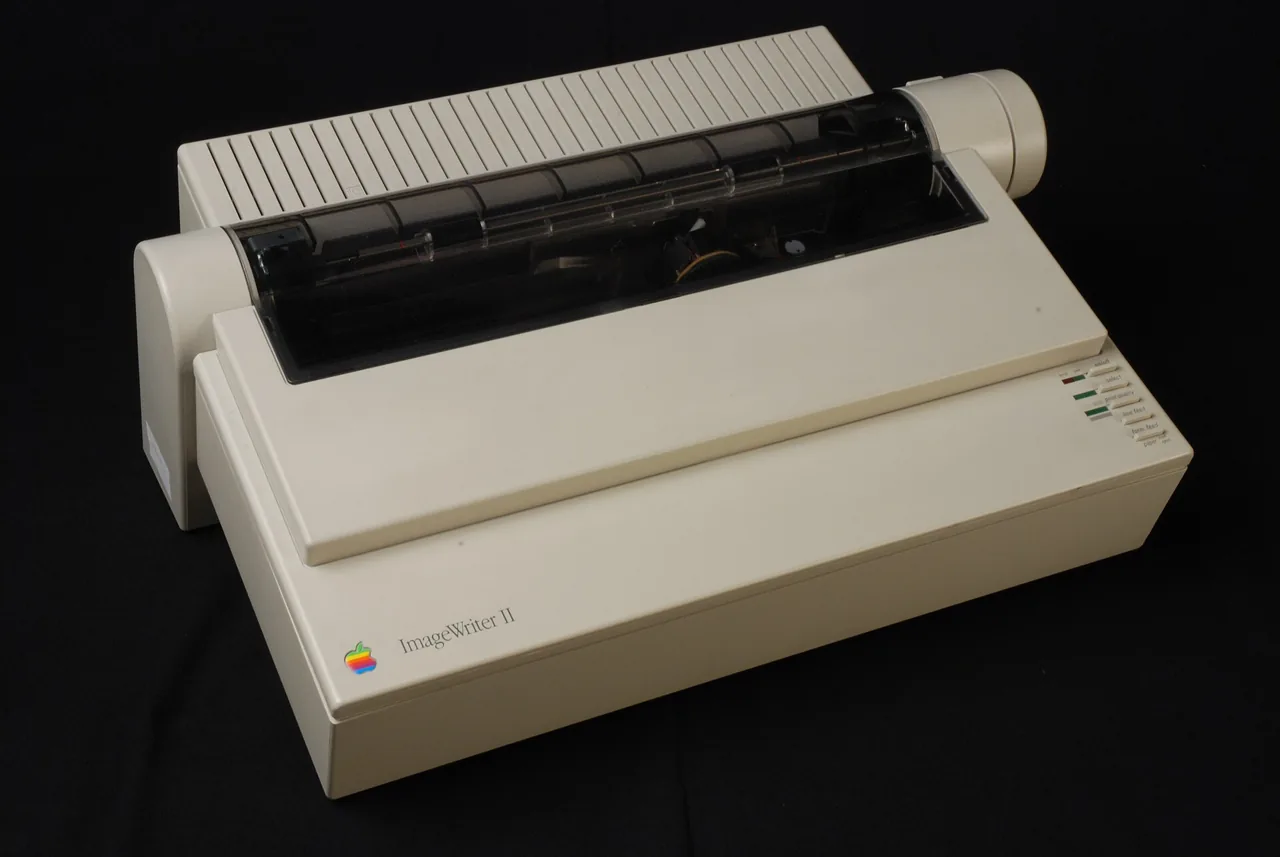
The ImageWriter II served as Apple’s designated serial dot matrix printer for both Apple II and Macintosh lines5, introduced in September 1985 to succeed the original ImageWriter, which had been the most widely used printer with Macintosh systems10. Marketed as twice as fast as its predecessor1112, it delivered draft output at 250 characters per second (cps), standard at 180 cps, and near-letter-quality at 45 cps1111214. One service document reports a slightly lower draft speed of 240 cps and a markedly slower near-letter-quality rate of 25 cps2, creating a persistent discrepancy in the record. The higher figures are more consistently cited. The printer supported three print modes with measurable throughput: 2.5 pages per minute in draft, two in standard, and half a page in near-letter-quality1.
Color printing was achieved via the ImageWriter II Color Ribbon (Order No. A9G0331), a four-color ribbon containing yellow, cyan, magenta, and black bands4. By overprinting, the printer could generate orange, green, and purple in addition to the base colors, enabling output in black plus six colors11112, or, as described in one Italian source, seven distinct colors14. This capability required compatible software, and while the printer functioned as a standard ASCII character set device49, it also supported downloadable fonts and national language character sets49. A dedicated character set included 32 special characters for Apple II computers, known as “Mouse Text”2.
Designed for shared environments, the ImageWriter II accepted an optional LocalTalk card (Order No. A9B0314) enabling networked use over AppleTalk12. The same expansion slot accommodated an optional 32K print buffer card or the LocalTalk card2111214. The printer featured an 8-bit serial interface compatible with RS-23214, and connectivity was maintained through a family of Smoke-branded cables tailored to specific host systems, including the Apple II, II Plus, IIe, IIc, IIGS, Apple III, and Macintosh models23.
Paper handling included support for up to four carbon copies1 and a single-bin sheet feeder (Order No. A9G0432)12. The Auto Paper Load feature advanced paper upon pressing the form-feed button2. While the original ImageWriter was praised for sturdier construction and superior tractor-feed reliability, the ImageWriter II offered quieter operation, improved print quality, and better paper handling, though some users found its output lighter and more prone to jams5. It was positioned as suitable for correspondence and graphics, but not for business documents requiring typewriter-grade resolution10.
Internally, the printer relied on the Main CPU PCB (part number 661-0581) and a Power Supply Board (661-0582) for 110/120 V operation8. These boards were shared with the ImageWriter II/L model, suggesting a modular design across variants8. The printer was compatible with all Apple CPUs of its era and could be shared across multiple machines with the optional AppleTalk card14. On the Macintosh, printing required the ImageWriter 2.6 or AppleTalk ImageWriter 3.1 driver, both available on the System Tools disk and Printer Installation disk15. For certain applications, such as microExplorer, use of system software 6.0 or later was mandatory7. Unix-like systems recognized it through commands such as iw2 and daiw4916.
At $595, the ImageWriter II was positioned as a mid-tier peripheral with an “excellent price/performance ratio” according to contemporary European assessment111214. Despite its technical advancements, it inherited skepticism from loyalists of the original ImageWriter, who regarded the older model as more durable and functionally superior5. The machine’s legacy rests not in groundbreaking design but in its role as a transitional workhorse, bridging the gap between basic dot matrix output and the coming wave of laser and inkjet alternatives, all while maintaining Apple’s push toward networked peripherals through AppleTalk.
Specifications
| Print method | Impact dot matrix |
| Draft speed | 250 characters per second (reported in multiple sources), 240 cps in one service document |
| Standard speed | 180 characters per second |
| Near-letter-quality speed | 45 cps (majority sources), 25 cps (one source) |
| Color capability | Black plus six colors via four-color ribbon (yellow, cyan, magenta, black) with overprinting |
| Carbon copies | Up to four sheets |
| Interface | 8-bit serial, RS-232 compatible |
| Expansion options | Optional 32K print buffer card or AppleTalk card |
| Sheet feeder | Single-bin, Order No. A9G0432 |
| LocalTalk support | Optional card, Order No. A9B0314 |
| Ribbons | Black (Order No. A2M0077), Color (Order No. A9G0331) |
| Order number | C0090LL/A |
| Compatible systems | Apple IIGS, IIc Plus, IIc, IIe, II Plus, II, Apple III, Macintosh, Lisa (with appropriate interface card) |
References
- AppleImageWriter2-BW2P
- PN 072-0230 Apple Service Technical Procedures Cross Family Peripherals Volume Two-Nov 1991 (1991)
- PN 072-0213F Apple Service Technical Procedures Peripheral Interface Guide-Jan 1991 (1991)
- 030-0781 AUX Command Reference Section 1 A-L 1990 (1990)
- Compute Issue 111 1989 Aug (1989)
- BYTE Vol 09-01 1984-01 1984 And Beyond (1984)
- 2552702-0001C uExpDevSWug
- PN 072-8124 Apple Service Module Identification Manual-Jun 1994 (1994)
- AUX 3.0 Command Reference Section 1 G-P 1992 (1992)
- 072-0186 Apple Support Training Library Macintosh Vol I
- ComputerEntertainer 4-7
- ComputerEntertainer 4-7
- 1984 02 BYTE 09-02 Benchmarks (1984)
- Playgames11
- MPW 2.0 Reference 1987 (1987)
- AUX 1.0 Programmers Reference 1987 (1987)