Apple ImageWriter
Apple Computer, Inc. manufactured the ImageWriter, a dot matrix printer introduced at $595 with the Macintosh Accessory Kit, notable for its quiet operation and integration across the Apple IIe, III, and Lisa lines.
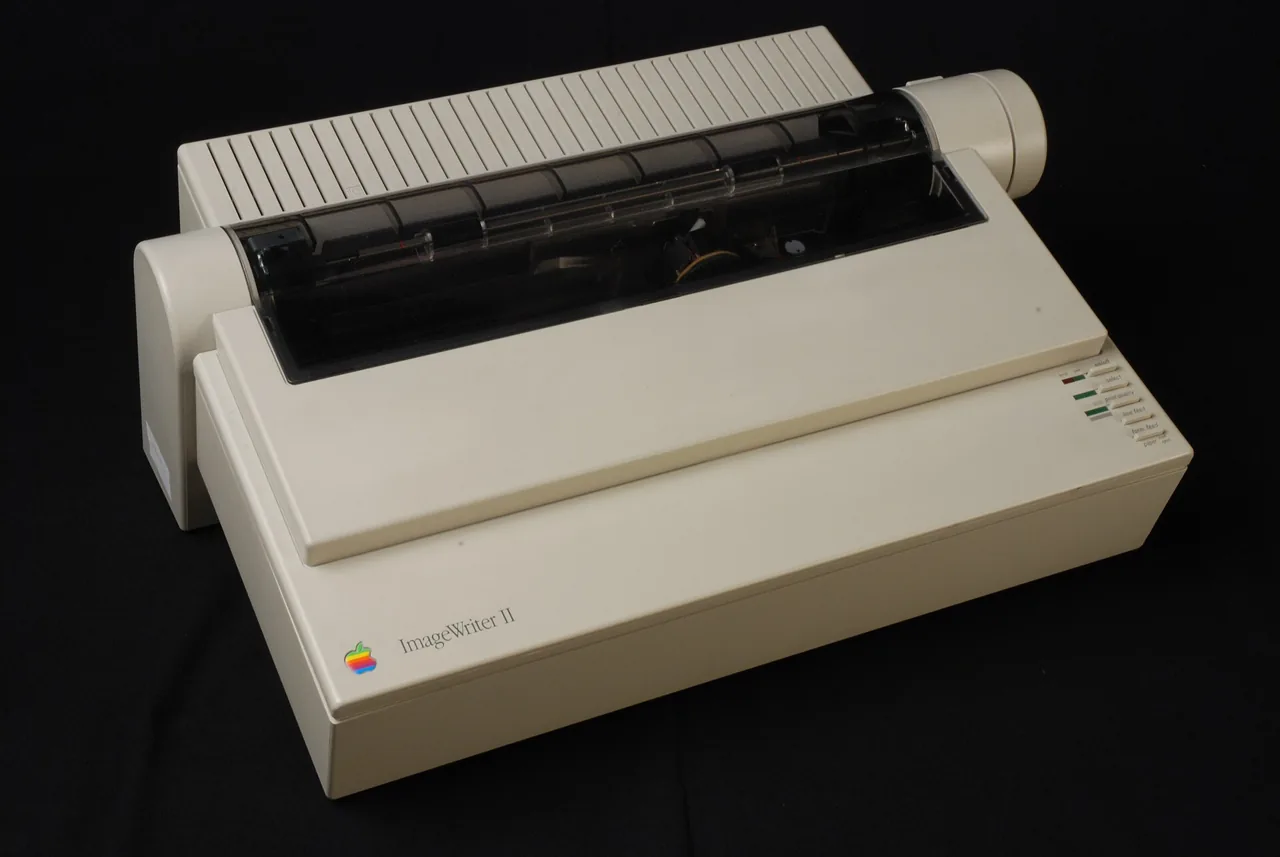
The ImageWriter delivered 120 characters per second in text mode and achieved a graphics dump speed reportedly up to 60% faster than comparable dot matrix printers of its price class234. Its impact dot matrix mechanism resolved at 140 by 160 dots per square inch, a density that, while not matching later letter-quality standards, provided legible output for business and educational use2. The printer’s advertised noise level of 53 dB was emphasized in period literature as unusually low, so quiet that one manual claimed reading a sentence aloud would be louder than the machine in operation234. This was achieved through a chassis “specially constructed with overlaid seams and special sound-deadening materials,” a design priority that aligned with Apple’s broader aesthetic of minimizing user distraction234.
Engineers at Apple designed the control electronics explicitly to ensure “perfect compatibility” with the Apple IIe, Apple III, and Lisa systems234. The serial interface connected via a cable to the printer-icon-labeled port on early Macintosh models, a physical pairing that reinforced the bundled ecosystem7. The ImageWriter also supported special typographic capabilities including superscript and subscript, features uncommon in budget dot matrix units at the time2348. Printer drivers were included on the Printing Tools diskette distributed with Macintosh operating system releases, and later software dependencies, such as those for microExplorer printing, required OS 6.0 or higher7.
The machine was marketed as an improved version of Apple’s earlier Dot Matrix Printer, and though the fact sheet does not specify model numbers, later documentation distinguishes the original as the ImageWriter I159. It existed alongside several derivatives: the wide-carriage variant accommodated broader paper, while later models such as the ImageWriter II, IIL, LQ, I.O., and IQ represented divergent paths in speed, form factor, and network capability91011125. On AppleTalk networks, the original ImageWriter could be used alongside its successors, provided the correct software version, ImageWriter 2.6 or AppleTalk ImageWriter 3.1, was in place1412.
One of its more obscure technical afterlives involved the Thunderscan optical digitizer, a third-party accessory that replaced the ribbon cartridge and converted the ImageWriter into a flatbed scanner for Apple II systems10. Thunderscan supported the original ImageWriter, wide-carriage variant, and ImageWriter II when used with an Apple IIe, IIc, or IIGS10. This repurposing speaks to the mechanical resilience and modular design of the printer’s housing, a trait later users would explicitly favor over its successors.
Despite being superseded, the original ImageWriter retained a loyal following. A 1989 Compute! article observed that many users believed the older model superior to the ImageWriter II: sturdier in construction, less prone to tractor-fed paper jams, and capable of producing darker, cleaner printouts9. This sentiment stands in contrast to typical upgrade narratives, suggesting that refinement in Apple’s peripheral line may have sacrificed durability for speed and aesthetics. At its launch, the printer was called “the best dot matrix printer on the market” and judged “a better deal than any other dot matrix printer with comparable performance,” claims made in the same breath as its 53 dB noise rating234.
References
- AppleImageWriter2-BW2P
- 1984 03 BYTE 09-03 Simulation (1984)
- BYTE Vol 09-01 1984-01 1984 And Beyond (1984)
- 1984 02 BYTE 09-02 Benchmarks (1984)
- PN 072-0213F Apple Service Technical Procedures Peripheral Interface Guide-Jan 1991 (1991)
- EnhancingYourAppleII-Vol2 DonLancaster
- 2552702-0001C uExpDevSWug
- 030-0781 AUX Command Reference Section 1 A-L 1990 (1990)
- Compute Issue 111 1989 Aug (1989)
- Compute Apple Vol 05 02 Issue 06 1987 Dec (1987)
- PN 072-8124 Apple Service Module Identification Manual-Jun 1994 (1994)
- AppleTalk Network User's Guide for the Apple IIGS (1989) (1989)
- Lisa Sales Marketing Binder Feb84
- MPW 2.0 Reference 1987 (1987)
- PN 072-0230 Apple Service Technical Procedures Cross Family Peripherals Volume Two-Nov 1991 (1991)
- AUX 1.0 Programmers Reference 1987 (1987)