Epson MX-80
Epson manufactured the MX-80, a dot matrix printer sold from at least 1981 onward, notable for its adoption across multiple platforms including the TRS-80 Color Computer, Apple II, and IBM PCjr, where it was rebranded as the IBM Graphics Printer.
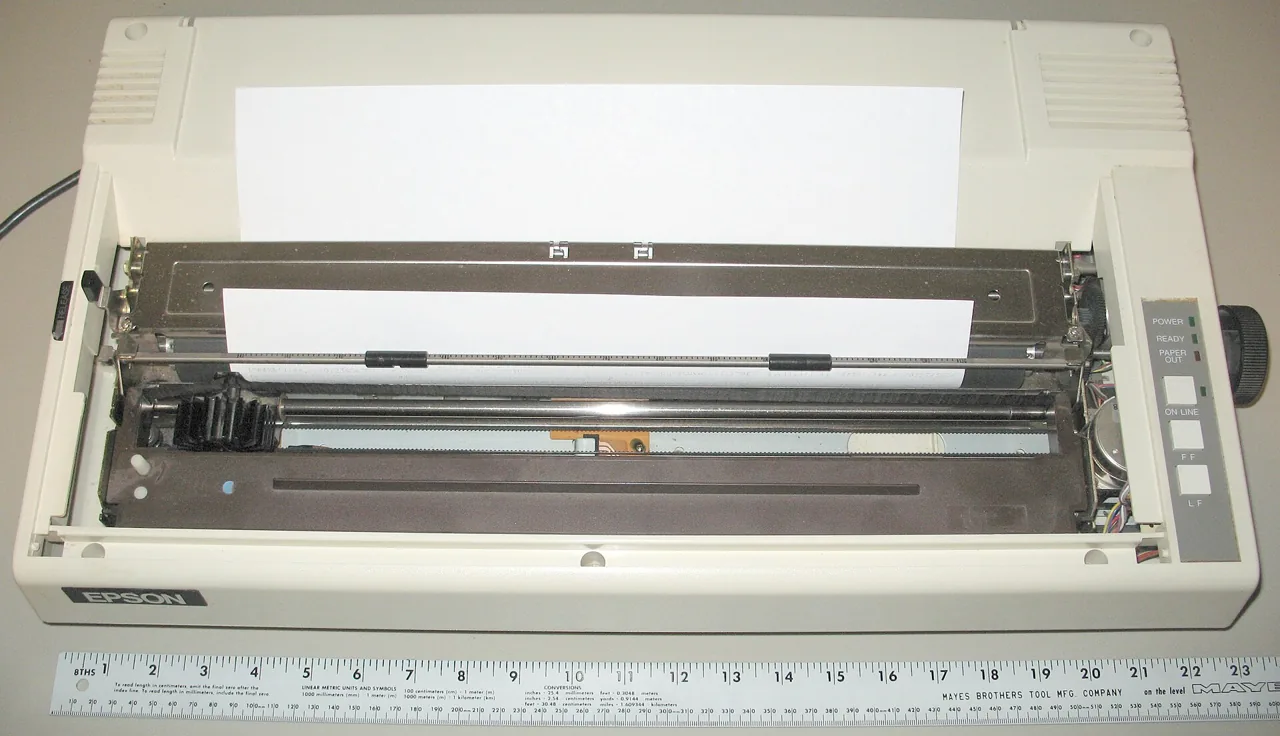
The MX-80 delivered text at 80 cps, positioning it as a mid-tier impact printer during the early 1980s6. It formed characters using a dot matrix mechanism, a standard for draft-quality output at the time16. While the surviving documentation does not specify interface types beyond one custom adapter, the printer could be connected directly to the TRS-80 Color Computer via a cable that plugged into an internal connector and terminated in a four-pin DIN plug, operating at 600 baud10.
Graphics capability was an optional feature, enabled through the Graftrax upgrade, which included an MX-80 Graphics ROM111214. This allowed rudimentary bitmap output, a significant enhancement for users of the Apple II and other home computers seeking visual output beyond text15. Third-party software such as CBM Graphics for Epson further extended its utility, though documentation is silent on whether this referred to Commodore hardware or was a misattribution1214.
Pricing varied significantly across vendors and configurations. The base model was listed at $499 in one 1981 source7, while another listed it at $41511. When bundled with Graftrax, the price was $349, suggesting promotional or channel-specific pricing discrepancies1214. At least one vendor listed the price as CALL, indicating possible negotiation or fluctuating availability11.
The MX-80 was part of a broader Epson line that included the MX-70, MX-100, and later FX series printers27. The MX-80/100 was sometimes referenced together, though the documentation does not clarify whether this indicated a dual model listing or a bundled package8. The FX-80 and FX-100 followed as faster models, with the FX line reaching 160 cps16.
One of the machine’s quiet distinctions was its rebadging as the IBM Graphics Printer for the PCjr. The documentation notes this was the same unit sold under IBM’s label, typically at a higher price than the equivalent Epson-branded model16. This rebranding highlights the MX-80’s role as a de facto standard in early personal computing, reliable enough for IBM’s endorsement and accessible enough to sustain a third-party ecosystem.
Despite its ubiquity in period literature, the surviving documentation is silent on key technical details: no dimensions, weight, paper width, buffer size, or power requirements are recorded. There is no mention of CPU architecture, RAM, or ROM capacity beyond the existence of a Graphics ROM. The exact release or discontinuation dates remain undocumented in the source material. What endures is its footprint across platforms (from the H-8913 to the Apple II15), and the fact that third parties developed dedicated interface hardware, such as the Epson-to-Color-Computer adapter sold by Texas Computer Systems for $60.0010.
References
- remark-issue36-1983 (1983)
- BYTE Vol 07-05 1982-05 Japanese Computers (1982)
- rem-xref-issue-1-47
- MICRO Vol51-08 82
- 1982 12 BYTE 07-12 Game Plan 1982 (1982)
- 1982 09 BYTE 07-09 Computers and the Disabled (1982)
- MICRO Vol40-9 81
- The Rainbow Vol. 03 No. 07 - February 1984 (1984)
- micro 43 dec 1981[ocr] (1981)
- MICRO Vol47-04 82
- 1981 06 BYTE 06-06 Operating Systems (1981)
- micro 63 aug 1983[ocr] (1983)
- 1981 07 BYTE 06-07 Energy Conservation (1981)
- micro 65 oct 1983[ocr] (1983)
- micro 56 jan 1983[ocr] (1983)
- The Complete Guide to Success with the IBM PCjr