IBM PCjr
IBM released the PCjr in 1983 as a home-targeted personal computer with 64KB of memory, an 8088 processor, and a controversial cordless keyboard, priced at $599 for the base model.
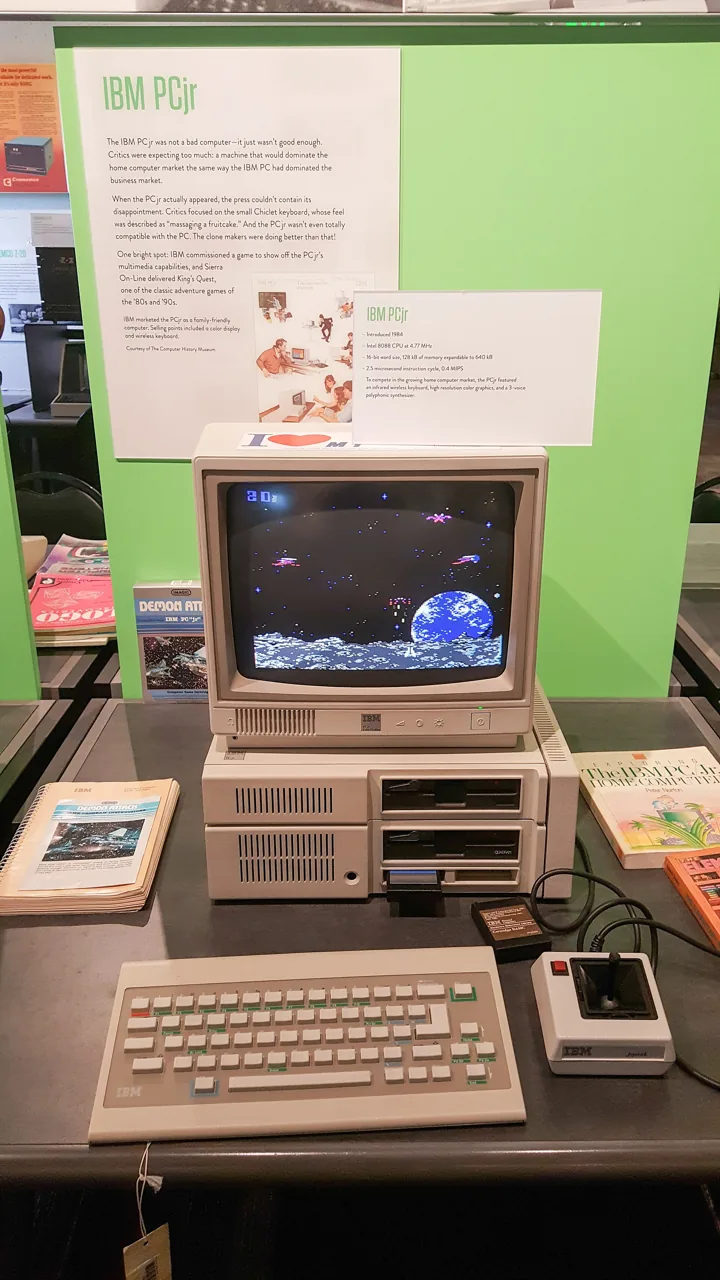
The IBM PCjr, model number IBM 4860 PCjr, was introduced to the media in 1983 and reached the market in early 19848. Marketed as the newest member of the IBM Personal Computer family, it shared the Intel 8088 microprocessor with the IBM PC and PC-XT, aiming to extend IBM’s business-oriented architecture into the home210. The base model shipped with 64KB of user memory and relied on a standard audio cassette recorder for storage when equipped with a data cable; the enhanced model added 64KB for a total of 128KB and included a 360KB dual-sided 5¼-inch floppy drive212. Maximum user memory remained capped at 128KB, though IBM later announced limited expansion capability to 512KB in 1984210.
Video architecture imposed a hidden memory tax: in graphics mode, the system reserved at least 16KB for the screen buffer, reducing available memory for software to 48KB (or 112KB with expansion)3. The PCjr’s video memory occupied the top of user RAM, and hardware automatically redirected references to the B8000 hexadecimal address range to video memory, a design quirk inherited from IBM’s effort to maintain partial compatibility13. It supported 40-column display on a standard television or compatible monitor; the enhanced model added 80-column capability on a monitor2. True color output required the IBM Color/Graphics Monitor Adapter, as consumer TVs and composite monitors often failed to render accurate hues12. Turtle graphics, a feature in some educational software, depended on this adapter12.
The operating system, IBM Disk Operating System (DOS) 2.10, was stored permanently in ROM and developed by Microsoft as a revision of earlier DOS versions712. Only programs designed for DOS 2.10 were guaranteed to run4. While much IBM PC software was theoretically compatible, memory constraints created hard breaks: some PC applications requiring 128KB failed on the PCjr because its shared RAM and video buffer left insufficient space13. IBM published software specifically for the platform, including educational titles like Bumble Games, which had previously run on Apple and Atari systems112. APL Version 2.1 required not only 192KB of RAM (preferably 256KB) and a double-sided drive, but also a small hardware modification to the IBM 4860 PCjr to function14.
Keyboard and Input
The cordless keyboard, infamous for its rubber "chiclet" keys, offered full 83-key capability with scan codes compatible across the IBM PC line10. Despite IBM’s claim of compatibility with the IBM PC and PC-XT, the keyboard’s poor tactile feedback drew immediate criticism, becoming a symbol of the machine’s compromised design15. IBM later offered an attachable joystick and a $15 promotional joystick in 1985, acknowledging the system’s appeal to the entertainment market56.
Market Trajectory and Sales
Priced at $599 for the entry model and $999 for the enhanced version at IBM Product Centers, the PCjr faced early sales resistance due to cost28. Observers speculated the high entry price included a deliberate "price erosion" margin to counter low-cost competition1. IBM responded by slashing prices, reportedly dropping the system to nearly half its original cost, and by late 1984, sales surged8. Christmas 1984 saw widespread adoption, with 288,000 units sold that year and 205,000 in 1985, totaling 913,000 units across its lifespan6. Despite this, IBM had already abandoned the product by the time of its peak sales8.
On paper, the PCjr promised much: a color-capable, DOS-based home computer leveraging IBM’s business credibility15. It was marketed as a productivity tool for home, education, and even light business use, though acknowledged limitations, especially incomplete software compatibility and the keyboard, undermined its ambitions113. The machine’s slick packaging and ease of setup gave an initial impression of quality, but its compromises alienated both serious users and cost-conscious families13. It did not support the IBM Monochrome Display, further distancing it from business environments12.
Peripherals and Expandability
Peripherals included the IBM PC Compact Printer, Graphics Printer, Proprinter, Serial Adapter Cable, and Parallel Printer Attachment514. Optional expansions such as the IBM Personal Computer Math Co-Processor, Asynchronous Communications Adapter, and IBM Personal Computer Expansion Unit were available, though integration with the PCjr’s limited internal architecture was often awkward14. The IBM PCjr Internal Modem provided built-in telecommunications capability5.
Despite IBM’s claims of compatibility, the PCjr occupied an uneasy middle ground. It was too expensive and limited for business, too rigid and underpowered for the evolving home market. Its legacy is one of missed potential: a machine that briefly flared in sales only after its price collapsed and its manufacturer had moved on.
References
- Introducing IBM PCjr
- Telecommunications with the IBM PCjr
- PCjr Technical Reference Nov83
- The Complete Guide to Success with the IBM PCjr
- IBM PCjr For Students
- EugenePCjrClubNews 198512 Vol1No7 (1985)
- IBM PCjr User's Handbook
- EugenePCjrClubNews 199401 VolXNo1 (1994)
- IBM PCJr Welcome letter
- PC Seminar V01 N03 198311 (1983)
- IBM Config Junior
- 6936938-1 IBM The Guide Fall83-Winter84 Nov83
- 1984 08 BYTE 09-08 Modula-2 (1984)
- ZZ33-0523-0 APL PC Version 2.1 Nov86
- Computers that made Britain v1
- 1984 03 BYTE 09-03 Simulation (1984)