Kaypro II
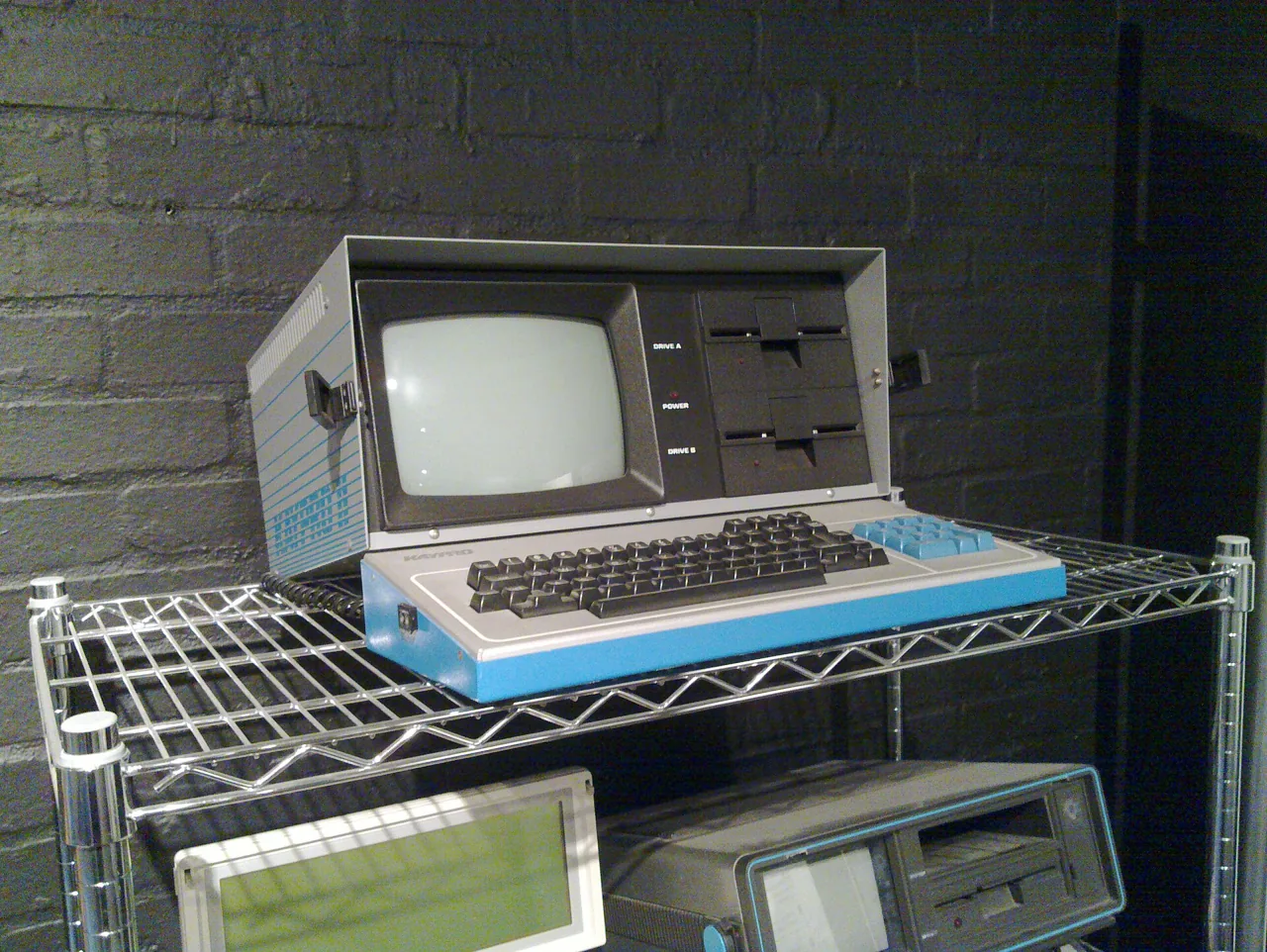
The Kaypro II was a portable Z-80 business computer sold in the early 1980s with 64K RAM, two disk drives of just under 200K capacity each, and a reputation for running nearly all contemporary CP/M software.
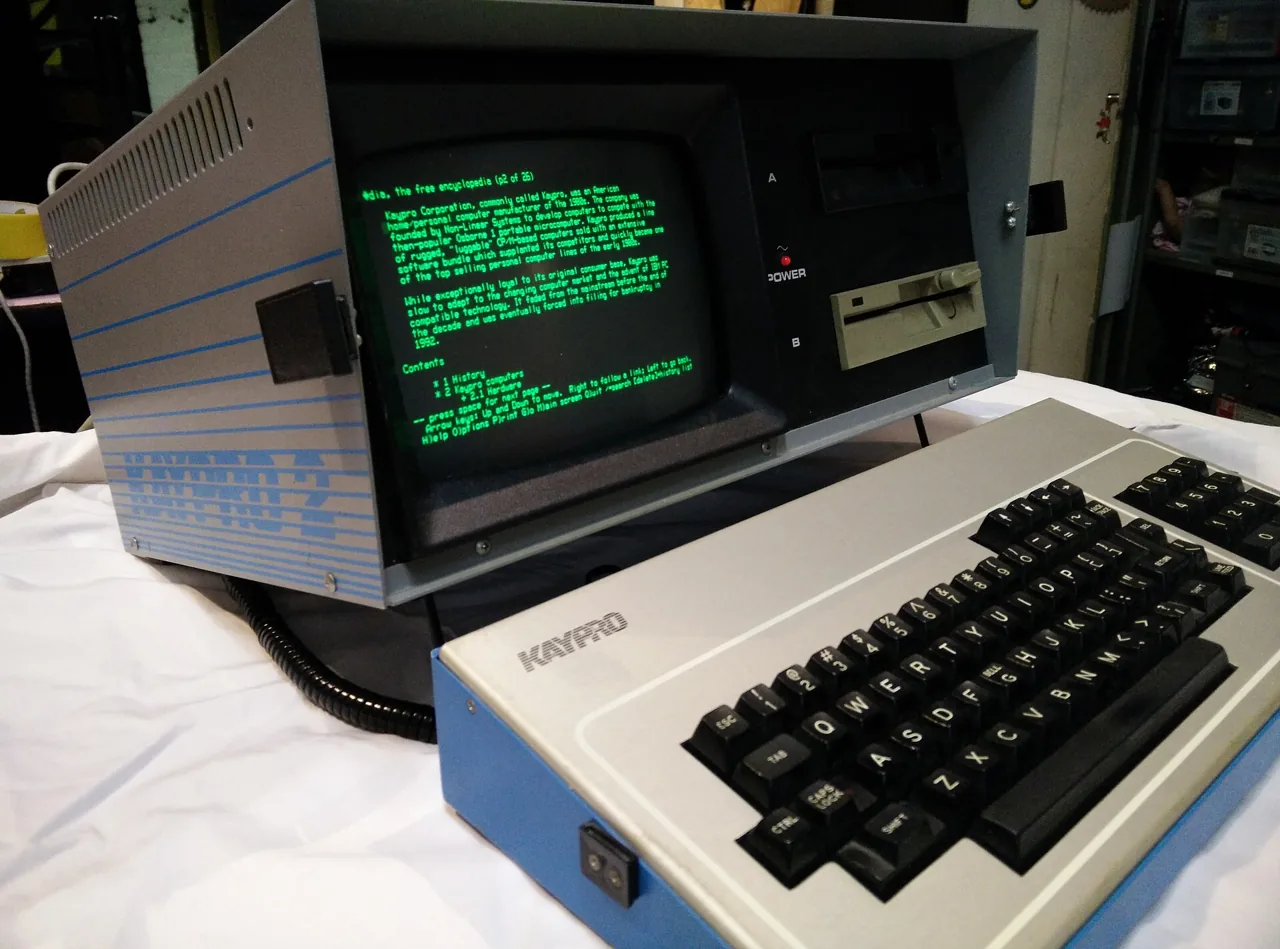
Introduced without a documented release year, the Kaypro II established itself as the smallest model in the Kaypro lineup, which also included the Kaypro 4 and Kaypro 10 68. Marketed as a "Geschäfts"-Computer, emphasizing its role in business environments, it combined portability with a "vollausgelegte CPU" (fully equipped CPU), a claim supported by its ability to run almost all programs available for personal computers at the time 68. Weighing under 6 kg, it was considered transportable, a significant selling point when portability was still a novelty in computing hardware 6.
Powered by a Z-80 microprocessor running at 2.5 MHz, the machine came standard with 64K of RAM 4. Storage was handled by two internal diskette drives, each offering just under 200K of capacity, with one source specifying 200KB per drive 678. The standard display configuration is not detailed in surviving documentation, but a field-installable hardware peripheral enabled high-resolution bit-mapped graphics at 640 by 256 pixels, complete with firmware support for drawing vectors, arcs, circles, rectangles, and point markers, as well as downloadable character sets 7. This upgrade, while optional, expanded the machine’s utility beyond text-based business applications into technical and graphical domains.
Performance could be enhanced via the Hop Up Kit, a third-party modification that increased clock speed from 2.5 MHz to 5 MHz, reportedly boosting calculation speed by up to 60% for $118.00 7. A separate circuit board with nicad batteries allowed for power backup, plugging directly into the motherboard, a practical solution for preserving data during transport, though the exact implementation details remain undocumented 7.
Software compatibility was a cornerstone of the Kaypro II’s appeal. It could run a broad range of CP/M software, including titles like AIRPORT, MULTI-BASIC LANGUAGE SYSTEM, PASCAL SYSTEM, MAC, BRAINSTORMER, and MANAGEMENT SIMULATOR 1. ZCPR and System Diagnostics were available specifically for the platform, enhancing command-line functionality and troubleshooting 5. The bundled software package contributed to its retail price of $1,475.00 in the U.S. market 13. In Germany, the listed price was 4,900,— DM, though one store offered it at a reduced 2,790,— DM, suggesting aggressive regional pricing or discounting 68.
The relationship between the Kaypro II and its larger sibling, the Kaypro 4, was functionally significant. When booted from a single-sided, double-density diskette, the Kaypro 4 would emulate a Kaypro II 2. This allowed compatibility with Kaypro II software, but created a file interchange limitation: files created on a Kaypro II could not be copied directly by a Kaypro 4 unless the latter was booted in II mode 2. However, the PIP utility could transfer such files onto a disk formatted for the Kaypro 4, offering a workaround 2. This tight integration suggests a deliberate design strategy to maintain software continuity across the product line, even as hardware evolved.
Supporting literature and utilities reflected an active user ecosystem. The Compleat Kaypro II, IV & 10 and Kaypro WP Plain & Simple provided guidance for users 11, while diagnostic tools like the Disk Drive Diagnostic Kit ($88.00) and Memory Minder CP/M ($99.00) addressed maintenance needs 10. QUIKPRO+II was offered at an introductory price of $149.00, and XtraKey was praised in period literature as “the best (keyboard) translation program I’ve seen” for Kaypro systems 71015. Publications such as Micro Cornucopia offered software disks like Micro C Kaypro Disk K18 for $12, targeting multiple models including the II 10.
Modifications and upgrades were well-documented in enthusiast circles. The 5MHz mod and KayPro Reverse Video Mod were discussed in technical forums, alongside reviews of color graphics capabilities and methods for adding joysticks 9. Upgrading a Kaypro II to a Kaypro 4 was a known path, and patches such as the KayPro ZCPR Patch extended system functionality 9. The distinction between “older Kaypro II, 4 or 10” and “1984 Kaypro 2, 4 or 10” implies hardware revisions over time, though the nature and extent of these changes are not detailed in the source material 10.
The Kaypro II’s legacy lies in its balance of portability, compatibility, and expandability within the constraints of early 1980s technology. It did not pioneer new architectures, nor did it boast cutting-edge specs, but it delivered a working, transportable CP/M platform at a time when such a combination was rare. Its limitations (undefined disk format, lack of standard display resolution data, no I/O or expansion specs) are symptoms of incomplete surviving documentation, not necessarily design flaws. What remains clear is that it functioned as a pragmatic tool, supported by a rich ecosystem of software, peripherals, and user modifications that extended its utility far beyond its baseline configuration.
References
- Kaypro Software Directory 1984 (1984)
- Kaypro Software Bulletin Jul83
- 1484-F Kaypro Technical Manual Sep85
- Kaypro Brochure Nov83
- profiles v2n6
- Computer für Anfänger
- profiles v1n2
- Computer für Anfänger (Bastei-Lübbe)
- MICRO CORNUCOPIA No.16 Feb 1984 (1984)
- profiles v3n2
- profiles v3n10
- BYTE Vol 10-01 1985-01 Through The Hourglass (1985)
- 1984 03 BYTE 09-03 Simulation (1984)
- Fujitsu Sales Prospector 1986 (1986)
- profiles v1n5
- 1984 02 BYTE 09-02 Benchmarks (1984)