Compaq Portable
A luggable IBM PC lookalike with a detachable keyboard and a price tag that undercut Big Blue by brute-force compatibility and a 28-pound swagger.
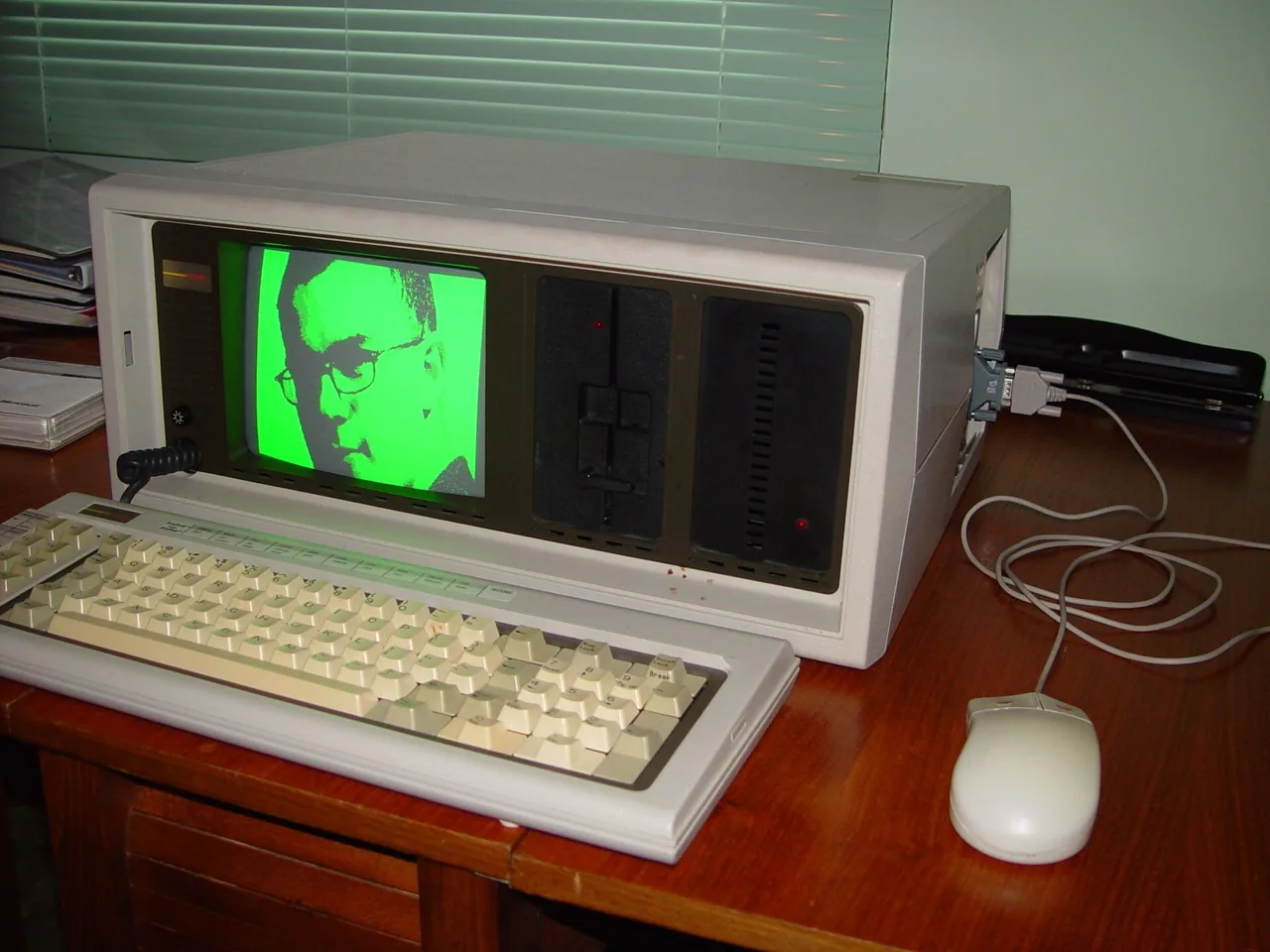
The COMPAQ Portable did not invent portable computing, but it weaponized compatibility. It was one of the first machines to legally clone the IBM PC at a time when software ecosystems were beginning to matter more than hardware novelty. Where others offered half-compatible knockoffs, Compaq bet everything on replication—down to the BIOS, the expansion slots, and the keyboard layout. The result was a 20 by 8½ by 15⅞-inch plastic enclosure15 that weighed in at 28 pounds15, not so much portable as *portable-ish*, but undeniably functional.
At its core sat an 8088 microprocessor46, the same silicon brain as the IBM PC, paired with 128-Kbytes of on-board RAM68. Two 64-Kbyte memory kits could be added via sockets on the processor board, bringing total RAM to 256-Kbytes6. This was no trivial upgrade path. RAM was expensive, and the ability to expand mattered. The machine came standard with one diskette drive8, a notable advantage over competitors who treated drives as costly add-ons8. A second drive could be added internally, and a conversion kit allowed the system to become a COMPAQ PLUS by installing a 10-megabyte fixed disk drive410.
The built-in 9-inch diagonal screen15 displayed 25 lines by 80 characters15, with characters rendered in a 7 by 9 dot matrix within a 9 by 14 cell15. It supported high-resolution graphics compatible with the IBM PC15. An external RGB monitor could be connected for full-color output15, a flexibility rare in luggables of the era. The display’s viewing angle was adjustable15, a small but meaningful concession to ergonomics.
The keyboard, detached and linked by a 6-foot retractable coiled cable15, mimicked the IBM PC exactly—10 function keys, a numeric keypad, and cursor controls15. Its typing angle was adjustable, a thoughtful touch for long sessions. This wasn’t just cosmetic. Because the keyboard layout and firmware matched IBM’s, users could switch without retraining. The same applied to software: programs written for the IBM PC ran on the Compaq815, as did expansion boards8. Compatibility wasn’t claimed; it was engineered.
Inside the case, five expansion slots were provided, three of which were available for user options68. The processor board housed the CPU, ROM, and RAM6.
Pricing was aggressive. Marketed as costing “hundreds less” than comparable IBM or Apple III systems8. It had optional configurations with MS-DOS/BASIC Version 34, and Compaq generally bundled only the operating-system software and a disk-based version of BASIC5. No sound hardware is documented, and the surviving literature is silent on I/O ports, graphics or sound chips, and exact clock speed. These omissions suggest Compaq considered such details secondary to fidelity.
The Compaq Portable was not elegant. It was heavy, boxy, and unapologetically industrial. But it worked—reliably, predictably, and without surprises. Its legacy lies not in innovation, but in execution: a machine that understood the real value of a computer was not its case or its clock, but its ability to run the software people already depended on.
Specifications
| CPU | 8088 microprocessor |
| RAM | 128-Kbytes standard, expandable to 256-Kbytes via two 64-Kbyte kits |
| Storage | Single diskette drive standard; second drive optional |
| Display | 9-inch diagonal, 25 lines by 80 characters, 7 by 9 dot matrix in 9 by 14 cell; IBM PC-compatible high-resolution graphics |
| Keyboard | Detachable, 6-foot retractable coiled cable, IBM PC layout with numeric keypad and 10 function keys |
| Expansion | Five built-in slots, three available for options; IBM-compatible expansion support |
| Dimensions | 20 by 8½ by 15⅞ inches |
| Weight | 28 pounds |
| Software | Compatible with IBM PC and PC/XT software; MS-DOS/BASIC Version 3 optional |
| Model Variants | COMPAQ Portable, COMPAQ PLUS (via hard drive upgrade) |
References
- 119400-006 Portable Line Options 199111 (1940)
- Compaq-3100T286LoralPortable
- Compaq 286-Based Products Technical Reference Guide Volume 1 198712 (1987)
- 1985 07 BYTE 10-07 Computers and Space (1985)
- BYTE Vol 09-01 1984-01 1984 And Beyond (1984)
- Compaq Maintenance and Service Guide 198411 (1984)
- 1986 08 BYTE 11-08 Object-Oriented Languages (1986)
- 1983 11 BYTE 08-11 Inside the IBM PC (1983)
- 1983 04 BYTE 08-04 New Chips (1983)
- 1984 03 BYTE 09-03 Simulation (1984)
- 1986 06 BYTE 11-06 Computers and Music (1986)
- 115538-009 User Programs Reference 9ed 199108 (1991)
- 1984 12 BYTE 09-13 Communications (1984)
- 1986 04 BYTE 11-04 Number Crunching (1986)
- 1982 12 BYTE 07-12 Game Plan 1982 (1982)