Compaq Portable II
The Compaq Portable II, released by COMPAQ Computer Corporation, was a space- and weight-optimized portable personal computer built around the 80286 microprocessor, offering modular expansion and full IBM PC compatibility at a time when portability still meant lugging over 23 pounds of beige metal.
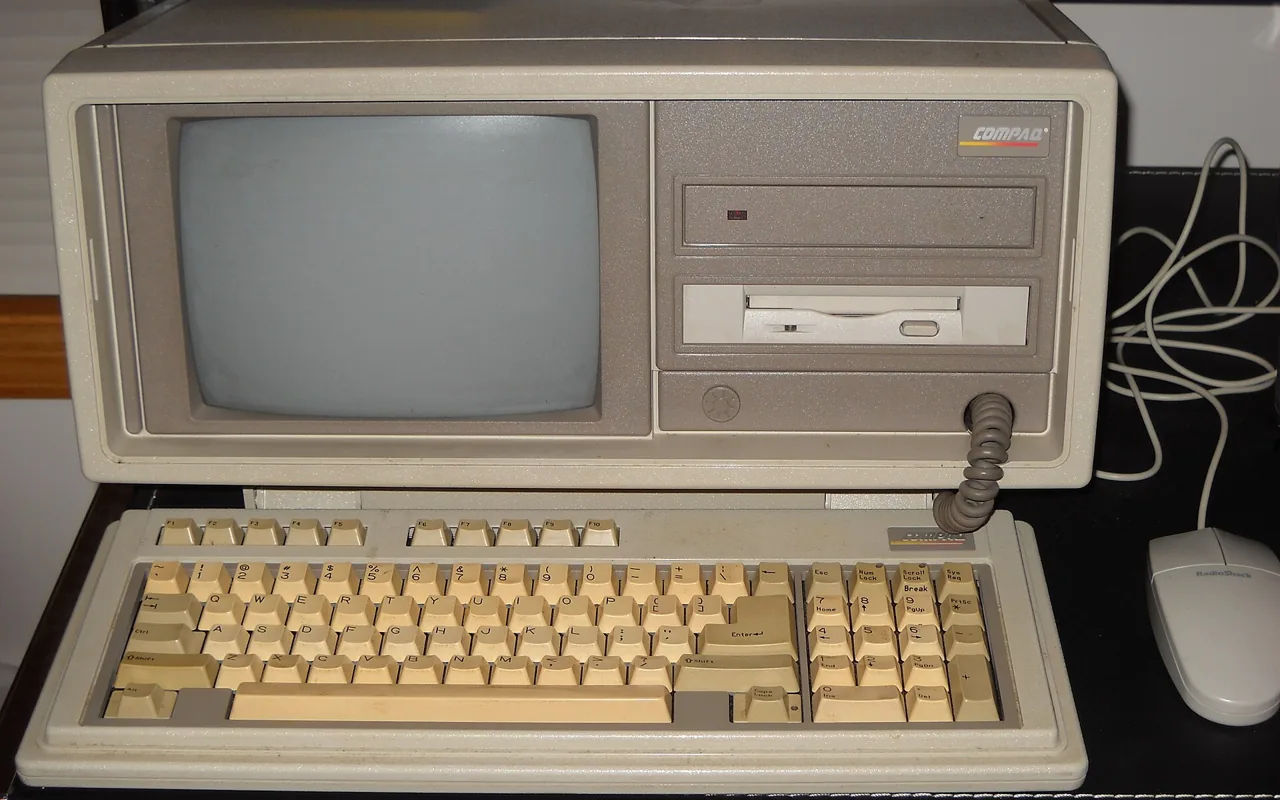
Market positioning for the COMPAQ PORTABLE II™ was clear: refine, not reinvent. While it forged no new technological ground, it represented a focused engineering effort to reduce size and weight while maintaining full compatibility with IBM PC systems2. At between 23½ and 26½ pounds, it was 17% lighter than the original COMPAQ Portable and nearly a third smaller in volume, with a depth of 14 inches, dimensions that made it notably more manageable than both the original COMPAQ Portable (28½ pounds) and the COMPAQ Portable 286 (30½ pounds)245. The system’s modular design allowed for straightforward upgrades, including memory expansion up to 4.1 megabytes and the addition of a modem, networking board, or mainframe communication board5. Notably, up to 2.1 megabytes of RAM could be added without consuming an expansion slot, preserving flexibility8.
The 80286 microprocessor delivered performance described as "three to five times faster" than the original COMPAQ Portable, IBM PC/XT, and other compatibles, with one source claiming a 400% speed increase over its predecessor45. Despite this, the surviving documentation does not specify the CPU’s clock speed, leaving the exact timing to inference. The base configuration included 256K bytes of RAM and one 360K-byte floppy drive, priced at $3499; a dual-floppy version with the same memory cost $3599, while the high-end model with 640K bytes of RAM, one floppy, and a 10-megabyte hard disk retailed for $47998. A conflicting advertisement lists a 512K, dual-floppy model at $1895, suggesting either a later price cut, a promotional offer, or a discrepancy in the source record48.
Storage options included standard 360K-byte floppy drives and an optional 10- or 20-megabyte fixed disk drive5. Data diskettes were fully interchangeable with other COMPAQ, IBM, and compatible systems, reinforcing its role as a true IBM PC clone5. The machine ran all popular business software written for IBM PCs, and its compatibility with the vast majority of PC software was a cornerstone of its appeal245. It shipped with MS-DOS manuals that were complete rewrites of the IBM PC versions, described by one reviewer as "much improved"2. An included Operations Guide and extensive diagnostics program aided user maintenance and troubleshooting2.
Thermal management was handled via strategic component placement to direct airflow from the power supply’s fan, which proved effective: the system never became warm to the touch even after more than a week of continuous use, and the fan itself was noted as "very quiet"2. The 165-watt power supply was engineered for a steady 120-watt load and utilized surface-mount technology, a detail underscoring the design’s focus on compactness28. An optional $89 power-switching board allowed automatic detection of 120-volt or 220-volt input, a practical feature for international users28.
Under MS OS/2, the system supported the COMPAQ Advanced VGA driver, enabling 256 colors at 640x480 resolution; without it, the display defaulted to 16 colors at the same resolution6. The surviving documentation is silent on native text modes, sound capabilities, and specific I/O ports, but the emphasis on VGA performance in the OS/2 context suggests a forward-looking posture for graphical applications. By 1991, the Portable II was listed alongside newer models such as the COMPAQ PORTABLE 386, COMPAQ PORTABLE III, and the SLT and LTE series, indicating its role as a transitional product in a rapidly evolving line6.
Despite its lack of architectural novelty, the Portable II benefited from COMPAQ’s reputation and distribution: the company was described as "the undisputed world leader in portable personal computers," backed by over 2900 Authorized COMPAQ Computer Dealers worldwide5. The original COMPAQ Portable had already achieved status as "the world's best-selling portable computer," and the Portable II carried that legacy forward through refinement rather than revolution45. Its solid construction, effective cooling, and modular serviceability made it a dependable workhorse, even as the market began shifting toward lighter, more integrated designs.
Specifications
| Processor | 80286 microprocessor458 |
| Performance | Three to five times faster than IBM PC/XT and original COMPAQ Portable; up to 400% faster than original COMPAQ Portable45 |
| RAM | 256K bytes (base); 512K (advertised); 640K (hard disk model); expandable to 4.1 megabytes, with 2.1 megabytes possible without using an expansion slot58 |
| Floppy drive | One or two 360K-byte diskette drives458 |
| Hard disk | Optional 10- or 20-megabyte fixed disk; 10-megabyte included in $4799 configuration58 |
| Weight | Between 23½ and 26½ pounds, depending on configuration2 |
| Dimensions | 14 inches deep; approximately 30% smaller than original COMPAQ Portable25 |
| Power supply | 165-watt unit with surface-mount technology; rated for 120-watt steady load, 165-watt peak28 |
| Optional power board | $89 module for automatic 120/220-volt sensing28 |
| Software compatibility | Runs all popular IBM PC business software; data diskettes interchangeable with IBM and compatibles245 |
| OS/2 display support | 256 colors at 640x480 with COMPAQ Advanced VGA driver; 16 colors without6 |
References
- 119400-006 Portable Line Options 199111 (1940)
- BYTE Vol 11-10 1986-10 Apple II GS (1986)
- Compaq 286-Based Products Technical Reference Guide Volume 1 198712 (1987)
- 1986 06 BYTE 11-06 Computers and Music (1986)
- 1986 08 BYTE 11-08 Object-Oriented Languages (1986)
- 115538-009 User Programs Reference 9ed 199108 (1991)
- Compaq Maintenance and Service Guide 198411 (1984)
- Byte Magazine Atari Articles
- G320-9781-00 PS2 and Printers Sales Advisor 198905 (1989)
- Compaq1986SecondQuaterReport (1986)