MITS Altair 8800
MITS introduced the Altair 8800 in 1975 as a microcomputer kit centered on the Intel 8080, triggering a surge in hobbyist computing and establishing the S-100 bus as a de facto standard.
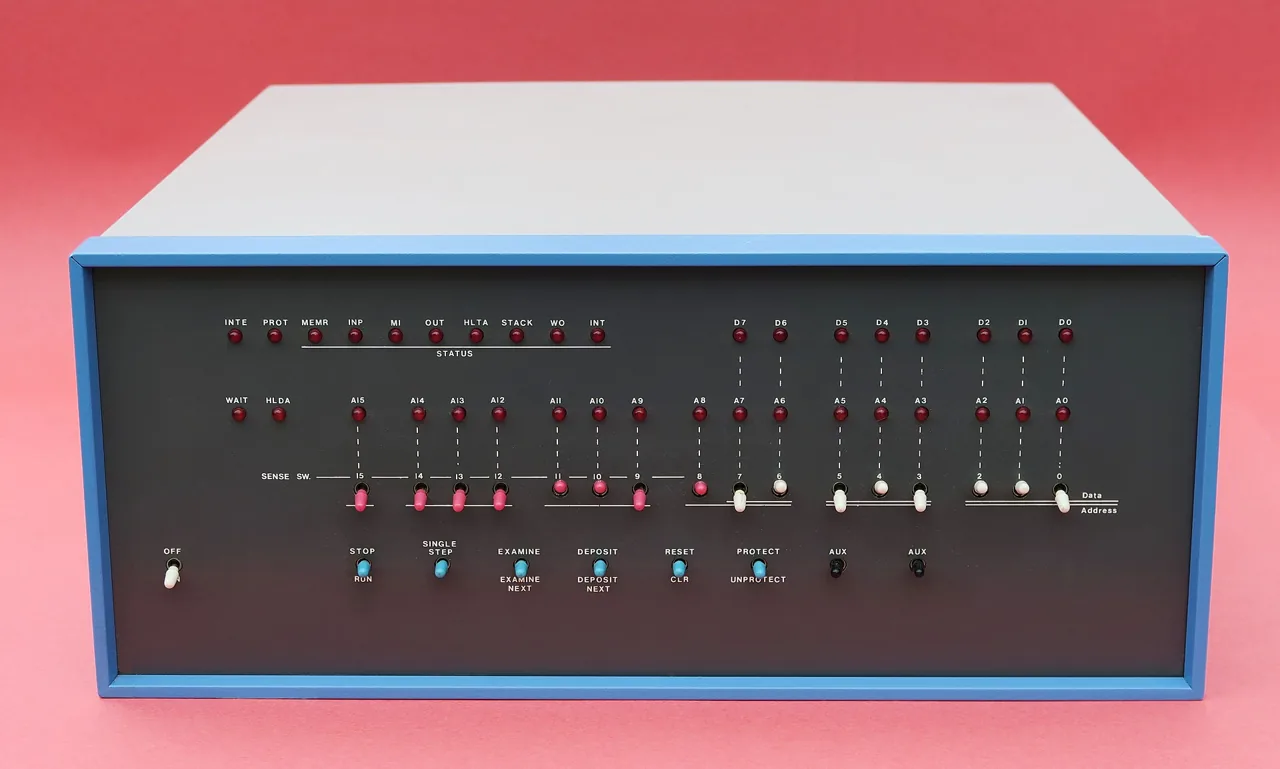
The Altair 8800 was not sold as a complete, ready-to-run machine but as a kit requiring assembly, a fact highlighted by reports of customers receiving components "in bits and pieces"9. Despite this, MITS moved quickly to meet demand, shipping approximately 700 units by February of the following year and reportedly selling over 2,500 kits in total9. Its 1975 debut is widely cited as the moment the personal computer hobbyist movement reached critical mass10.
The system was built around the Intel 8080 microprocessor, an 8-bit parallel CPU implemented on a single LSI chip using n-channel silicon gate MOS technology13. The machine operated with a basic cycle time of 2 microseconds1, and featured a separate 16-line address bus and 8-line bidirectional data bus3. The base kit included only 256 bytes of memory10, but expansion was central to the design: MITS offered a 1K static memory board3 and a 4K Static RAM board using Intel 2102 A-4 chips with worst case access of 450 nanoseconds2. The CPU could directly address up to 65,000 bytes1.
The machine’s 100-pin bus, known both as the "8800 SYSTEM BUS" and later as the "Altair bus" or "S-100 bus", used edge connectors rather than ribbon cable in production units39. MITS claimed to hold a patent on the bus12, a claim that did little to prevent widespread cloning. Indeed, systems like the Imsai 8080, PolyMorphic Poly 88, and Processor Technology SOL were hardware-compatible, allowing interchange of circuit cards8.
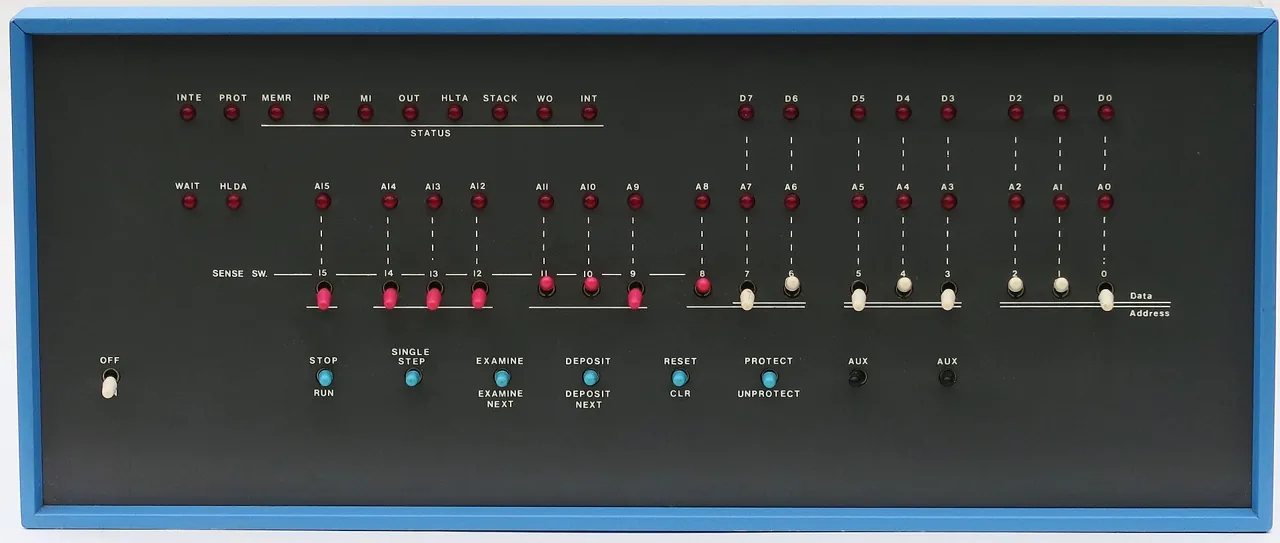
Front-panel interaction defined the user experience: a toggle switch-and-LED interface with roughly two dozen switches and three dozen lights810. Most switches set memory addresses or input data, while lights displayed addresses, data, or system functions8. This was not a machine for casual users; programming began with manual entry via switches, loading initial code from paper tape or cassette2.
Software support was surprisingly comprehensive for a kit machine. MITS developed its own system monitor (2.5K), a line editor (2K), and an assembler (3K), all distributed to users2. Ed Roberts, MITS founder, confirmed by phone that the company generated all software for the Altair9. The most significant software milestone was the development of 4K and 8K versions of BASIC by Bill Gates and Paul Allen’s fledgling company, Microsoft, marking their first commercial product10. Other offerings included Extended BASIC, a Disk Operating System, and a debug utility5.
Every Altair owner received a free subscription to Computer Notes and automatic membership in the Altair Users Group5. MITS also expanded rapidly, opening regional sales offices in Orange, California, and Miami, Florida9. By 1976, the Altair 8800 was described as "the most popular microcomputer in the field"267 and "the leader in the field"5, with MITS software earning "industry wide acclaim for its efficiency and advanced capabilities"25.
Despite its success, the machine had limitations. The documentation acknowledges only that "the Altair 8800 has very few, if any limitations"1, but the sparse base configuration and reliance on toggle switches suggest a steep entry barrier. Still, contemporary assessment was enthusiastic: one source claimed it "beats the socks off most mini's"1. The 8800’s influence extended beyond sales: it catalyzed an ecosystem. The Altair 8800b followed as a second-generation design, explicitly compatible with all prior hardware and software267, while MITS announced plans for an 8800a and a 6800-based Altair 6805.
References
- MITS Altair8800ComputerSystem Brochure
- MITS TheAltairSystem Brochure
- MITS Altair8800TheoryOperation 1975 (1975)
- MITS Altari8800OperatorsManual 1975 (1975)
- 1976 06 BYTE 00-10 The Game of LIFE in Color (1976)
- 1976 11 BYTE 00-15 More Fun than Crayons (1976)
- 1976 09 BYTE 00-13 Bicentennial (1976)
- bestofcreativeco0003unse
- ACS Newsletter 3 7
- 1995 09 BYTE 20-09 20 Years (1995)
- 1980 08 BYTE 05-08 The Forth Language (1980)
- ACS Newsletter 4 1
- 1977 11 BYTE 02-11 Memory Mapped IO (1977)
- 1980 09 BYTE 05-09 Homebrewing (1980)