Compaq Deskpro
introduced as a hardware- and software-compatible alternative to the IBM PC and PC/XT, featuring shock-mounted storage and dual-mode display capability.
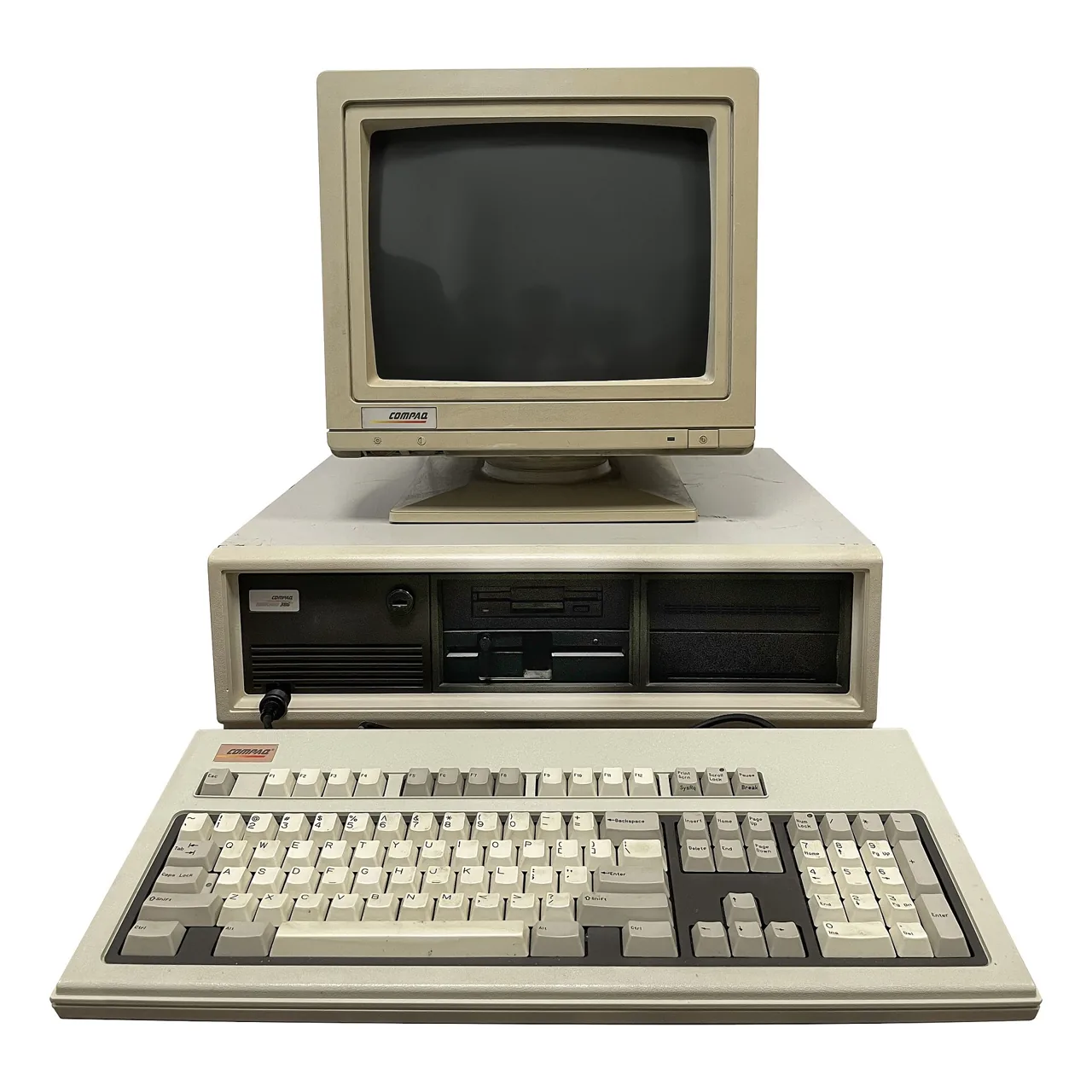
The Compaq Deskpro emerged not as a challenger to the IBM PC standard, but as a precise, expandable clone engineered for business users who demanded reliability and future-proofing. Unlike many early PC clones that cut corners, the Deskpro ensured broad software support from launch by being hardware and software compatible with the IBM PC and PC/XT 4. Its design borrowed directly from Compaq’s earlier portable success: the shock-mounting technology developed for the Compaq Plus transportable was reused to protect all internal mass-storage devices, a rare consideration in desktops of the era 14. This mechanical foresight gave the Deskpro a durability edge in office environments where vibration and accidental bumps were routine.
Central to its appeal was the dual-mode display system, which allowed high-resolution text and graphics to appear simultaneously on a single screen 4. This eliminated the need for a secondary monitor, a cost and space saving the company emphasized in marketing 4. The included 12-inch monitor was available in amber or green phosphor variants, though it came with a caveat: the monitor supplied with the standard configuration could not function with popular third-party graphics cards such as the Hercules card, limiting expansion for users seeking higher graphical fidelity 10. An RGB color monitor interface was available, but required separate configuration.
Under the hood, the Deskpro supported both 8088 and 8086 microprocessors 4, and offered an optional high-speed 8087-2 co-processor for floating-point calculations 11. Memory architecture allowed up to 640K bytes of RAM on the main system board, matching the IBM PC/XT limit and satisfying the needs of DOS-based applications at the time 14. Storage flexibility was a hallmark: the system unit could house four half-height drives, including combinations of two 360K-byte floppy drives, two 10-megabyte Winchester drives, or a 10-megabyte tape-cartridge drive for backup 14. Optional 30-megabyte fixed disks and corresponding tape backup units expanded capacity for data-intensive tasks 11. A 200-watt, 3-amp power supply provided sufficient headroom to support any internal storage combination without modification 14.
Expansion included a parallel printer port and a serial/clock card as standard 14. The system’s modularity extended to its claimed evolution path: Compaq asserted the Deskpro was “the only personal computer that can grow from a PC to XT to AT level of functionality,” though surviving documentation does not detail the exact upgrade mechanisms 11. It supported PC DOS Version 3.0 and was capable of running UNIX-based operating systems, positioning it as a machine for both mainstream office use and technical computing 11. Networking and multi-user operation were touted as feasible, though specific hardware or software requirements are not detailed in the source material 11.
The Deskpro was marketed as the desktop counterpart to the Compaq Portable, part of a family that included the Compaq Plus and the Deskpro line itself 4. Later models, the Deskpro 286 and Deskpro 386, were distinct units based on newer processors, though they inherited design elements such as careful construction 45. The original Deskpro’s legacy lies in its disciplined engineering: it was not faster, flashier, or cheaper than its peers, but it was thorough. By adhering strictly to IBM compatibility while enhancing physical resilience and display integration, it earned trust in corporate procurement channels. Compaq’s claim to make “the best-selling portable business computer in the world” at the time lent credibility, and the Deskpro extended that reputation to the desktop 11.
Specifications
| Processor | 8088 or 8086 microprocessor |
| Co-processor | 8087-2 (optional, high-speed) |
| RAM | Up to 640K bytes on main system board |
| Display | Dual-mode: high-resolution text and graphics on same screen |
| Monitor | 12-inch green or amber; RGB color monitor interface available |
| Storage | Up to four half-height devices: two 360K floppy drives, two 10MB Winchester drives, or one 10MB tape-cartridge drive; optional 30MB fixed disk |
| Power supply | 200-watt, 3-amp (standard) |
| Ports | Parallel printer port; serial/clock card |
| Operating systems | PC DOS Version 3.0, UNIX-based operating systems |
| Compatibility | Hardware and software compatible with IBM PC and PC/XT |
| Expansion | Supports internal tape backup for 10MB or 30MB fixed disks |
References
- Compaq 286-Based Products Technical Reference Guide Volume 1 198712 (1987)
- 115538-009 User Programs Reference 9ed 199108 (1991)
- 030-31645 Microsoft Windows 3.1 Resource Kit 1992 (1992)
- 1985 07 BYTE 10-07 Computers and Space (1985)
- 1987.04 Your Computer (1987)
- CompaqPowerful&Expandable
- 1986 06 BYTE 11-06 Computers and Music (1986)
- CompaqIntelligentModularity
- 1987.04 Your Computer (1987)
- 1986 01 BYTE 11-01 Robotics (1986)
- BYTE Vol 10-01 1985-01 Through The Hourglass (1985)
- Fujitsu Sales Prospector 1986 (1986)
- URP 10th edition
- 1984 08 BYTE 09-08 Modula-2 (1984)