Osborne 1
The Osborne 1, released by Osborne Computer Corporation, was a portable personal business computer that bundled CP/M, productivity software, and dual floppy drives at a price of $1795, triggering a brief but intense market surge before collapsing under self-inflicted product transition missteps.
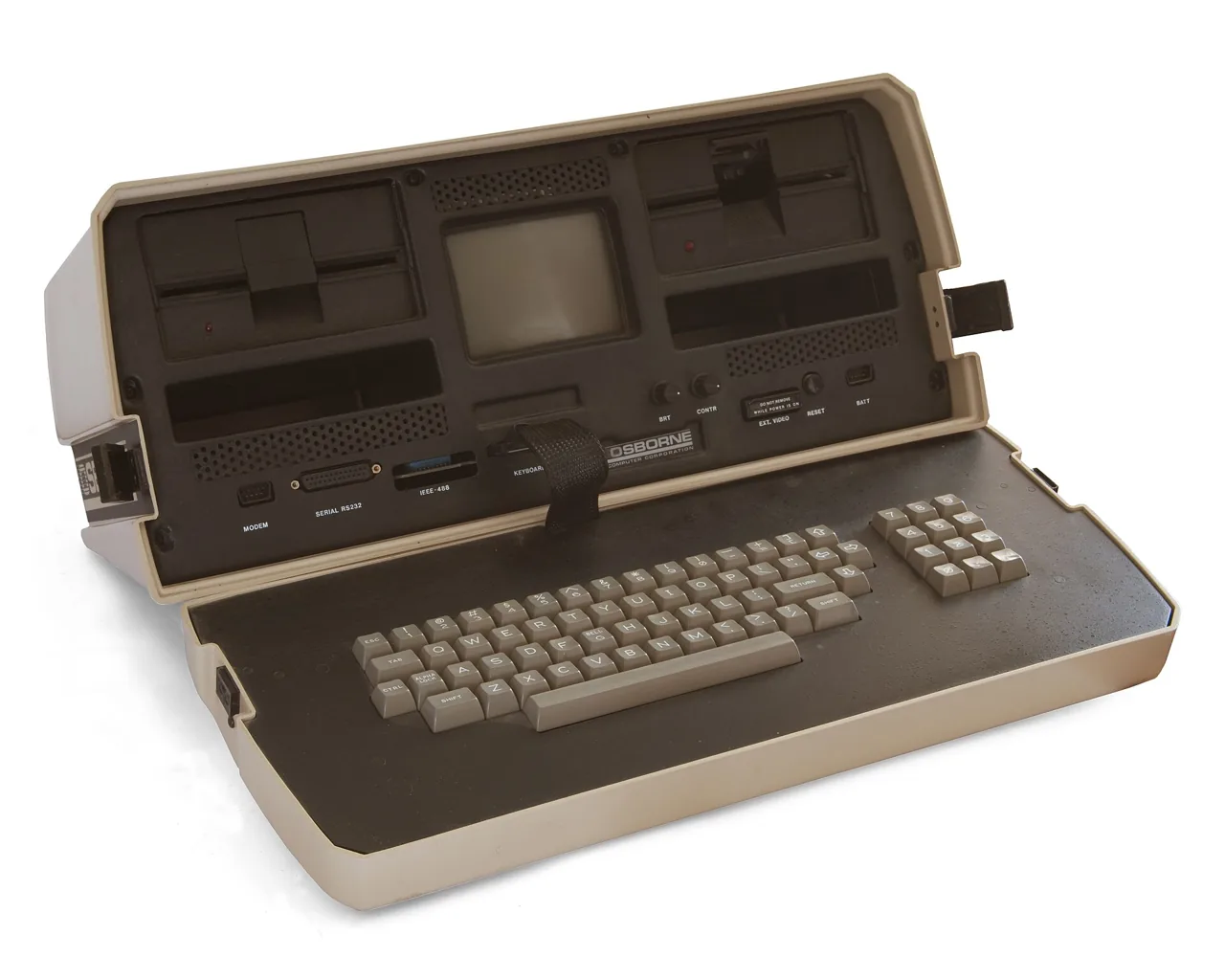
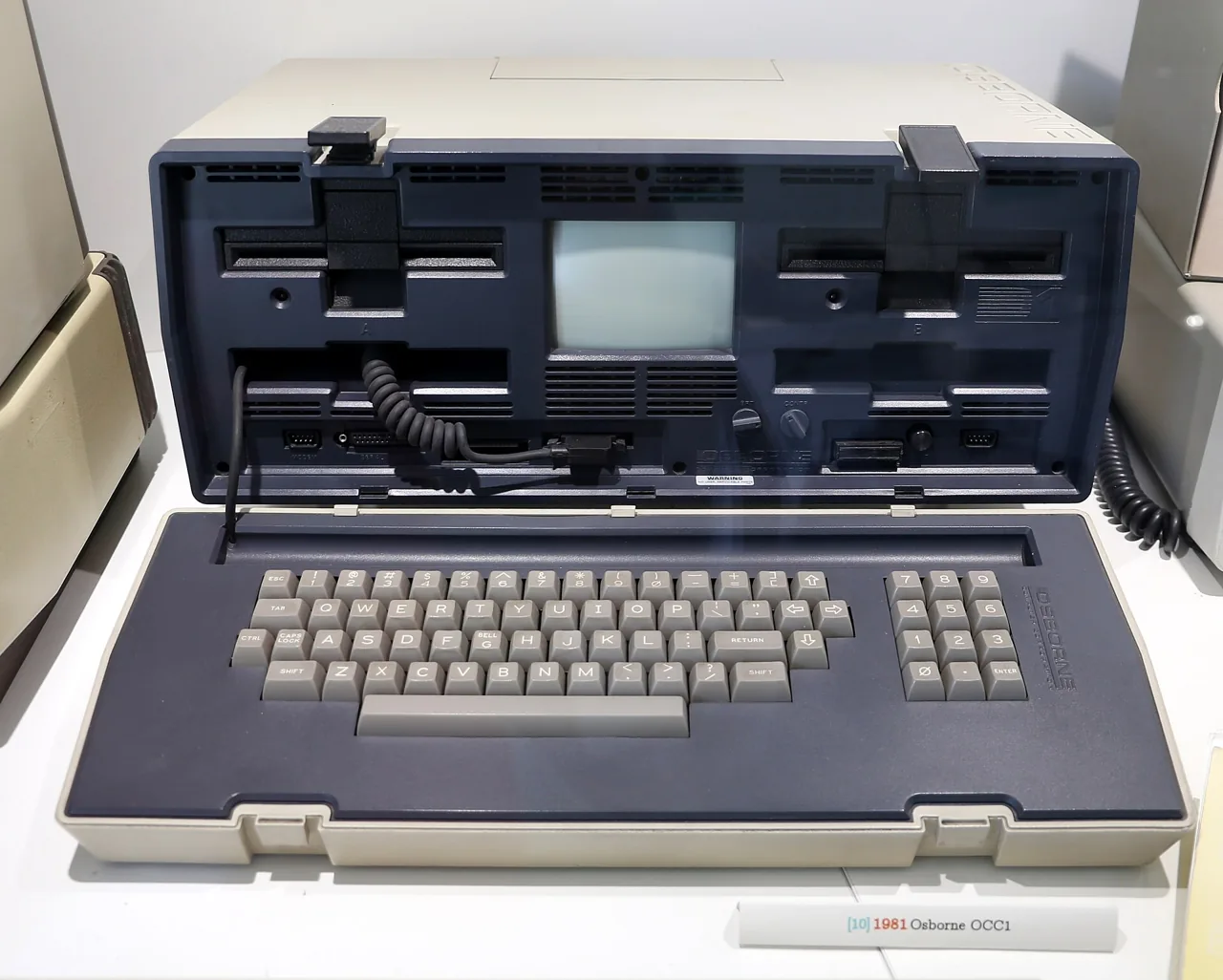
Adam Osborne aimed to compress established microcomputer technology into a transportable form and undercut the market with aggressive bundling1216. The result was the Osborne 1: a Z80A-based luggable8 with 64K bytes of RAM and a standard CP/M operating system11112141516. Its system board integrated the CPU, ROM, RAM, keyboard, video display, I/O interfaces, and beeper1, following a design trend shared by Apple, Tandy, Xerox, and Zenith1. Physical I/O included IEEE 488 and RS-232C interfaces121416, with optional accessories such as a battery pack, modem electronics, couplers, and external monitor connections11216.
The machine shipped with a suite of software valued at over £800, including WordStar, MailMerge, SuperCalc, CBASIC, and MBASIC8111415. Microsoft BASIC-80 and Digital Research's CBASIC-2 were included114, reinforcing its positioning as a turnkey business tool. German-language variants were available, including localized versions of WordStar and SuperCalc, a German SETUP replacement priced at 90 Mark, and a financial accounting package aligned with the DATEV standard at 2610 Mark9.
Storage relied on two internal floppy drives, each reportedly offering 100K bytes121416, though some sources describe them as holding only 90K bytes26. This discrepancy remains unresolved in the documentation. The built-in monitor and full business keyboard completed the package121416, with the keyboard clipping over the display for transport1216. The case was described as weatherproof, though conflicting reports cite either brushed aluminum12 or plastic16, a contradiction not clarified in surviving materials.
In the UK, sales exceeded one million pounds, with approximately 500 units distributed monthly through a national dealer network11. Future Management served as sole distributor, operating from Milton Keynes811. By late 1984, the Osborne 1 was being phased out, with the Osborne Express announced as its replacement8. A price drop to "less than £500" signaled its decline8.
The Osborne Executive, intended as an upgrade, was "upward compatible" and capable of reading files created on the Osborne 17. However, production delays prevented shipment for several months26. As dealers and customers waited, sales of the Osborne 1 collapsed. Osborne Computer Corporation, already financially unstable, entered Chapter II reorganization, effectively bankruptcy26. The company briefly reemerged but failed to regain market relevance26.
The Osborne 1’s legacy rests on its audacious bundling and pricing strategy, which briefly made it a sales phenomenon, advertised as selling 2,500 units per week10. Yet its downfall illustrates the peril of announcing a successor before it ships. The machine itself was technically unremarkable, built on proven components, but its integration and package value were, at the time, disruptive1214. It remains a case study in how software bundling and market timing can outweigh raw technical specifications.
Specifications
| Manufacturer | Osborne Computer Corporation |
| Model | Osborne 1 |
| CPU | Z80A |
| RAM | 64K bytes |
| Storage | Two floppy drives (100K bytes each, per 121416; 90K bytes per 26) |
| Operating System | CP/M |
| Display | Built-in monitor |
| Keyboard | Full business keyboard |
| I/O Interfaces | IEEE 488, RS-232C |
| Case Material | Weatherproof brushed aluminum (per 12), weatherproof plastic (per 16) |
| Optional Accessories | Battery pack, modem electronics, couplers, external monitor connections |
| Price (US) | $1795 |
| Price (UK) | £1,250 (initial), later reduced to £959 and then "less than £500" |
References
- The Osborne Portable Computer
- 1986 06 BYTE 11-06 Computers and Music (1986)
- Assembly language debugging hardware:software for the Commodore 64 computer
- Towers International Microprocessor Selector
- Assembly language debugging hardware:software for the Commodore 64 computer
- Byte Magazine Atari Articles
- Dynacomp Catalog 33
- PersonalComputerNews085-03Nov1984 (1984)
- ComputerPersoenlich 83 09
- 1983 04 BYTE 08-04 New Chips (1983)
- ComputingToday198208 (1982)
- 1981 06 BYTE 06-06 Operating Systems (1981)
- 1982 12 BYTE 07-12 Game Plan 1982 (1982)
- 1982 01 BYTE 07-01 The IBM Personal Computer (1982)
- ComputingToday198206 (1982)
- 1981 07 BYTE 06-07 Energy Conservation (1981)