WordStar
MicroPro International Corporation’s WordStar dominated early microcomputer word processing, combining deep functionality with a rigid command structure that polarized users and shaped how text was created on CP/M and MS-DOS systems.
WordStar emerged as a workhorse, emulating the behavior of dedicated word processing systems on general-purpose microcomputers 11. Its design philosophy assumed user commitment: before first use, the INSTALL program required detailed configuration of the operating environment, and unlisted hardware demanded dealer intervention 11. This was not software that bent to the machine; the machine bent to it. On the H/Z-100, for instance, two versions existed, with the newer 3.3 release dynamically relocating its I/O routines to a separate memory segment if enough memory was available, otherwise falling back to standard routines that disabled function and keypad keys 14. Such conditional execution revealed a program straining against the limits of early microcomputer memory models, where 256K was the bare minimum for Release 4.0, 384K for 5.0, and 512K strongly advised for stable operation 610. Page Preview in Release 5.0 demanded the full 768K complement on the Z-100, a steep requirement in its time 610.
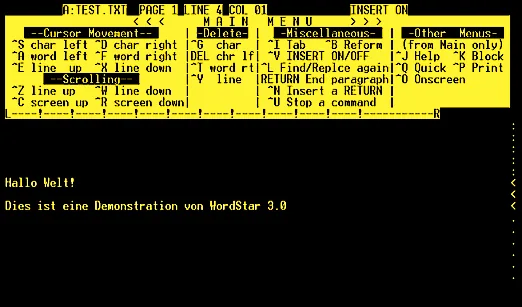
The editor’s command set became legendary for its consistency and opacity. Cursor motion relied on the Ctrl-key diamond: ^E up, ^X down, ^S left, ^D right, a layout that persisted in derivatives like WordPerfect and Turbo Pascal’s editor, but baffled newcomers 12. Yet this rigidity coexisted with surprising extensibility. A reserved memory area, MOR-PAT, allowed assembly language subroutines to patch the program directly. Kaypro famously exploited this to retrofit arrow key support by altering a BIOS translation table, choosing to adapt their hardware’s behavior to WordStar’s expectations rather than the reverse 12. The WSCHANGE configuration utility in version 4 further empowered users, enabling near-total customization of the interface 3. Memory-resident programs could run alongside WordStar, provided they were loaded first, and MS-DOS commands remained accessible during editing if memory permitted 3. Background printing allowed concurrent work on another file, a rare multitasking illusion on single-tasking systems 5.
MicroPro segmented its offerings aggressively. The base product evolved into tiered packages: WordStar w/Tutor at $169 in 1986, the Pro Pac bundle at $239–$265, and Pro Plus at $345 4. The Professional line included MailMerge and CorrectStar in Release 3.3, with 4.0 integrating an improved spelling checker and mail merge natively; reviewers called the spelling module “one of the best things about the whole package” and urged upgrades for users lacking the full suite 3. Yet adoption was not universal: one user reported reverting to 3.3 despite upgrading to 4.0, citing unresolved flaws detailed in a Silveira review, and pleading publicly for fixes in a future 4.1 13. File compatibility frayed with Release 5.0, which could read older files but required a workaround, printing to the virtual WS4 “printer,” to convert backward 5.
WordStar’s reach extended across platforms: CP/M, MS-DOS, Apple, Osborne 1, and Kaypro systems all hosted it 7891113. The Z-100 WordStar Connection, released in 1988, was a technical feat: a utility package allowing native execution of PC-compatible WordStar 4.0 and 5.0 on the non-PC Z-100 without emulation, preserving features like Page Preview while omitting Tel-Merge and PC Outline 6. Programmed by Patrick Swayne of HUG, it represented a late-life effort to sustain relevance on niche hardware 610. The software’s credibility was such that it wrote entire books, including the first draft of The Osborne Portable Computer, a fact the publisher highlighted as proof of its utility 9. A CP/M Users’ Group convert program eased migration, and testimonials ranged from “well-suited to computer novices” to claims of near-perfection after “extensive patching” 1113.
WordStar 2000 and its variants, listed at $298 to $285 between 1985 and 1986, were distinct products, not simple updates, suggesting a strategic fork that diluted focus 24. Meanwhile, bundled hardware/software packages like the MH-1 through MH-3 sold at steep list prices (up to $995), though discounted heavily through vendors like MicroHouse 8. The program’s legacy is etched in its contradictions: it was praised for efficiency and accessibility, yet its non-WYSIWYG interface drew criticism until Release 5’s Page Preview mitigated the issue 5. It empowered users to reshape it, yet demanded they conform to its architecture first. WordStar processed text by conditioning the user to its logic, and in doing so, defined an era of invisible, keyboard-driven composition.
Pricing & Packaging
| WordStar base | $229 (1982) |
| WordStar w/Tutor | $169 (1986) |
| WordStar Pro Pac | $239–$265 (1985–1986) |
| WordStar Pro Plus | $345 (1986) |
| WordStar 2000 | $239–$298 (1985–1986) |
| WordStar 2000 Plus | $285 (1986) |
| MH-1 (CP/M) | $645 list, $319 MicroHouse (1982) |
| MH-2 (CP/M) | $995 list, $519 MicroHouse (1982) |
| MH-3 (CP/M) | $790 list, $419 MicroHouse (1982) |
References
- Using Wordstar Shelton Burton 1988 (1988)
- 1985 07 BYTE 10-07 Computers and Space (1985)
- remark-volume8-issue10-1987 (1987)
- 1986 01 BYTE 11-01 Robotics (1986)
- remark-volume10-issue9-1989 (1989)
- remark-volume10-issue2-1989 (1989)
- MICRO Vol63-08 83
- 1982 08 BYTE 07-08 Logo (1982)
- The Osborne Portable Computer
- remark-volume11-issue1-1990 (1990)
- OsborneCPMUserGuideSecondEdition 1982 ThomHogan (1982)
- profiles v3n11
- profiles v5n9
- remark-volume6-issue2-1985 (1985)