MultiPlan
Microsoft’s cross-platform spreadsheet, designed to run on MS-DOS, CP/M, Apple, and Macintosh systems with support for over a million cells in later versions.
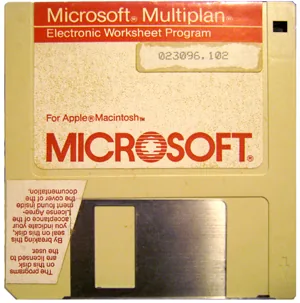
MultiPlan arrived not as a revolution but as a migration. Microsoft’s first serious bid to move beyond BASIC interpreters and word processors into structured data, targeting the same business users wrestling with VisiCalc’s limitations. It was not the fastest, nor the simplest, but it was ambitious: a spreadsheet engineered for portability across eight-bit and sixteen-bit systems, from the IBM PCjr to the Macintosh, with a syntax that dropped the @ prefix familiar to VisiCalc users in favor of cleaner function calls1. This was deliberate; Microsoft wanted MultiPlan to feel less like a calculator on a grid and more like a modeling environment. Whether it succeeded depended on the machine, the memory, and the patience of the user.
The original MultiPlan demanded 64K of RAM and an MS-DOS boot disk1, a modest ask in 1983, but the PCjr version required a minimum of 128K of RAM, though this allowed only relatively small models4. The worksheet grid stretched to 255 rows by 63 columns in early versions11, but Multiplan 2.0, dubbed the “New MS-DOS Multiplan,” expanded that to a 255 × 4095 matrix: over a million cells10. That capacity was theoretical for most; few systems of the mid-1980s could address that much memory, but the specification signaled intent: this was software built to scale.
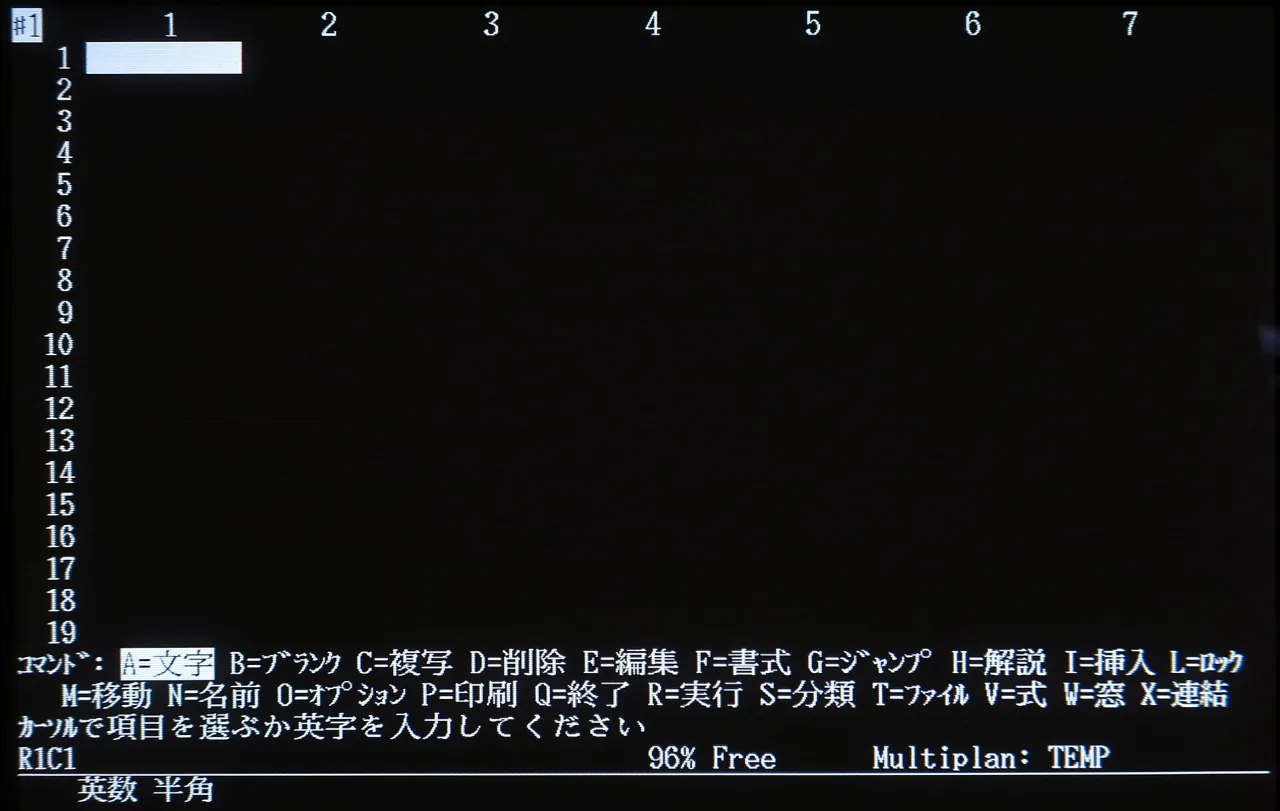
Its feature set leaned into complexity. MultiPlan supported iterative calculations, allowing users to define convergence thresholds based on cell value changes, a rarity among contemporaries4. It could sort data numerically or alphabetically4, format cells with floating dollar signs, exponents, and percentages4, and apply up to 16 colors to window borders and backgrounds on compatible systems11. The “naming” feature let users assign plain-English labels to cells or ranges, a usability leap over row-column notation23. Prompts appeared in full words or phrases, not cryptic codes, and an on-line reference guide offered context-sensitive help, luxuries in an era when many programs shipped with nothing but a manual23.
Interoperability was a cornerstone. MultiPlan could directly import VisiCalc files236, easing migration, and by version 2.0, it could read and write Lotus 1-2-3 files “in one deft command”10. A SYLK conversion utility enabled data import from Condor, WordStar, and other ASCII sources8. For multitaskers, a DVP (DESQview Program) file could be added to the Multiplan diskette from the DESQview diskette, allowing it to run under Quarterdeck’s DESQview, an early DOS multitasker5. This was not an afterthought; it reflected Microsoft’s awareness that power users needed more than one application at a time.
The Macintosh version, supplied on a single 3½-inch Sony floppy disk containing the OS, program, and Help file, came with a 172-page manual and an order form for a $10 backup disk7. The Apple II manual, in contrast, exceeded 400 pages7, indicating the program’s depth, and perhaps its opacity. A 1984 review noted the Mac version had “idiosyncrasies” and command incompatibilities with earlier versions, and that transferring data to its companion graphics program, Chart, felt “arduous” for users of integrated suites7.
Pricing tells its own story. One source lists the original price at $2453, another at $14914. The PCjr version was priced at $454, suggesting Microsoft segmented the market aggressively. The discrepancy remains unresolved in the documentation, but the lower price may reflect a promotional bundle or later discounting as competition intensified.
MultiPlan was never the spreadsheet that defined a generation. But it was the one that taught Microsoft how to build complex cross-platform applications: how to manage memory efficiently4, how to handle file compatibility, and how to structure user assistance. MultiPlan did not win the market, but it built the foundation. Microsoft claimed its software was running in “well over a million installations worldwide” in 1982 and 1983236, a figure that likely included MultiPlan among its ranks. It was not a triumph, but it was a presence, one that quietly shaped what came next.
References
- 158-999000-186 Multiplan for MS-DOS 1983 (1983)
- 1982 12 BYTE 07-12 Game Plan 1982 (1982)
- 1983 04 BYTE 08-04 New Chips (1983)
- Introducing IBM PCjr
- Quarterdeck DESQview V1 UsersManual
- PERSONAL COMPUTING JULY 1983 (1983)
- 1984 12 BYTE 09-13 Communications (1984)
- remark-volume5-issue7-1984 (1984)
- remark-volume5-issue9-1984 (1984)
- 1986 01 BYTE 11-01 Robotics (1986)
- 6936938-1 IBM The Guide Fall83-Winter84 Nov83
- ComputerPersoenlich 83 20
- MICRO Vol60-05 83
- 1984 08 BYTE 09-08 Modula-2 (1984)
- NZ-bits-and-bytes-issue-2-01
- 1986 06 BYTE 11-06 Computers and Music (1986)