PKZIP
PKWARE’s archiving and compression utility, sold for $47.00 in 1992, became the de facto standard for bundling and shrinking files across DOS and UNIX systems, despite internal contradictions in its documented capabilities.
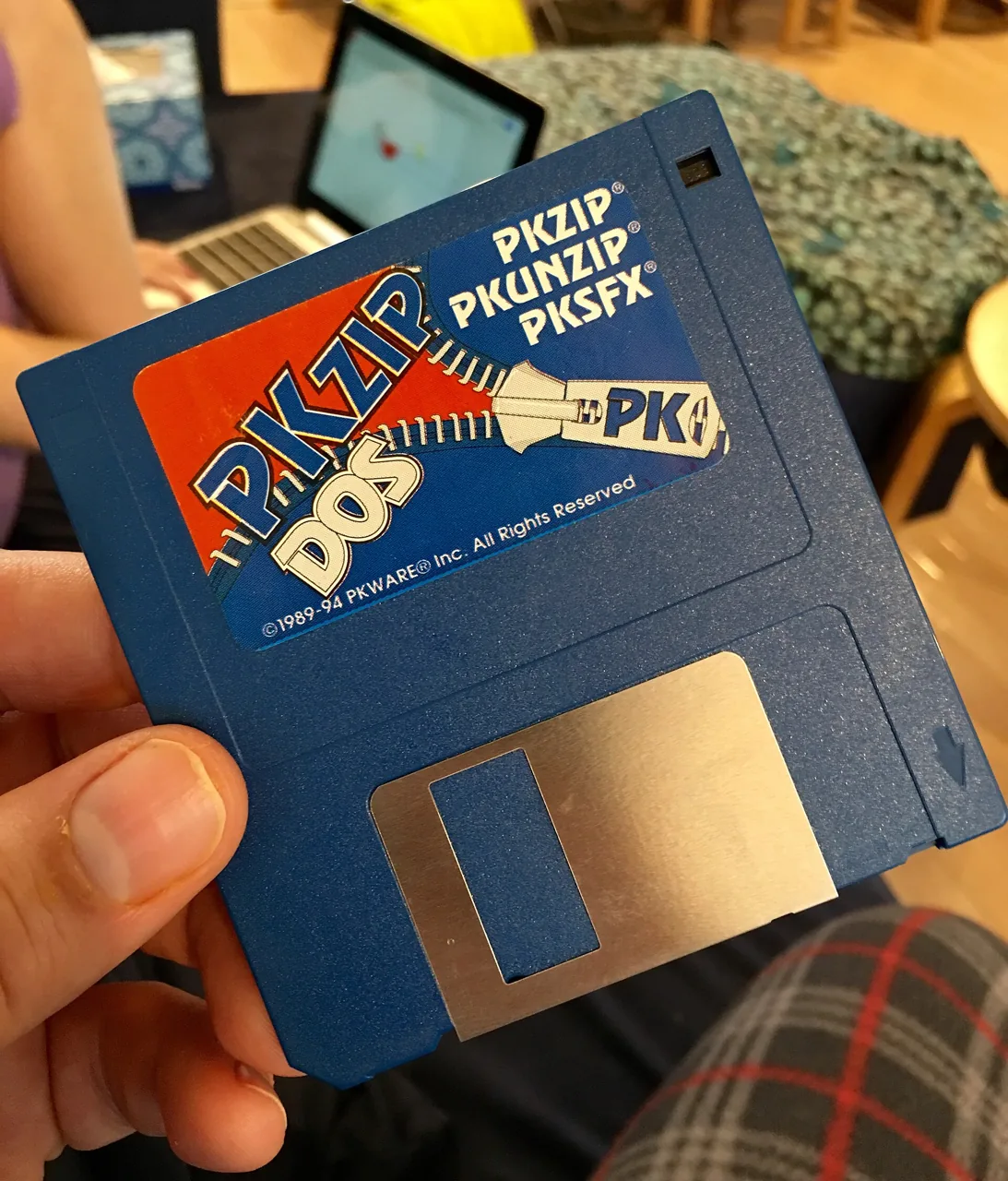
Persistent documentation conflicts obscure a core feature: whether PKZIP could generate self-extracting archives. The 1992 BYTE review explicitly states the utility allows users to “store compressed files as a single self-extracting .EXE file that automatically uncompresses when run”4. Yet Public Domain 6 dismisses PKZIP as “prehistoric because it can't produce self-extracting archives”9. The contradiction remains unresolved in surviving materials. However, the existence of a “Self-extracting PKZIP V2.04G” file containing PKZIP, PKUNZIP, and related tools10 suggests such functionality was at least present in specific distributions, if not universally acknowledged.
PKZIP’s command-line interface demanded precision. Options were case sensitive78, and subtle syntax controlled critical behaviors: the -i- flag archived only files with the archive attribute set, while the trailing minus prevented resetting that bit78. The -ws option included system-bit files in operations78. These granular controls reflected a tool built for power users, not casual adopters. Performance varied under memory managers; PKZIP 2.04G required PCCE to run in 512K environments, crashing otherwise1112, though QuarterDeck’s DPMI interface could dramatically accelerate execution by enabling EMS/UMB memory use10.
Interoperability was conditional. While all later PKZIP versions supported prior compression standards1, reverse compatibility failed: older UNZIP versions encountering archives from newer PKZIP releases could halt with the blunt error “Sorry, I don't know how to handle this file”1. Users were advised to ensure PKUNZIP matched or exceeded the PKZIP version that created the archive1. PKUNZIP itself was frequently distributed independently on shareware disks to enable unpacking, even when PKZIP was not included1.
On UNIX platforms, PKZIP for SPARC-based Solaris 2.x systems appeared by 1998, supporting Version 2.513. It extended functionality beyond native .ZIP handling, allowing viewing and extraction from TAR, GZIP, UUencode, XXencode, MIME, and BinHex formats13, and could generate UUencoded .ZIP files13. Crucially, it preserved UNIX file permissions, including user and group IDs, last access times, and modification timestamps13, a necessity for system administrators relying on file integrity. Self-extracting archives were also supported in this port13.
Technical friction emerged in layered environments. PKZIP 2.04 encountered issues with Stacker 4.0 on 386-class machines running DOS 6 or higher, a conflict rooted in PKZIP’s use of DPMI services3. The workaround required either appending the -) option to the command line or placing it in PKZIP.CFG to permanently disable DPMI use3. The software’s reliance on DPMI3 and undocumented interrupt functions for accelerated screen output1112 illustrates a design ethos prioritizing speed and direct hardware access over portability or stability in virtualized or compressed disk environments.
Encryption introduced legal constraints. PKZIP 1.10 included data encryption technology, triggering U.S. and Canadian federal export restrictions that prohibited its distribution on international networks such as the Internet, Usenet, BITNET, and EARN5. This limitation shaped early distribution patterns, confining the encrypted version to domestic channels while lighter, non-encrypting variants circulated globally. Later versions apparently navigated these restrictions, though the documentation is silent on how.
Despite quirks and contradictions, PKZIP’s dominance was acknowledged contemporaneously. It was described as “the most popular archiving program for the PC”9 and received a “WORLD CLASS AWARD”1516, reaffirmed as “award winning” in 19951516. Its file format, though never fully detailed in the available sources, became a lingua franca for data exchange, outlasting the software itself. The persistence of the .ZIP standard is less an artifact of elegance than to timing, utility, and the sheer weight of adoption, fueled by a $47 tool that compressed files, courted controversy, and left a fragmented paper trail of how it actually worked.
References
- beebugv1207
- beebugv1207
- STR1020.TXT.generated
- 1992 02 BYTE 17-02 Tomorrows Chips (1992)
- ZNET513.TXT.generated
- EugenePCjrClubNews 199511 VolXINo11 (1995)
- beebugv1206
- beebugv1206
- Public Domain 6
- CSC Hard Drive Bible - Edition 8 - 1996 (1996)
- beebugv1209
- beebugv1209
- SunExpert-v09n03-1998-03 (1998)
- beebugv1208
- Byte V19N9 Sept1994 (1994)
- 1995 09 BYTE 20-09 20 Years (1995)