The Print Shop
Broderbund’s The Print Shop, released in late 1985 for the Atari 8-bit, was a menu-driven desktop publishing program that bundled clip art, type styles, and printer support to let home users produce banners, greeting cards, and signs. It became one of the era’s most widely adopted creative software titles.
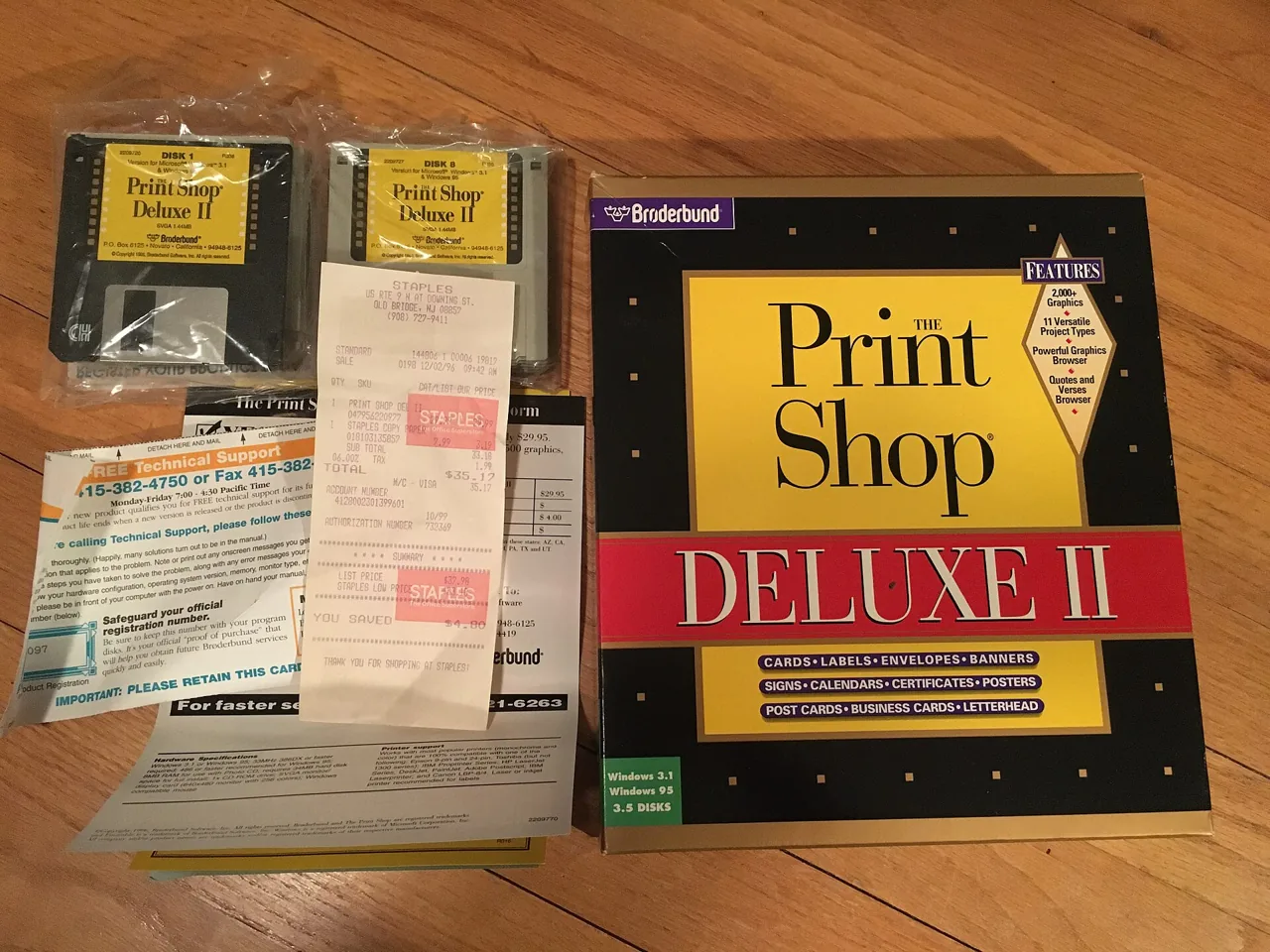
For a generation of home computer owners, The Print Shop was the first software that made tangible output feel magical. It arrived during a period when most personal computing remained abstract (lines of code, spreadsheets, or games), but here was a tool that produced physical artifacts: birthday cards on perforated fanfold, classroom banners strung across bulletin boards, flyers for garage sales. Its success stemmed from a tightly focused design: a completely menu-driven interface eliminated the need to memorize commands9, and it shipped with free samples of colored paper and envelopes, reinforcing its role as a complete, ready-to-use system9. The program supported most popular dot matrix printers of the time8, though notably excluded 24-pin models. This limitation could be addressed with a $40 third-party patch from NAP Systems, or by waiting for a new version of the software7.
The core software included eight type styles in multiple sizes and formats13, dozens of clip art images, border designs, and abstract patterns13, plus a built-in editor for creating custom graphics13. It ran on the Apple II series (II+, IIe, IIc, IIGs)5, the Commodore 64 and 12859, the Atari 400, 800, XL, and XE5, and the Tandy T1000/3000 (requiring a minimum of 256K and two disk drives)13. Pricing varied: the Commodore 64 version carried a $44.95 list price8, while the PC version retailed for $59.957. In Germany, the Atari version was listed at 139.00 DM2, and The Print Shop Companion sold in the UK for £29.956.
Broderbund expanded the ecosystem with a series of add-on disks, all requiring the base program9. The Print Shop Graphics Library Disk 1 added 120 ready-to-use designs89, while Disk 2 and Disk 3 introduced themed graphics covering hobbies, holidays, sports, and zodiac signs59. The Holiday Edition offered 26 seasonal themes including Christmas, Hanukkah, and New Year’s, along with new fonts and full-panel layouts5. The Print Shop Companion, though usable standalone, was designed to extend the original with additional editors, fonts, and icons6. A separate Paper Pack included 120 colored sheets and 42 matching envelopes5.
By 1988, Broderbund claimed “over a million happy Print Shop users”10, and the program was hailed as “one of the most popular software programs of all time”10. For many Atari 8-bit owners, it was not just popular. It was singular. One period review noted it was “the only usable Atari 8 bit program within the desktop publishing format,” and that “for many users it was the 8 bit Atari and Print Shop which gave them an insight into this field”6. Its ease of use was repeatedly emphasized: “easy to use, foolproof and a whole lot of fun”6. The Print Shop Deluxe, later released, expanded on the original with enhanced graphics, fonts, and layout options316.
References
- MCBA ShopFloorControlCapacityRequirementsPlanningDIBOLSampleScreensReports Oct81
- Preisliste PL 4 zum Atari Katalog 1985-1 (1985)(Compy-Shop)(DE) (1985)
- Computer Gaming World - 199301 - Number 102 (1993)
- 1986 04 BYTE 11-04 Number Crunching (1986)
- BrderbundSoftware-InnovativeSoftwareForEveryPartOfYourLife1987 (1987)
- AtariUser32-Dec87
- EugenePCjrClubNews 198811 Vol4No11 (1988)
- PROTECTO Price Catalog for Commodore 64 and VIC-20
- TheEverythingBookForCommodoreComputerswinterspring1989 (1989)
- BrderbundSoftwareCatalog1988 (1988)
- Handleman Company Computer Software Catalog and Information Guide Fall-Winter 1985 (1985)
- GC20-0370-7 System370-30xx-4300-9370BibliographySystem&AppPrograms Jan90
- 1987.04 Your Computer (1987)
- Dynacomp Catalog 33
- Compute Issue 073 1986 Jun (1986)
- CompuServe Magazine 1993-01 (1993)