Atari 400
Atari’s entry-level home computer, released alongside the 800 as part of a dual-tier strategy, and shipped with a ROM-based operating system expandable via cartridge.
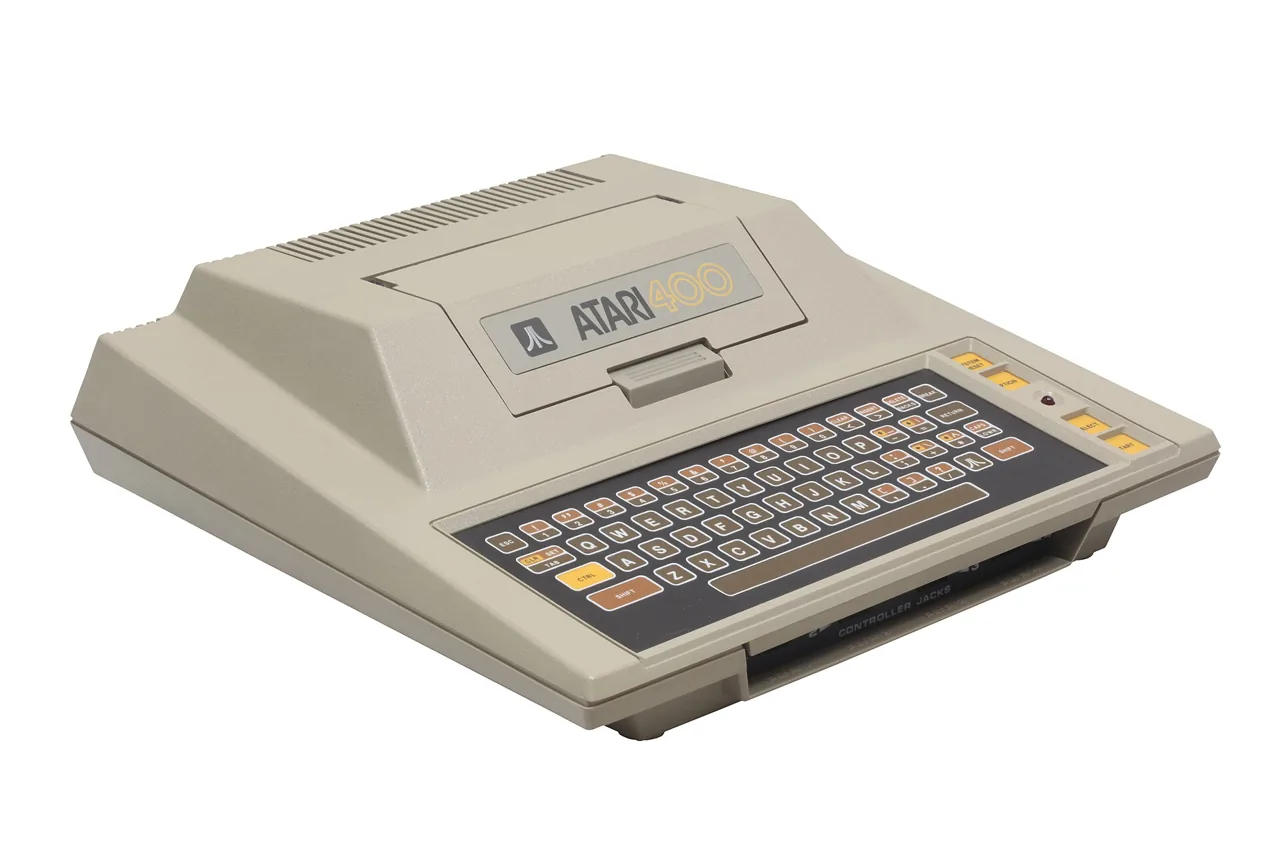
The Atari 400 entered the market as the budget counterpart to the Atari 800, sharing its core architecture. Marketed as a "Home Computer"2, it was built around the 6502B microprocessor running at 1.78 MHz1, and shipped with 8K bytes of RAM, expandable to 16K at an authorized service center1. Its operating system resided in 10K bytes of ROM, with additional routines accessible through plug-in cartridges that could expand the OS footprint to 16K1. Despite its modest base memory, third-party upgrades allowed for systems with 32K or more; one non-Atari 32K module could replace the internal 8K RAM entirely, enabling full utilization of the expanded memory space16.
The machine’s audio-visual capabilities were ahead of many contemporaries. It generated 16 colors, each with 8 intensity levels, offering rich palette options for games and educational software1. Sound was handled by four independent synthesizers capable of four octaves, variable volume control, and output through both an internal speaker and the television audio channel1. Video and RF output were integrated via a built-in modulator, FCC-approved, and shipped with a 15-foot RF cable for direct connection to consumer televisions1.
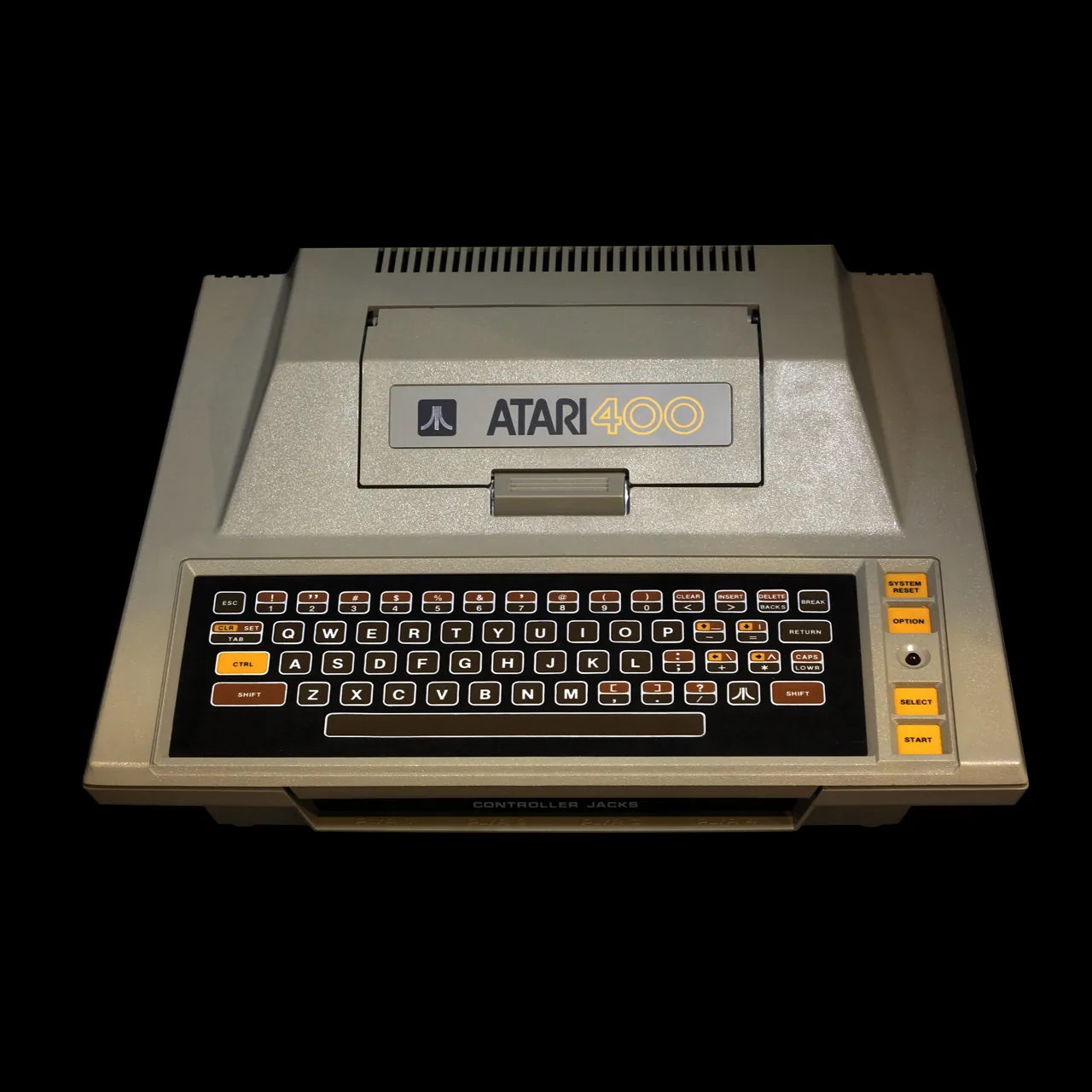
The keyboard, a source of both praise and derision, consisted of 57 alphanumeric keys plus additional controls, though the exact complement beyond alphanumerics is unspecified in surviving documentation1. The console included a power adapter, switchbox, and owner’s guide as part of “The Basic Computer” package2.
Software came primarily on plug-in cartridges or cassette via the ATARI 410 Program Recorder2. Disk storage required the ATARI 810 Disk Drive1 and the ATARI 400/800 Disk Operating Systems Reference Manual guided users through its use15. Notable software packages included the CX483 Programmer Kit ($54.00)611 and CX419 Bookkeeper Kit ($195.00)611, while games like Star Raiders, Pac-Man, and Missile Command demonstrated the system’s graphical prowess7891014. With the addition of RAMCRAM, a third-party memory expansion, even business software such as VisiCalc became viable on the 40016.
Peripherals expanded functionality significantly. The 850 Interface Module ($169–$189)611 enabled connection to printers and modems, including the 830 Acoustic Modem ($159.00)611 and the 1027 Letter Quality Printer ($299.00)6. The 1050 Double Density Drive ($379.00)611. Bundled kits such as The Educator and The Communicator targeted specific user segments2.
Pricing was inconsistent across regions and time. In the UK, the 16K model carried a price of £4001213, while US promotions listed the 16K model at “$99. Our Price $149.00” with a $50 rebate611. Third-party RAM expansions were priced as high as $320 for 32K16. By 1983, Atari’s lineup included upgraded configurations like the 32K, 48K, and 64K models, priced at $174, $199, and $259 respectively, though these were explicitly labeled as non-Atari memory solutions611.
Backward compatibility remained a selling point. Later XL-series machines, including the 600XL and 800XL, maintained OS-level compatibility with 400/800 software45. The 1200XL could run most Atari-produced 400/800 programs, though some third-party titles required address modifications45. This continuity highlighted the 400’s role as the foundation of a cohesive, if fragmented, software ecosystem.
Despite its capabilities, the 400 faced criticism for cost. A 1982 UK review noted that at £400, it was “a fairly expensive machine by today's standards” and urged Atari to lower prices to improve competitiveness1213. The machine’s design, while innovative in shielding and integration, limited out-of-box memory. Yet its advanced sound and graphics subsystems, coupled with a growing library of cartridges and peripherals, secured its place in households where gaming and experimentation converged.
References
- Atari 400-800 System Service Manual 1981-04 (1981)
- Salespersons Guide To The Atari 400 Home Computer System
- Atari 400-800 Operating System User's Manual 1980-08-15 (1980)
- The Blue Book
- The Blue Book
- Compute Issue 039 1983 Aug (1983)
- Electronic Games Issue 17 Vol 02 05 1983 Jul (1983)
- arcade express v1n10
- Electronic Games Issue 09 Vol 01 09 1982 Nov (1982)
- Electronic Games Issue 11 Vol 01 11 1983 Jan (1983)
- MICRO Vol62-07 83
- Personal Computing Today Aug 1982 (1982)
- Personal Computing Today Aug 1982 (1982)
- Electronic Games Issue 16 Vol 02 04 1983 Jun (1983)
- yourataricomputerxledition
- 1981 06 BYTE 06-06 Operating Systems (1981)