Atari 800XL
The Atari 800XL Home Computer, released by Atari Inc. and later produced under Atari Corporation, consolidated the legacy of the 800 series into a streamlined 64K machine with built-in BASIC and full software compatibility across the Atari home computer line, though early adopters faced compatibility roadblocks requiring a dedicated translator disk.
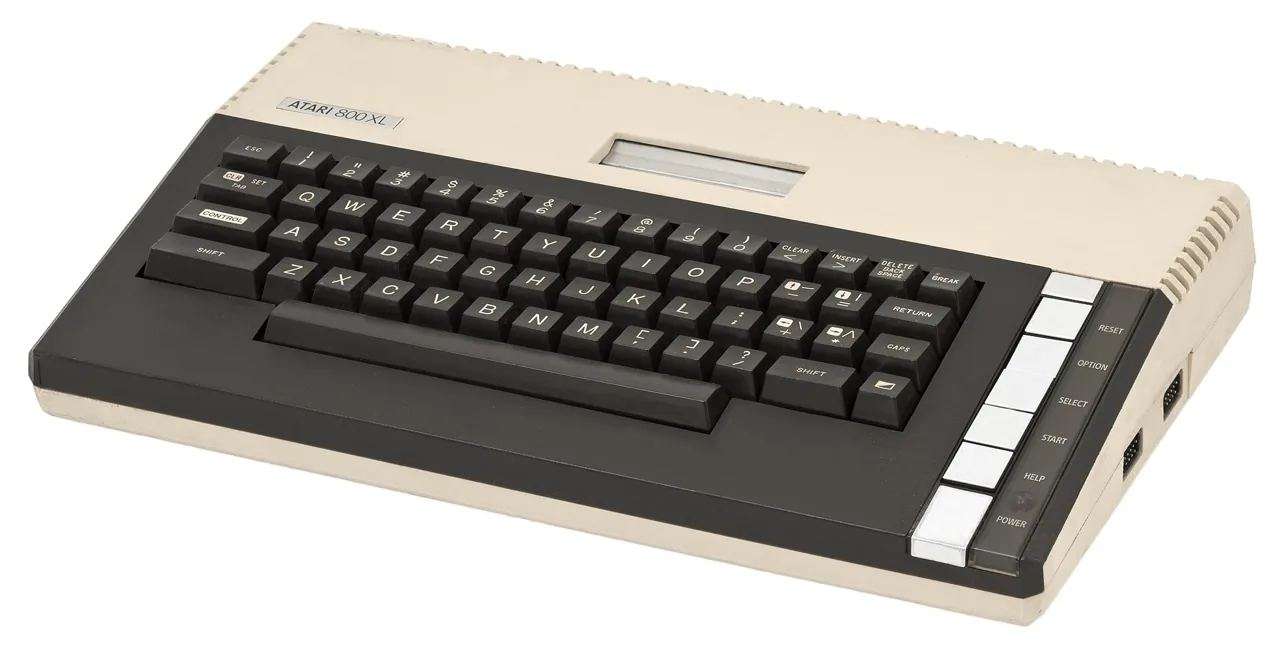
The 800XL was positioned as a modernized successor to the Atari 800, integrating the advanced graphics and sound architecture first introduced in the 1979 model that utilized VLSI technology to deliver high-end capabilities at a consumer price point1. Marketed as the second machine in Atari’s "new generation" line, intended to replace the 400, 800, and 1200XL, it arrived with a suggested retail price of $299, placing it between the $199 600XL and the $499 1200XL1213. By February 1986, production was winding down, signaling the end of an era for Atari’s 8-bit line14.
Under the hood, the 800XL ran a 6502C microprocessor at 1.79 MHz10, with 64K of RAM and 24K of ROM housing both the operating system and the ATARI BASIC Programming Language10. Its design preserved entry points to core ROM routines, ensuring backward compatibility in principle. Yet in practice, changes to the operating system rendered many older programs unbootable116. Atari addressed this with a translator disk available from customer service and user groups for a nominal fee, which disabled the resident ROM and loaded either OS version A (pre-1982) or version B from floppy disk, effectively restoring functionality for legacy software1. Only two official Atari products (States and Capitals and Graph IT) were reported to have issues on the XL platform1.
The machine shipped with a full-stroke keyboard featuring 62 typewriter-style keys, including a HELP key and four special function keys, plus 29 dedicated graphics keys1012. Reviewers noted the key action was tighter and more heavily sprung than competitors’, avoiding the "cheap, loose, and bouncy" feel common in other home computers of the era. It was judged "about as good as a vintage Apple" given its price16. The international character set supported localized use, though physical dimensions, weight, and exact display resolutions remain undocumented in surviving materials.
Graphics and sound were managed by three custom Atari chips: GTIA for display output, POKEY for sound generation and controller I/O, and ANTIC for screen control and input/output management10. The system was advertised as supporting high-resolution graphics with a palette of 256 colors and four-channel audio12. It included a serial I/O connector for peripherals and expansion potential, though specific bus architecture details are absent from the record10.
Software support was extensive: over 2,000 programs were available, including VisiCalc, Home Filing Manager, The Payoff, Pole Position, Summer Games, Gauntlet, Pawn, and Mirax Force810. It maintained compatibility with cassette, disk, and cartridge formats across the Atari home computer range12. Peripherals such as the 1010 Program Recorder, 1050 Disk Drive, 1027 and 1029 printers, Koala Pad, Touch Tablet, Track Ball, and U.S. Doubler were actively supported27815. A bundle priced at 668 DM included the 800XL with 128K RAM and Basic XE5, and users of the 600XL could upgrade to the 800XL for £2515.
Despite Atari’s struggles against the Commodore 64 and TI-99/4A13, the 800XL was regarded as solidly built and suitable for both gamers and programmers16. With over 1,000 authorized service centers in North America, post-purchase support was extensive10. The machine’s legacy rests on its role as the definitive iteration of Atari’s 8-bit line: refined, compatible, and resilient, even as production neared its close.
References
- Byte Magazine Atari Articles
- AtariUser01-May85
- AtariUser03-Jul85
- AtariUser43-Nov88
- Preisliste PL 4 zum Atari Katalog 1985-1 (1985)(Compy-Shop)(DE) (1985)
- AtariUser02-Jun85
- AtariUser04-Aug85
- AtariUser35-Mar88
- 1984 06 BYTE 09-06 Computers and Education (1984)
- Atari new product slicks 1983 (1983)
- Antic Vol 5-08 1986-12 Shoppers Guide (1986)
- Family Computing Issue 01 1983 Sep (1983)
- Introducing IBM PCjr
- AtariUser10-Feb86
- AtariUser40-Aug88
- Electronic Games Issue 33 Vol 03 09 1984 Nov (1984)