Atari 1200XL
Atari Inc. introduced the 1200XL in 1983 as the first model in its XL series, a 64K home computer marketed as a premium machine with built-in diagnostics and an expanded keyboard, though its high initial price and compatibility quirks undermined its position against rivals like the Commodore 64.
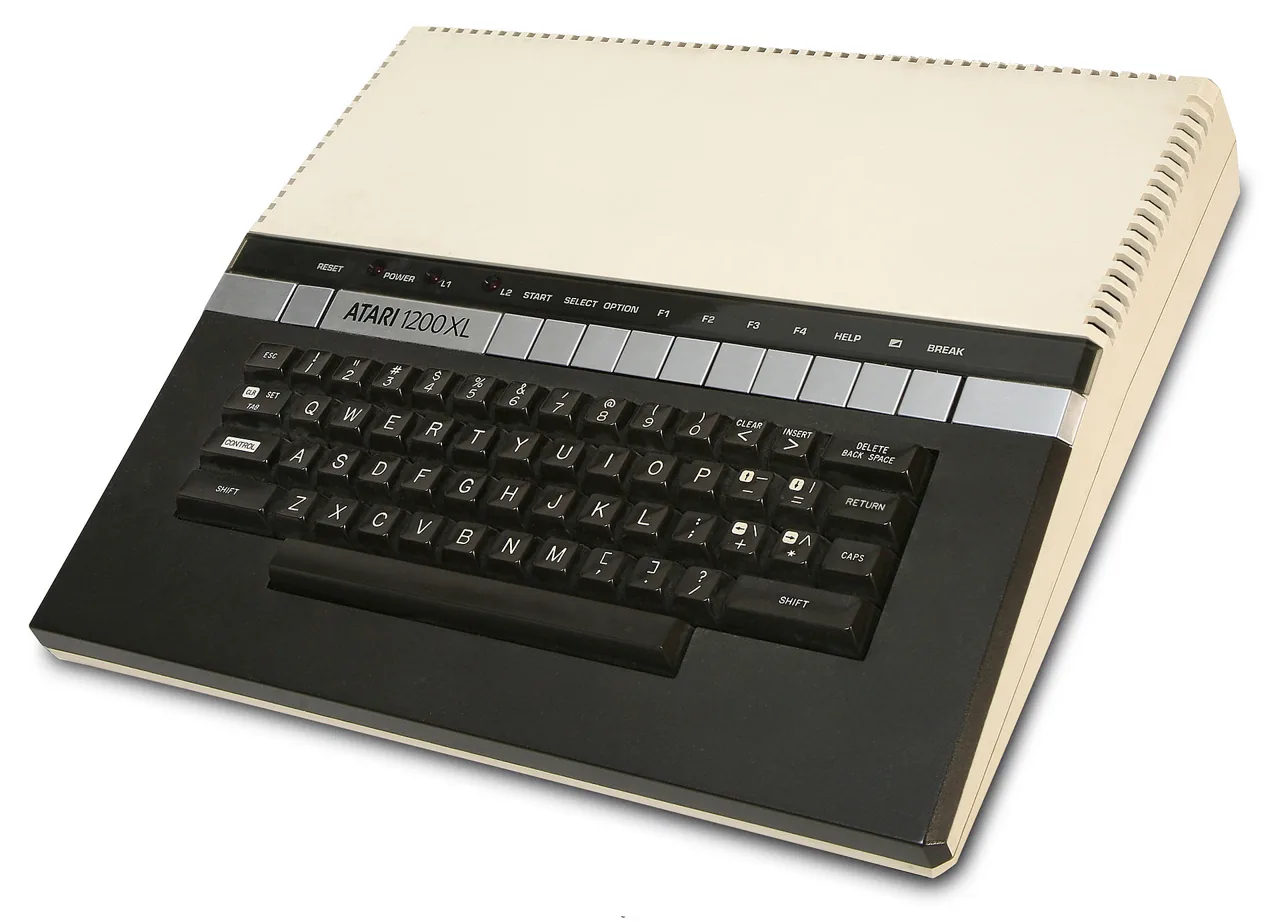
The 1200XL arrived under strained circumstances. First revealed just after Warner Communications’ stock sharply declined, the machine carried a manufacturer’s suggested list price of $995, later reduced to $899, placing it substantially above the Commodore 642. By late 1983, it was advertised for as little as $6002, and one source noted it selling for $499, though another listed it with “CALL” for pricing, indicating inventory uncertainty1016. Its market presence was brief. By mid-1983, rumors circulated that it was about to be discontinued, and within a year it was confirmed as such610.
Internally, the 1200XL held 64K bytes of RAM, but only 48K were normally accessible. The remaining 16K required special software to utilize1235. It featured 11 graphics modes and 5 text modes. Two of those graphics modes were newly introduced “map modes,” including mode 15, a four-color display at 160×1921315. Sound was handled by four distinct voices spanning 3½ octaves, managed by a dedicated microchip that offloaded audio processing from the main CPU1.
The keyboard, housed in a sleek polished steel enclosure, included 12 user-programmable function keys, one-touch cursor controls, and a Help key, features absent on earlier models135. It also supported an integral European character set with currency symbols and special glyphs, accessible via keyboard shift13. A later comparison noted that the 800XL’s keys had shorter strokes and a non-glare finish, but conceded the 1200XL’s keyboard “is still the best of the series”7.
Despite Atari’s claim that the 1200XL was compatible with virtually all existing Atari 400/800 software and peripherals, the reality was more constrained134. It could run official Atari and Atari Program Exchange (APEX) titles, but some third-party cartridges and independent software required address code modifications to function34. The built-in operating system diverged from the 400/800 format, and when Atari changed the system architecture, many programs became unbootable, triggering error messages instead of loading14. The system in the later 600XL and 800XL was described as more refined than the 1200XL’s14.
The machine included a self-diagnostic test program accessible at startup, capable of checking memory and peripherals, a feature highlighted in marketing and service documentation1235. The game cartridge slot was relocated to the left side, a shift from prior front-loading designs3. Notably, the 1200XL lacked a rear expansion slot, a deficiency so prominent that the follow-up 1400XL was specifically designed to correct it. One publication noted the 1400XL’s appearance was “virtually identical” except for that addition6. There was even speculation that warehouse stock of 1200XLs might be converted into 1400XLs6.
Atari positioned the 1200XL as its most powerful home computer at launch, claiming compatibility with over 2,000 programs and seven languages including AtariWriter, Microsoft BASIC, Pascal, and Forth1. Yet contemporaneous reviews expressed skepticism, particularly over price and backward compatibility2. One assessment concluded Atari may have rushed the machine to market2. Within months, it was superseded by the 600XL and 800XL, explicitly designated as replacements for the 400, 800, and 1200XL lines9.
References
- 1983 04 BYTE 08-04 New Chips (1983)
- Electronic Fun Computer and Games Vol 01 10 1983 Aug (1983)
- The Blue Book
- The Blue Book
- Joystik Vol1-6 83-Jul
- Compute Issue 039 1983 Aug (1983)
- MICRO Vol71-0405 84
- Family Computing Issue 01 1983 Sep (1983)
- Introducing IBM PCjr
- micro 61 jun 1983[ocr] (1983)
- Electronic Games Issue 33 Vol 03 09 1984 Nov (1984)
- MICRO Vol61-06 83
- micro 66 nov 1983[ocr] (1983)