Commodore 128
Commodore released the C-128 in 1985 as a dual-CPU, triple-mode home computer with 128K RAM and compatibility with both C64 software and CP/M applications, positioning it as a high-end upgrade path for existing users.
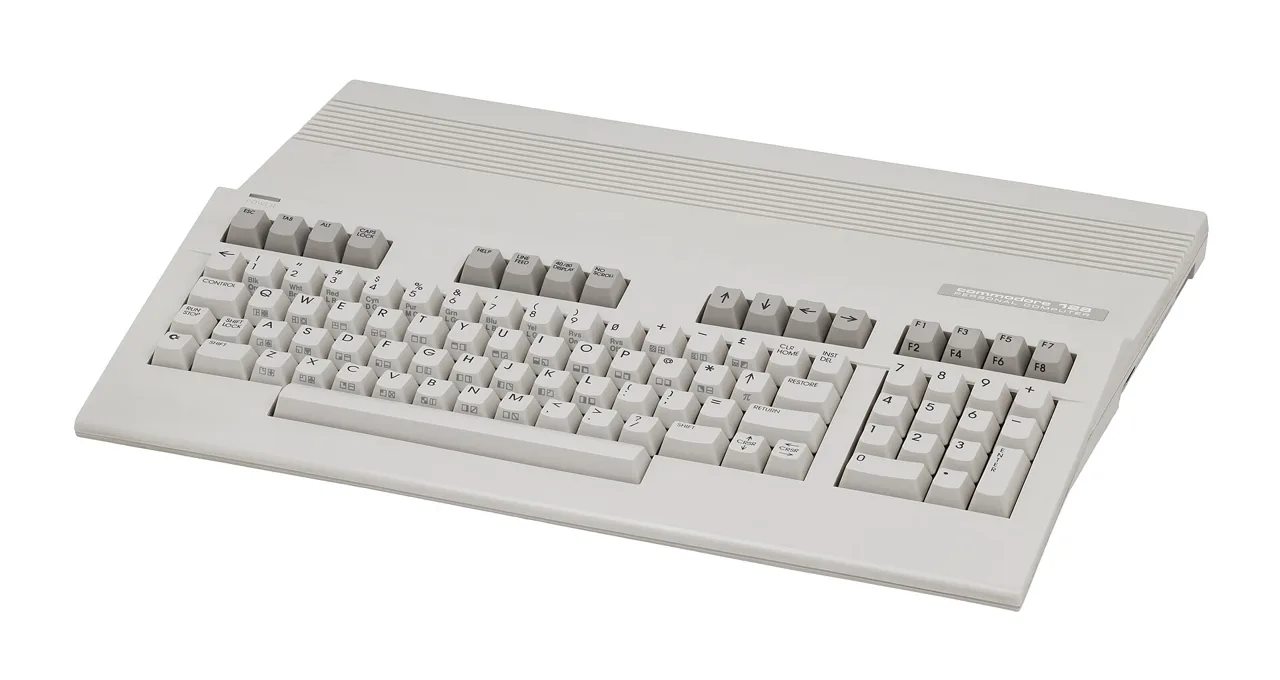
The C-128 was designed to serve as a bridge between the wildly successful C64 and the business computing world, offering three distinct operating modes: native 128 mode, C64 compatibility mode, and CP/M mode121314. This tripartite architecture, described contemporaneously as "drei verschiedene Betriebsarten", allowed users to run legacy C64 software, access enhanced capabilities via Commodore Basic 7.0, or execute CP/M 3.0 applications131459. The machine’s dual-processor configuration centered on an 8502 microprocessor, compatible with the 6502 family and switchable between 1 MHz and 2 MHz operation1314. In C64 mode, the system reverted to using a 6510A CPU running at 1.02 MHz1314.
Memory architecture was a key differentiator. The base configuration included 128K of RAM and 48K of ROM1314, with the ability to expand memory by 512K using external modules, bringing total capacity to 640K1011. The 1750 RAM Expansion Unit (REU) not only enabled this expansion but also supported data transfer rates up to 1 megabyte per second, a notable performance claim for the era10. Video memory was expandable to 64K, required for certain software such as the desktop publishing application NEWS MAKER 1283.
Display output supported both 40- and 80-column text modes, with pixel resolutions of 320 × 200 and 640 × 200 respectively in 128 mode1314. The system retained the C64’s 16-color palette1314, and could drive either RGBI or composite monitors, notably the Commodore 190210. However, some applications required an RGB monitor and a mouse, indicating a push toward more sophisticated graphical environments3.
Storage was initially handled via external drives such as the 1571 and 1581, with the original "Flat 128" model integrating CPU and keyboard in a single case and relying entirely on peripherals2. The later 128D revision introduced a built-in 1571 drive and a detached keyboard, adopting what one Danish publication called "Commodores slanke PC look"59. The 128D was marketed as the "NEW C-128D" with packages explicitly listing the internal disk drive as a feature6.
The keyboard, praised in period reviews as "elegant" and well-styled, included a numeric keypad, a feature absent on the C64 and increasingly expected in professional machines5912. I/O capabilities included a "schnellen seriellen Bus" (fast serial bus) for disk and printer connectivity, along with support for modems like the 1670 and C-166013146. Mouse support was provided through the C-1350 and C-1351 models, and third-party graphics interfaces such as the XETEC Super Graphix series were compatible6.
Software support emphasized backward and forward compatibility. All C64 software could run in C64 mode, and the catalog assured users of "100 per cent compatible" operation112. Native C-128 software, including titles like COMPUTEI'S FIRST BOOK OF THE COMMODORE 128, was explicitly designed for 128 mode and would not function on earlier hardware1. CP/M mode enabled use of business software such as WordStar, dBase II, and The Perfect Series10, though a documented flaw existed: 10 of the 96 characters in the CP/M Plus printing character set were incorrect, causing compatibility issues with standard CP/M print routines8. The editorial response suggested workarounds involving ASCII output and printer mode settings, indicating a layer of technical friction8.
At launch, the C-128 was priced at £199.95 in the UK4, and was expected to be available by autumn 198512. Bundled packages such as the "COMMODORE 128 COMPENDIUM PACK" included the C2N datasette, Music Maker Keyboard, and games like Spirit of the Stones, Jack Attack, and International Soccer4. Other supported software included GEOS CBM 64/128 and Superbase 1284.
Despite its ambitious scope, the C-128 inherited complexities that undermined its usability. The need to manage multiple character sets (PETSCII vs. ASCII), inconsistent printer behavior in CP/M mode, and the requirement for specific hardware upgrades to run certain software reflected a machine stretched across too many use cases. Yet its engineering, particularly the switching between modes and the performance of the REU, demonstrated Commodore’s technical ambition at its peak.
Specifications
| RAM | 128K, expandable to 640K with REU |
| ROM | 48K |
| CPU | 8502 microprocessor (6502-compatible), 1 or 2 MHz |
| Secondary CPU | 6510A at 1.02 MHz (C64 mode) |
| Video RAM | Supports 64K upgrade |
| Display Modes | 40-column (320 × 200), 80-column (640 × 200) |
| Colors | 16 |
| Keyboard | Integrated numeric keypad |
| Storage | External 1571/1581; 128D with internal 1571 |
| Expansion | 1750 REU (up to 512K), fast serial bus |
| Compatible Peripherals | C-1350/C-1351 mouse, 1670/C-1660 modem, XETEC Super Graphix |
| Operating Modes | 128 mode (Basic 7.0), C64 mode (Basic 2.0), CP/M mode (CP/M Plus) |
| Software Compatibility | C64 software, CP/M applications (WordStar, dBase, Perfect Series) |
| Launch Price (UK) | £199.95 |
References
- TheEverythingBookForTheCommodoreC-64C-128HomeComputerwinterspring1987 (1987)
- BBS VOL 06 11 1995 Nov (1995)
- TheEverythingBookForCommodoreAndAmigaComputersholidayEdition
- Your Commodore Issue 38 Nov 87
- RUN (1985) Nr 09 (December) (1985)
- Compute Issue 106 1989 Mar (1989)
- PROTECTO Price Catalog for Commodore 64 and VIC-20
- BYTE Vol 11-10 1986-10 Apple II GS (1986)
- RUN (1985) Nr 09 (December) (1985)
- CommodoreBuyersGuideVol3
- Compute Issue 072 1986 May (1986)
- Computer And Video Games Issue 049 Nov 85
- Run 1985-03 (1985)
- Run 1985-03 (1985)