Commodore Amiga 2000
Commodore’s January 1987 personal computer aimed at corporate and work-at-home users, featuring expandable memory, multiple expansion slots, and built-in multitasking capabilities.
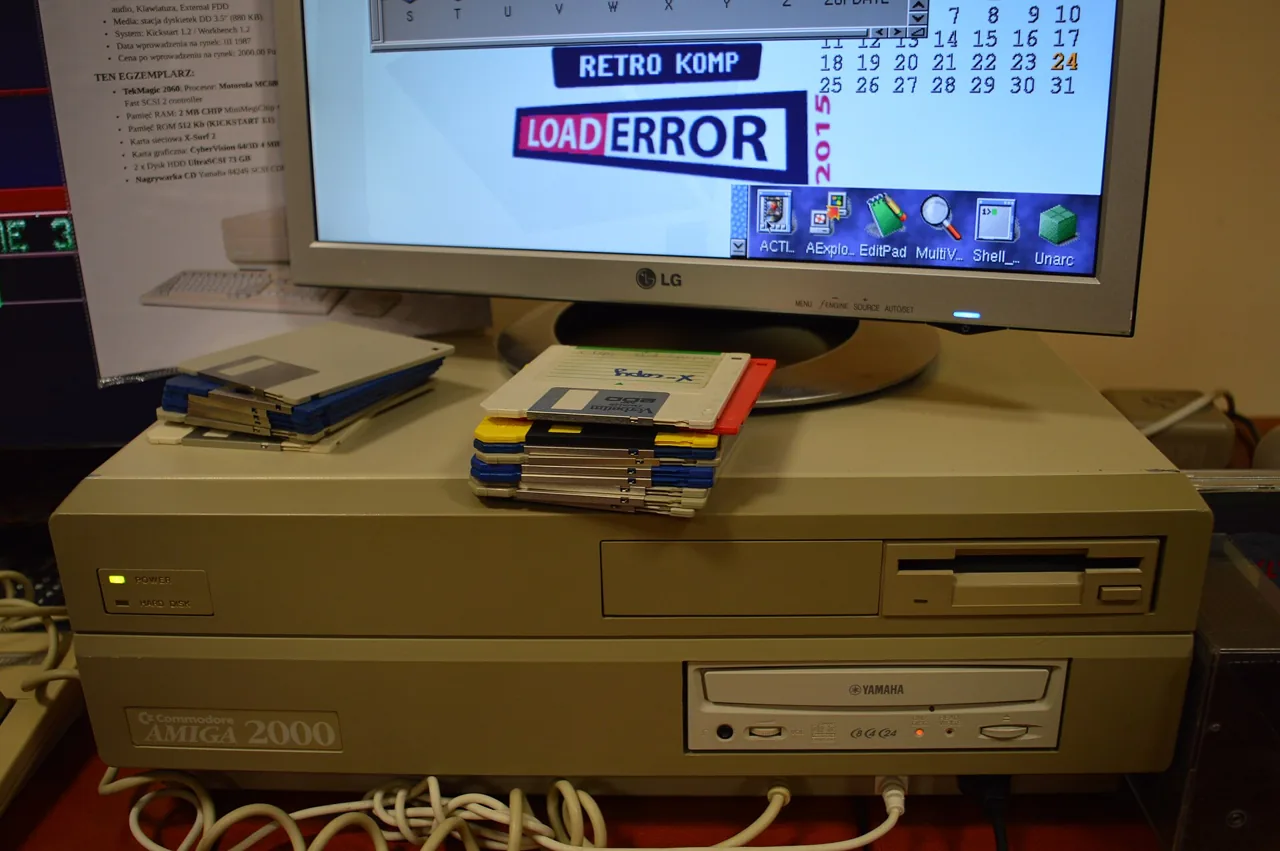
Introduced in January 1987, the Amiga 2000 was positioned not as a home machine but as a serious contender for corporate and telecommuter markets1516. This strategic pivot toward business users already entrenched in DOS-based systems backfired1516. The machine arrived with a suggested retail price hovering just under $1,500 for the base configuration1516, though another source cites a sticker price of $2,195.0026, a discrepancy that reflects either regional variance or bundled configuration differences. Later variants like the Amiga 2000-16/9 and 25/100 carried MSRPs of $2,999 and $4,699 respectively, with pricing valid until June 30, 19911.
The base unit shipped with 1 MByte of RAM26, though a component list in one service document notes a 512 Kb central unit78, a contradiction possibly explained by early revisions or differing interpretations of "central" versus total memory. Expansion was a core design tenet: the system could be upgraded to 9 MBytes of RAM6, and third-party solutions like the GVP 8/2 Memory Expansion offered 2MB (expandable to 8MB) for $1753. The MEGACHIP 2000 add-on allowed users to install 2MB of Chip RAM and 8MB of Fast RAM, mirroring the architecture of the later Amiga 300015.
Its hardware foundation included a single 3.5" floppy drive1516, with space for a second internal unit2, and built-in hard disk control1. The Amiga 2000HD variant included a 40 MB hard drive with 28 millisecond access time and auto-boot capability26. Video output supported interlaced and non-interlaced high-resolution modes at 31.25 kHz1, with one document citing a 640x400 resolution, though this may refer to a compatible monitor rather than the A2000’s native output2. The system included a Genlock video card option and offered both PAL video and monochrome output4. Audio was handled by a four-voice, two-channel system1.
Expansion was facilitated through seven internal slots1516 and an Open System Architecture (OSA) that encouraged third-party development4. The machine supported an internal IBM PC/XT compatibility option2, and the A-MAX Emulator II ($129) was available as a peripheral3. I/O included RS-232 and Centronics ports, composite video, and connectors for VCRs2. The keyboard used a DIN connector78, and the package included a mouse and joystick2.
The system ran a real-time multitasking operating system comprising AmigaDOS, the Workbench user interface, and the CLI command-line interpreter78. AmigaDOS 2.0 became available for the A20009, and users could switch between Kickstart 1.3 and 2.0 ROMs using add-ons like the MULTISTART II5. The base ROM (Amiga 1.3, part number 8850) was available separately for $393.
Commodore offered a trade-in program through March 31, 1990, allowing Amiga 1000 owners to upgrade to the 20001516. This move was widely interpreted as an attempt to clear older inventory and force adoption of the new model1516. The company’s broader marketing missteps, particularly its failure to stabilize the Amiga DOS and its insistence on pushing the platform as a business machine amid a DOS-dominated landscape, alienated both developers and loyal users1516. The Amiga 2500, featuring a Motorola 68020 CPU and 3 MBytes of RAM, was part of the same family26, with a suggested retail price of "SCALL" (call for pricing)26.
The Amiga 2000’s 200-watt power supply was available as a standalone replacement for $14515163, a telling detail for a machine whose expandability demanded substantial internal power. Despite its technical strengths, multitasking, graphics co-processor, sprites, and expandability2, the 2000 suffered from Commodore’s erratic strategy and internal inconsistencies. It was a machine built for professionals, yet delivered without the ecosystem or pricing clarity professionals required.
References
- Amiga World Issue 058 1991 07 IDGC I (1991)
- TheEverythingBookForCommodoreAmigaComputersfall1989 (1989)
- Amiga World Issue 059 1991 08 IDGC I 300dpi (1991)
- Amiga 2000 triptico 01 (2000)
- Amiga World Issue 059 1991 08 IDGC I 300dpi (1991)
- TheEverythingBookForCommodoreAndAmigaComputerssummer1989 (1989)
- Amiga 2000 ESP desplegable 01 (2000)
- Amiga 2000 ESP desplegable 01 (2000)
- Amiga Magazine-25 met Cognition en Metins Software Story
- Amiga Computing Issue 105 Nov 96
- Introduce Yourself to Amiga 1985 Commodore (1985)
- ACs TECH For The Commodore Amiga Volume 3 Number 4 1993-11 PiM Publications US (1993)
- Amiga Joker 1992 05 (1992)
- Amiga Joker 1994 11 (1994)
- TIBUG-1996-03-04 corrected (1996)
- TIBUG-1996-03-04 (1996)