Commodore Amiga 1200
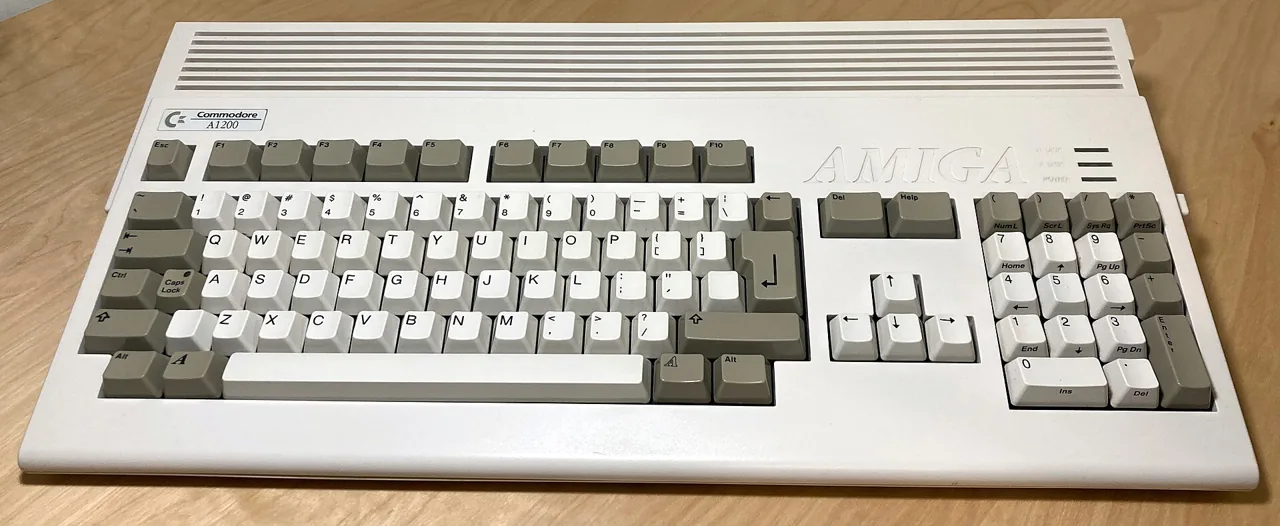
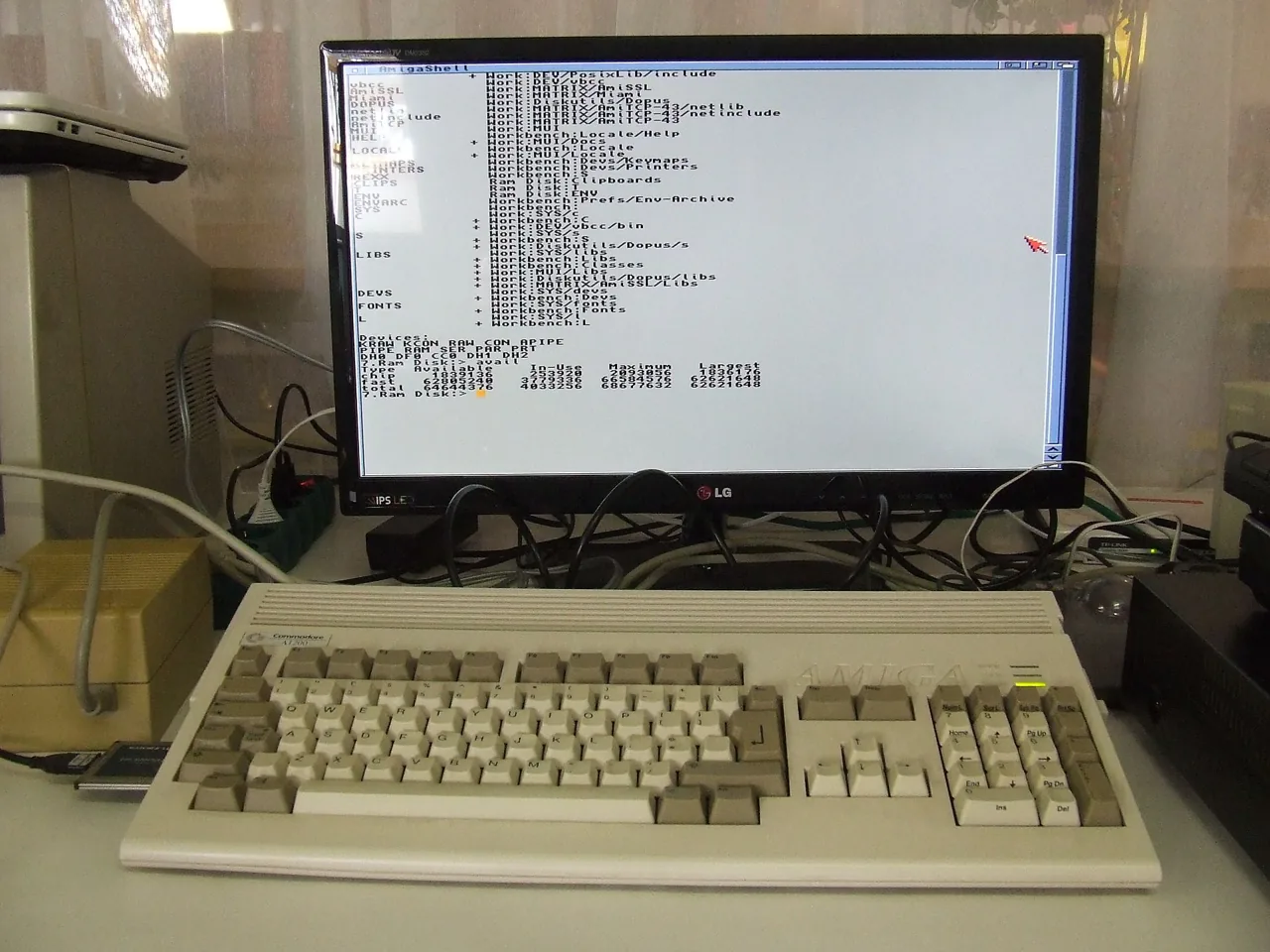
The Commodore Amiga 1200, launched as a home computer and marketed as the "succescomputer" of 1993 and beyond, brought the AGA chipset into consumer living rooms10.
Its German launch price was listed at 548 DM without accessories and 598 DM for the 2MB standard model, though conflicting documentation reports prices as high as 698 DM when bundled with the Magic software package1268. In the UK, the standalone unit retailed for £299.99, while configurations with hard drives ranged from £379.99 (20 MB) to £549.99 (127 MB)4. Bundled storage options in Germany included a 170 MB 2.5" hard drive for 859 DM, a 1.08 GB 3.5" drive for 1,049 DM, and a 850 MB variant priced at 999 DM1711. The system shipped with Workbench 3.1 and, in some configurations, the Magic Softwarepaket257.
Expansion Culture
The A1200’s longevity was defined not by its stock hardware but by the aftermarket ecosystem that rapidly enveloped it. Turbo cards were a dominant upgrade path: the Blizzard 1230 IV offered 50 MHz operation and support for up to 128 MB of RAM, priced at 349 DM111. More aggressive options included the 40 MHz Blizzard 1240 with 68040 CPU (549 DM)7 and the 50 MHz Blizzard 1260 with 68060 (1,199 DM)7. SCSI interfaces enabled connectivity to CD-ROM drives and scanners, with the Sgirrei SCSI interface priced at 129 DM111, and the SCSI II Mastercard for M-TEC turbo cards at 169 DM111. Tower cases, such as the Gold Design (from 299 DM) and the Micronik Infinitiv Tower (399 DM), allowed full desktop rehousing111.
CD-ROM integration was aggressively marketed: 4x, 6x, and 8x CD-ROM drives were available, often bundled with a CD-32 emulator to enable playback of CD32 game titles111. The A1200 Joypad was explicitly promoted as essential for CD-32 games111. Internet access was supported via the Surf Kit (modem and software, 299 DM), Surf Ware (179 DM), T-Online Decoder (139 DM), and TKR Multisurfer (198 DM)7.
Design and Compatibility
The motherboard carried Kickstart 3.1 in ROM. The AGA (Advanced Graphics Architecture) chipset was central to its marketing, positioned as a living-room upgrade path10. It shared monitor compatibility with the high-end A4000, supporting the A1940, A1942, and IDEK MF 5017 (17") and MF 5021 (21") displays68.
An internal floppy drive compatible with the A600 and A1200 was available separately for £3512, and an internal IDE controller for the A4000 (potentially adaptable to the A1200 via Alfapower) was offered with IDE Fix software for £5912. The existence of a "Tower 1200" variant priced at 998 DM suggests factory or partner-supported vertical configurations1.
Market Position and Trade-In
Commodore promoted a trade-in program accepting older Amiga systems with full accessories at "top prices," even allowing upgrades to the A1200 without surcharge12. This aggressive stance reflected both confidence and urgency, as the machine was proclaimed a success before broad market validation. The surviving documentation is silent on production figures, exact release date, physical dimensions, sound hardware, and display resolutions, leaving key technical and historical details obscured. What remains clear is that the A1200 was less a finished product than a platform: an invitation to expand, accelerate, and reconfigure, sustained by a third-party upgrade market long after Commodore’s own support waned.
References
- Amiga Magazin 1996-07 (1996)
- Amiga Joker 1996 06 and 07 (1996)
- ACs Guide To The Commodore Amiga Summer 94 1994 PiM Publications US (1994)
- CUAmiga 046 Dec 1993 (1993)
- Amiga Joker 1996 06 and 07 (1996)
- Amiga Joker 1993 12 (1993)
- Amiga Magazin 1996-09 (1996)
- Amiga Joker 1993 12 (1993)
- Amiga Magazine-25 met Cognition en Metins Software Story
- Amiga Magazin 1996-07 (1996)
- Amiga Computing Issue 105 Nov 96