Commodore Amiga 3000
A machine that didn’t just raise the bar for Amiga—it rewrote the rulebook, then handed it to desktop publishers, video editors, and UNIX tinkerers who had long been exiled to costlier platforms.
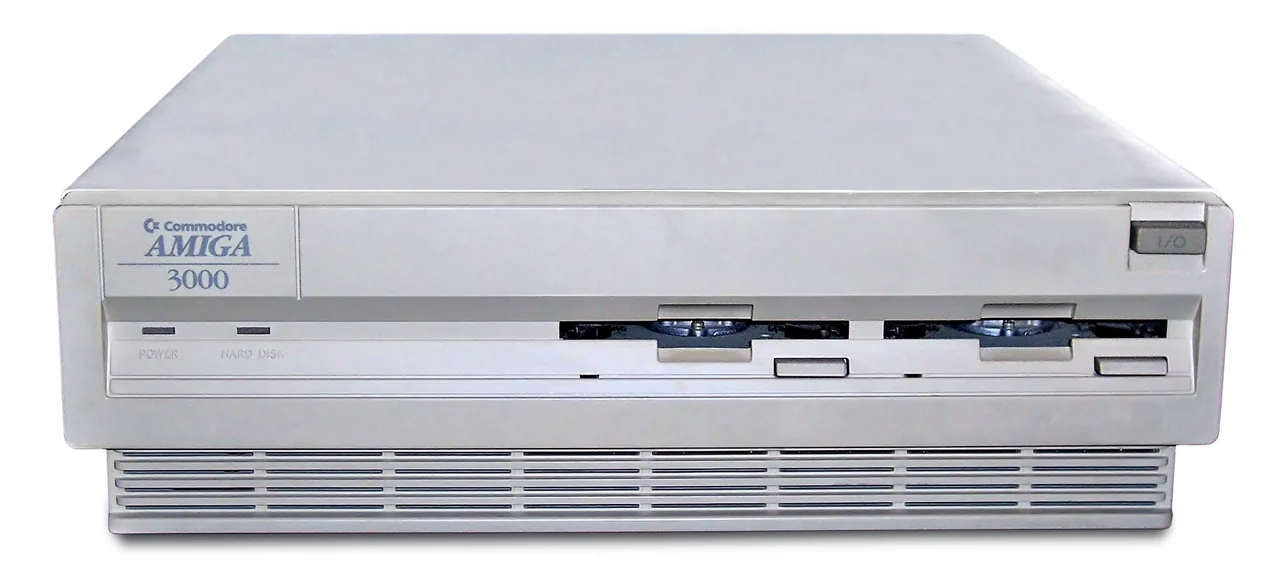
Commodore's first entry into the "super Amiga" tier5, the Amiga 3000 arrived not with a whisper but a documented promise: a 32-bit architecture built around the Motorola 68030 processor121214, a significant leap from the 68000-based machines that defined the earlier Amiga experience. Marketed explicitly as a "workstation in the creative area"12, it was never intended for the bedroom hacker or the casual gamer. This was hardware engineered for tasks like desktop publishing and digital image processing12, a pivot so sharp it effectively declared the Amiga 2500/30 obsolete before the dust had settled12.
The 3000 offered two clock speeds: 16 MHz and 25 MHz1214, with corresponding math coprocessors. The 16 MHz variant used the Motorola 688811214, while the 25 MHz models upgraded to the faster 68882, both clocked in step with their respective CPUs1214. The motherboard included 1 MByte of Chip Memory and 1 MByte of Fast Memory12, expandable to 2 MByte of Chip Memory and up to 16 MByte of Fast Memory internally12. One review noted 6 MBytes of RAM in total, with 2 MBytes designated as chip RAM5, suggesting configurations varied widely in the field.
Storage centered on a built-in SCSI controller1212, described in Danish documentation as retrieving approximately 1.1 MB of data per second14. This throughput justified its "advanced" billing. Hard drives ranged from 40 MB to 100 MB across configurations51415, with model designations like Amiga 3000-25/100 reflecting the 25 MHz CPU and 100 MB drive1215. The machine’s compact footprint—smaller than the Amiga 2000 in both base area and height12—belied its internal complexity, a motherboard designed to route memory, ROM, SCSI, and expansion access over a full 32-bit data bus12.
Video output relied on a nine-pin SubD connector, the same as used by VGA monitors for PCs12, supporting both interlaced and non-interlaced high-resolution video at 31.25 kHz12. Graphics were handled by the Enhanced Chip Set (ECS)5, a refinement over earlier Agnus and Denise chips, though the surviving documentation is silent on exact color depths or resolutions specific to the 3000. Audio remained faithful to the Amiga lineage: four-voice, two-channel sound12, capable but no longer groundbreaking by 1990.
Shipped with Workbench 2.0515, AmigaDOS 2.06, and Kickstart 26, the OS environment was stable and feature-rich for its time. The inclusion of UNIX as a supported operating system15 was a quiet flex. This was not just a multimedia toy, but a machine that could be pressed into service as a proper workstation. Peripherals like the VideoToaster5, genlocks4, and PC emulators5 expanded its utility, though the documentation offers no details on I/O ports or expansion slots.
Pricing was a spectacle. While MSRP ranged from $2,999 for the 16/50 model to $4,699 for the 25/10012, one source claims some configurations originally sold for nearly $20,0005. In Germany, prices spanned 800 to 14,000 Marks depending on configuration12, while UK listings show £1,995 for a 25/40 and £2,295 for a 25/10015. The 16 MHz version, reportedly underpowered for the intended creative workload, was quietly discontinued when demand failed to materialize5.
Available in West Germany from June 199012 and referenced in a November 1990 demonstration folder49, the A3000 was positioned as Commodore’s answer to the Macintosh’s dominance in creative fields. Byte Magazine called it “the most complete multimedia platform you can get in a single box”12, a claim that, while bold, was not without merit. Its integration of video, audio, and expandable processing in one chassis was unmatched at any price. The arrival of the Amiga 4000 later slashed A3000 prices to under $1,0005, and secondhand units now trade around $400–5005.
Perhaps its most lasting contribution was not in sales, but in influence. A large part of the A3000’s technology gradually trickled down to the broader Amiga line6, most notably the release of AmigaDOS 2.0 across all Amiga models6. It was the first Amiga where the high-end no longer felt like a separate species—just a faster, more capable version of the same machine millions already used. That democratization of power, not raw specs, was its true legacy.
References
- Amiga World Issue 058 1991 07 IDGC I (1991)
- Amiga World Issue 058 1991 07 IDGC I (1991)
- Amiga World Issue 059 1991 08 IDGC I 300dpi (1991)
- Carpeta Demostracion AMIGA (a500, a2000, a3000) (2000)
- CUAmiga 046 Dec 1993 (1993)
- Amiga Magazine-25 met Cognition en Metins Software Story
- Carpeta Demostracion AMIGA (a500, a2000, a3000) (2000)
- Amiga Computing Issue 034 Mar 91
- Archive item #64er199007
- COMputer [Det Nye] (1991) Nr 03 (28 Februar - 27 Marts) (1991)
- Commodore User Issue 93 1991 Jun (1991)
- Omni 1990 Aug (1990)