Commodore 64
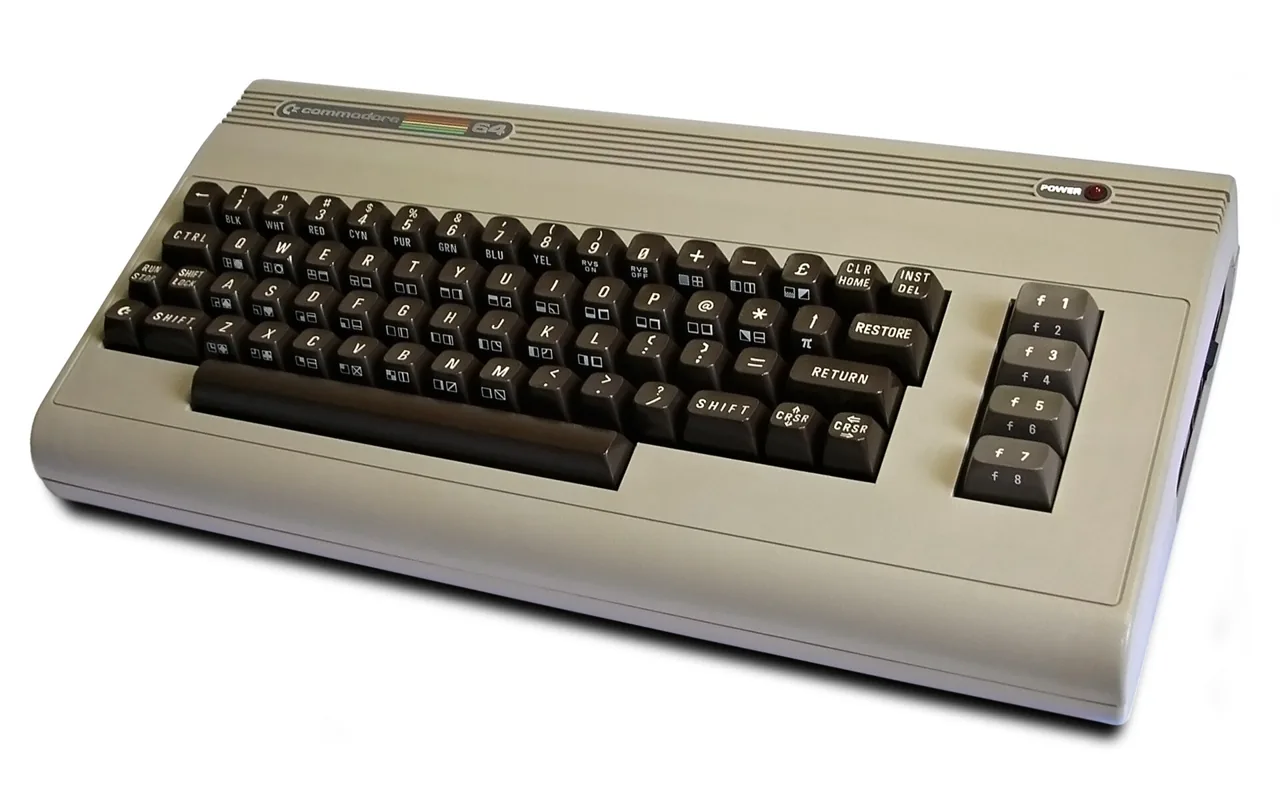
Commodore manufactured the 64K RAM home computer Commodore 64, which became the dominant product in the company’s lineup, accounting for 96% of its sales in fiscal 19839.
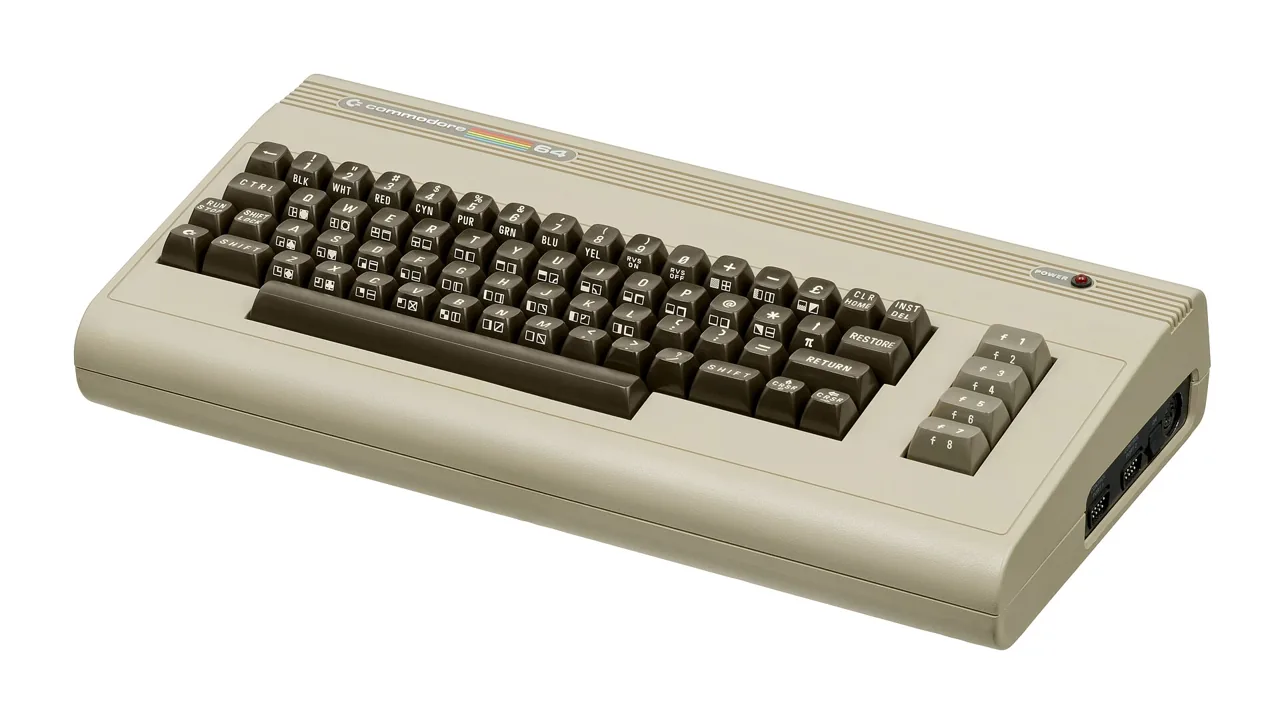
The Commodore 64 emerged from a transnational design effort, assembled by a team in Japan working with American engineers at Commodore5. Though visually similar to the earlier VC-20, the internal architecture was entirely new, marking a conceptual departure despite surface continuity10. The machine centered on the MOS 6510 microprocessor, a derivative of the 6502 with an identical instruction set, capable of addressing 64K of memory, which also defined the system’s maximum memory capacity104. While advertised as having 64K RAM, one source notes the available user memory was approximately 40K, attributing the discrepancy to the inclusion of operating memory and other system functions not typically counted in a machine’s advertised capacity810. Parts of the address space could be dynamically assigned to either RAM or ROM, allowing for flexible memory mapping10.
Storage versatility was a hallmark: the system supported ROM cartridges, cassette tapes, and diskettes, with software distributed across all three media248. Cartridge-based software was particularly common for games, and third-party titles such as Attack of the Mutant Camels, Pharaoh's Curse, and Oubliette appeared in catalogs alongside Commodore offerings2. HesWare, a notable software vendor, released programs for both the VIC-20 and Commodore 642. Productivity software included The Quick Brown Fox word processor and CalcResult, an electronic spreadsheet4.
A key expansion capability was the Z-80 microprocessor cartridge, which transformed the Commodore 64 into a dual-CPU system and enabled use of the CP/M operating system415. This required both the cartridge and Digital Research’s CP/M system disk, but it significantly broadened software compatibility, allowing the machine to run CP/M applications and thereby compete with systems like the IBM PCjr and Apple II415. Despite the shared naming and physical resemblance, the Commodore 64 was not compatible with the VIC-20, a point Commodore explicitly clarified in renaming the machine from its initial "VIC-64" designation to avoid consumer confusion8. Only a narrow subset of floppy-based software designed for both systems could be shared, and such titles were scarce8.
By mid-1983, production had scaled sufficiently for international rollout, with reviews in periodicals such as PCW9. Mike Curtis, reviewing in May 1983, characterized the machine as a professional, high-quality update to a proven architecture, comparable to the Apple IIe in its evolutionary approach, rather than a radical innovation9. Commodore supported the platform with a series of manuals, the first of which appeared in early 1983, with planned follow-ups on CP/M, music, and BASIC programming5. A 12-page software catalog debuted alongside the machine at the Consumer Electronics Show, signaling strong initial software backing5.
Pricing varied widely by region and time: U.S. prices reportedly dropped to around $400, with some units sold for under $200, while in New Zealand the machine carried a price tag of $1,295 NZD413. The machine’s affordability, expandability, and software library positioned it as a major competitor in the home computer market4. Later catalogs listed the Commodore 64 alongside the 128 model, suggesting a shared product trajectory, though the fact sheet does not detail their technical relationship67.
References
- The Games Machine Issue 33 Aug 90
- Electronic Games Issue 22 Vol 02 10 1983 Dec (1983)
- Compute Gazette Issue 07 1984 Jan (1984)
- Introducing IBM PCjr
- Commodore Magazine (Australia) Vol 3 Iss 2 1983 (1983)
- Sierrafall1988 (1988)
- SierraCatalog1987 (1987)
- Electronic Games Issue 19 Vol 02 07 1983 Sep (1983)
- Computers that made Britain v1
- Hofacker - Beherrschen sie ihren Commodore 64 (C. Lorenz)
- The Commodore 64 Connection
- Your Computer Issue 046 (1985 05)(IPC Electrical-Electronic Press)(GB) (1985)
- NZ-bits-and-bytes-issue-2-01
- YourComputer 1985 01 (1985)
- Compute!'s Commodore Peripherals, A Users Guide
- micro 57 feb 1983[ocr] (1983)