Apple IIe
Apple released the IIe as a cost-reduced, more capable successor to the Apple II Plus, standardizing 64KB RAM and offering switchable character sets for international use, with its production footprint shrinking to just a few dozen chips.
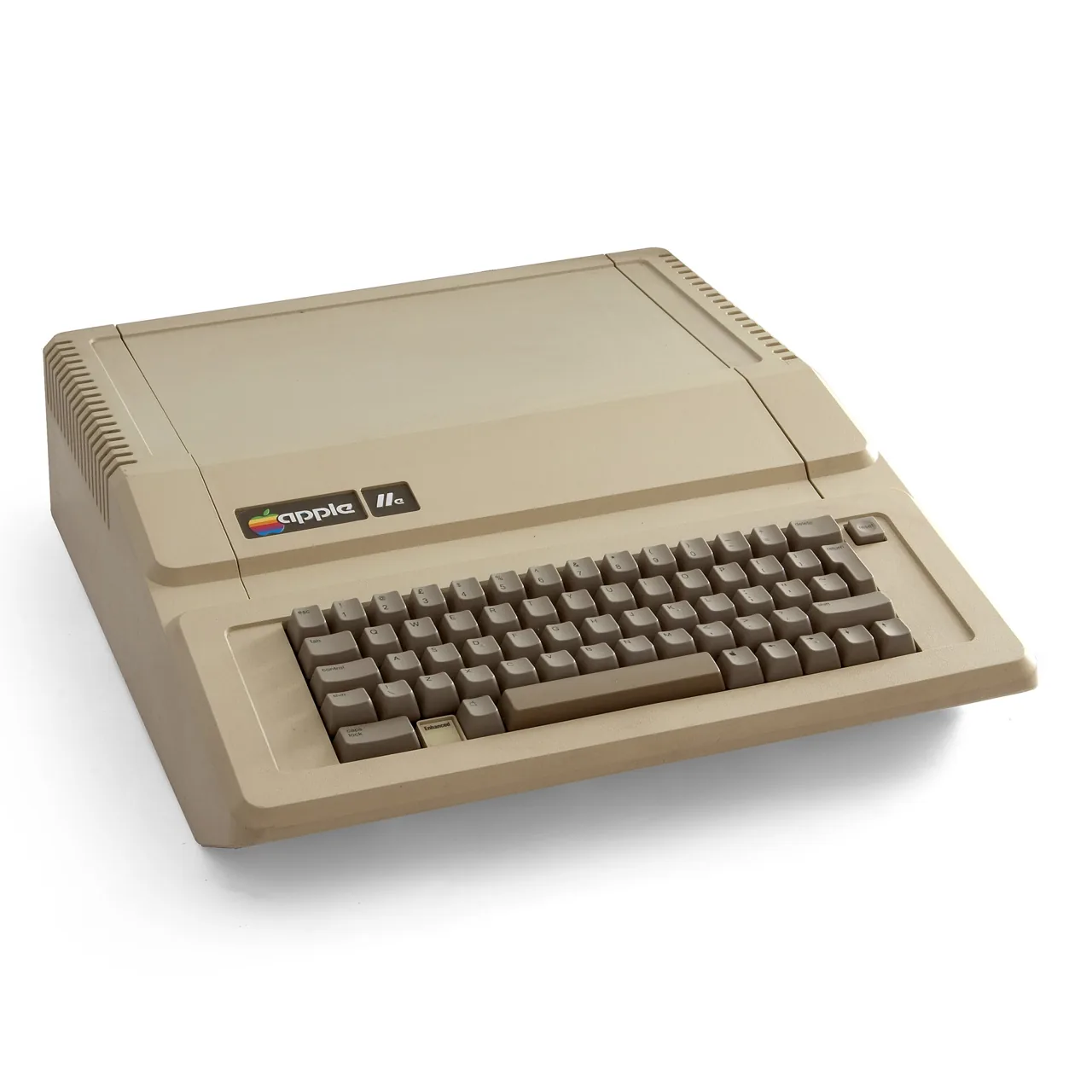
The Apple IIe arrived amid conflicting reports on its debut year (1983 in some accounts, 1984 in others), but its role was unambiguous: a streamlined evolution of the Apple II Plus, engineered for lower manufacturing cost and broader usability2. With only a few dozen chips on the motherboard, the design marked a significant reduction in component count compared to its predecessor, lowering production expenses while improving reliability1213. It retained full backward compatibility with earlier Apple II software, ensuring a smooth transition for existing users2.
Standard configuration included 64KB of RAM, though some sources list an initial 48KB2310. A later 128KB model emerged, often paired with an 80-column text card and softswitch support, enabling access to extended memory and enhanced display modes3. The 80-column capability, absent in the base machine, required an add-in card. This card also provided a special 40-column screen mode for compatibility215. The keyboard, inherited from the Apple III, introduced upper/lowercase typing and a switchable layout between ASCII and the German character set, a rare concession to non-English users in Apple’s early lineup23. Physical keys included OPEN-APPLE, SOLID-APPLE, and SHIFT, central to the machine’s command structure15.
Two years after the original IIe, Apple introduced an Enhanced version featuring the 65C02 processor and 128KB of RAM2. Existing owners could upgrade via an enhancement kit priced at $702. The line culminated in the Platinum IIe, released in January 1987, which carried forward nearly the same keyboard as the Apple IIGS and continued production until 1993, when Apple officially ended the entire Apple II series2.
Pricing varied significantly by configuration and region. The Apple IIe 64K with 40-column display listed at $1,175, while the 128K 80-column model reached $1,39510. A full Starter System (System A), including 64K, 80-column card, Disk II drive with controller, Apple Monitor III, and stand, carried a $1,750 price tag10. Other listings noted figures of 899 and 750 without specifying currency16.
Software support remained strong well into the late 1980s. The IIe ran CP/M via a Z80A (4 MHz) or Z80B (6 MHz) card, the latter requiring an additional 64KB RAM7. The extended 80-character card also included 64KB of supplementary RAM7. Notable applications included Apple Works, Apple Pascal, Superbase, WordStar, and Intuit’s Quicken91416. BPI Systems offered a suite of ProDOS-based accounting tools, while MVP-FORTH provided a professional development environment614.
By the late 1980s, the Apple IIe had become the dominant machine in U.S. school computer labs11. Institutions had invested heavily in educational software libraries and site licenses, creating inertia against migration to MS-DOS platforms11. One administrator lamented, “I would love to update my computer lab with MS-DOS PCs. But I don't want to discard all my Apple IIe software programs!”11. This entrenched software base extended the IIe’s relevance long after its technical specifications had grown outdated. The Apple IIe Card for the Macintosh LC later served as a dedicated hardware emulator, preserving access to legacy applications within Apple’s evolving ecosystem2.
Specifications
| RAM (standard) | 64 KB |
| RAM (Enhanced) | 128 KB |
| Processor (Enhanced) | 65C02 |
| Keyboard features | Upper/lowercase, switchable ASCII/German character set |
| Display expansion | 80-column card (add-in) |
| Special keys | OPEN-APPLE, SOLID-APPLE, SHIFT |
| CP/M options | Z80A at 4 MHz or Z80B at 6 MHz with additional 64 KB RAM |
| 80-column card RAM | Additional 64 KB |
References
- 1984 08 BYTE 09-08 Modula-2 (1984)
- Computers that made Britain v1
- ComputerPersoenlich 84 03
- ComputerPersoenlich 83 19
- 1984 06 BYTE 09-06 Computers and Education (1984)
- PERSONAL COMPUTING JULY 1983 (1983)
- MICRO Vol64-09 83
- micro 64 sep 1983[ocr] (1983)
- Apple Pascal Update v1.1
- AcornUser081-Apr89
- Compute Apple Vol 05 02 Issue 06 1987 Dec (1987)
- 1984 12 BYTE 09-13 Communications (1984)
- TrackstarBrochure