Apple IIgs
Apple Computer Corporation's 16-bit evolution of the Apple II series, released in late 1986 with a 65C816 processor and expandable memory, targeted at developers and high-end users despite its steep price.
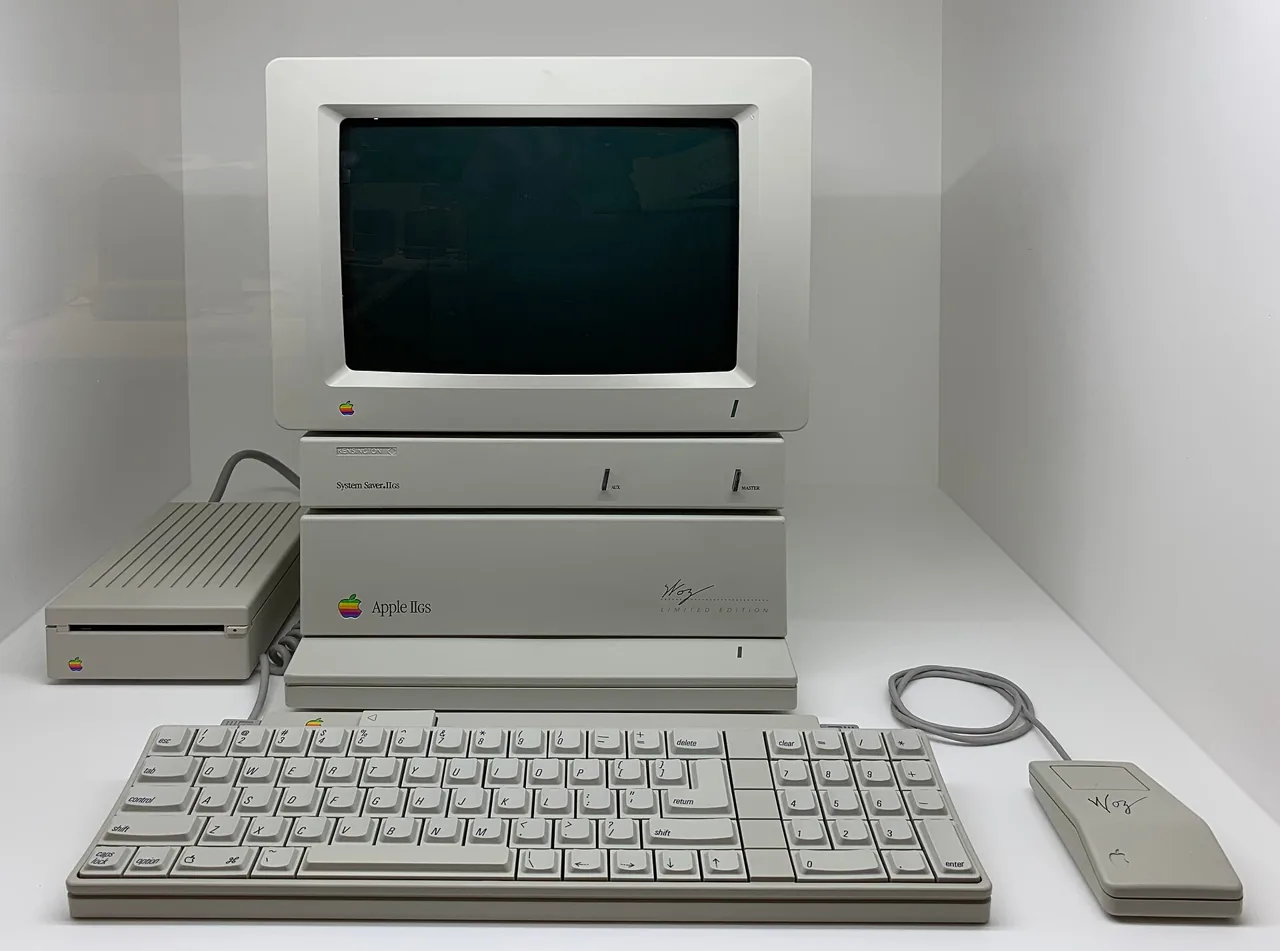
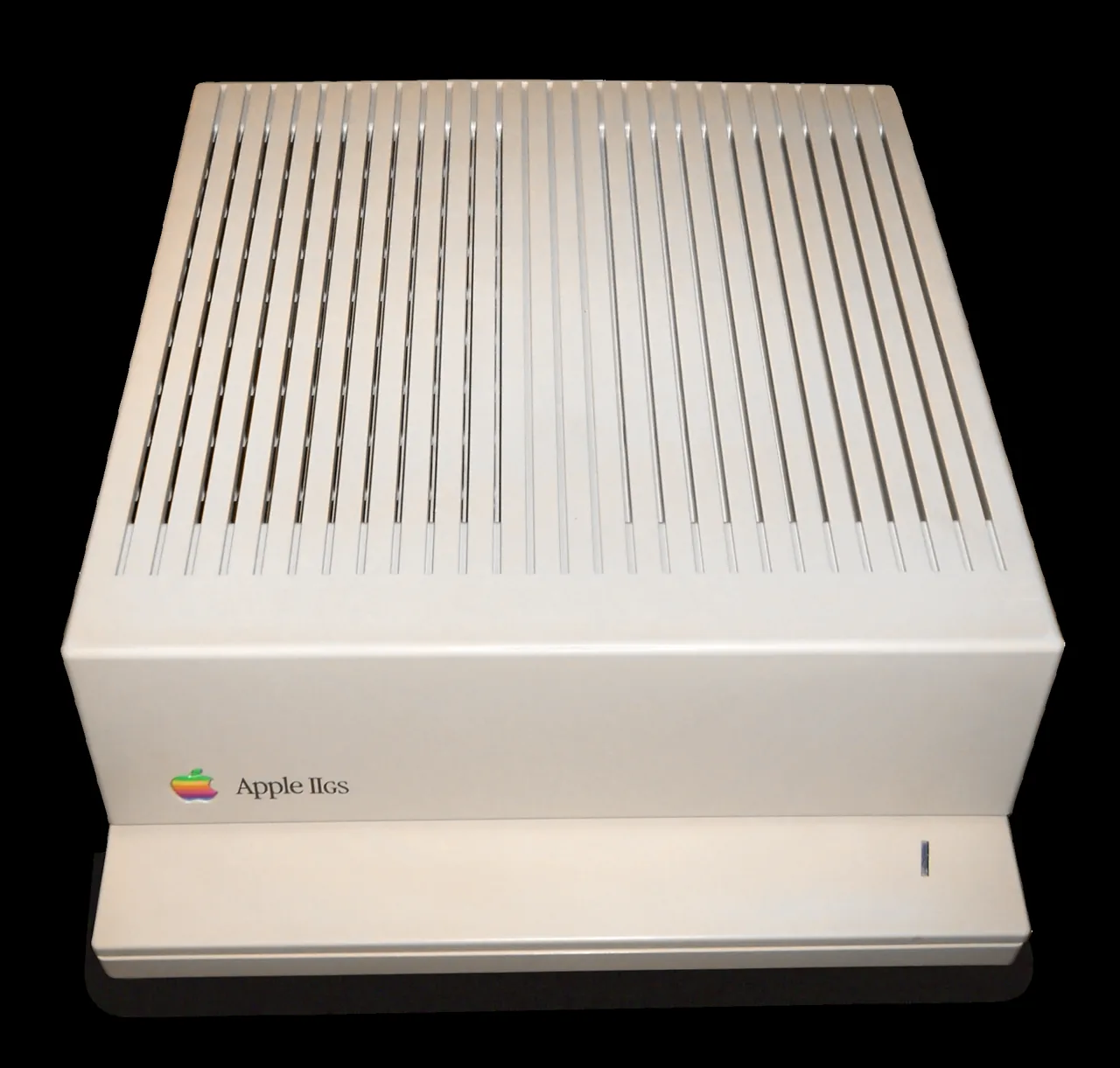
The Apple IIGS emerged from a fog of internal ambiguity, arriving in late 19867. Its designation, “GS,” hinted at ambitions beyond mere compatibility, yet its identity was muddled from launch; even at Apple, documentation was sparse and awareness low7. This opacity sparked an unusual grassroots response: a cadre of developers began pooling discovered technical details, forming an ad hoc knowledge network long before official resources caught up7.
The machine centered on the 16-bit 65C816 microprocessor, running between 1.0 and 2.8 MHz15. The base configuration shipped with 512 Kbyte of RAM, expandable to 8 Mbytes, though certain applications demanded more: HyperCard IIGS, for instance, required at least 1.5 MB2. It included 128 Kbytes of ROM, upgradable to 1 Mbyte, and later ROM revisions (notably version 04 GS) promised significant enhancements: a graphics coprocessor, a jump to a 7 MHz 65816, and a new 16-bit expansion slot standard3. These upgrades were documented in developer bulletins like STR411.TXT.generated, revealing Apple’s roadmap for the platform3.
Graphically, the IIGS supported up to 650 horizontal by 195 vertical dots, with 16 colors available on screen simultaneously15. It offered both high- and low-resolution display modes and supported either monochrome or color output15. The keyboard retained the standard QWERTY layout with a 14-key numeric pad, but included firmware-level support for Dvorak and nine international layouts via the Control Panel15. Eight internal slots were provided, one reserved for memory expansion, and seven general-purpose I/O ports enabled peripheral connectivity15.
Its operating system, GS/OS, was available in version 5.0 and evolved through at least 5.0.2. Version 5.0.4 or later was required to run HyperCard IIGS, a port of the landmark hypermedia environment2. GS/OS 6.0 was rumored to include a SCSI Manager, aligning with the release of the Apple II High-Speed SCSI Card34. The Apple IIGS Video Overlay Card also extended multimedia capability, supported by a dedicated development kit24.
Software support was real but constrained. Titles like King of Chicago and the King’s Quest series appeared in native IIGS versions, and productivity tools such as Drawing Table and Audio Animator leveraged its enhanced audio and graphics8101214. Developer tools including MPW IIGS, APW, AppMaker/GS, and beta drafts of the Toolbox and GS/OS references indicated serious investment in the platform’s programmability4. AppleShare File Server software allowed the IIGS to function on AppleTalk networks using LocalTalk cables, reinforcing its role in educational and small-office settings1.
Yet the machine’s trajectory was hamstrung by cost. Priced at $2,660 for the 512 Kbyte model and $1,299 for a color monitor in Australia in 198715, it faced a subsequent price increase, blamed on DRAM shortages, shocking users and further limiting its installed base5. Fewer units in circulation meant fewer incentives for developers, creating a feedback loop that stifled growth despite the machine’s technical promise5.
The Apple IIGS thus occupies a paradoxical place in the lineage: a machine of genuine innovation, equipped with firmware and software tools that hinted at a future beyond 8-bit roots, yet held back by pricing and internal neglect. It became, by necessity, the machine for those with both technical curiosity and deep pockets: the Apple of choice not for the mass market, but for those willing to extract its capabilities from silence and speculation12.
References
- AppleTalk Network User's Guide for the Apple IIGS (1989) (1989)
- APDAlog 199104 (1991)
- STR411.TXT.generated
- APDA Recent Releases 199005 (1990)
- Compute Issue 104 1989 Jan (1989)
- Apple Direct Vol 2 No 10 199007 (1990)
- 1988.08 Your Computer August 1988 (1988)
- MindscapeInc.ProductCatalog1987 (1987)
- VirginMastertroniccatalog-1989 (1989)
- Compute Apple Vol 05 02 Issue 06 1987 Dec (1987)
- Archive item #963826
- Compute Issue 100 1988 Sep (1988)
- Sierrafall1988 (1988)
- SevenNewAdventuresFromSierraAndTigersoftware1989 (1989)
- 1987.04 Your Computer (1987)