Apple Lisa
Apple Computer, Inc. released the Lisa in January 1983 as a personal computer featuring a bit-mapped display, mouse-driven interface, and multitasking operating system, priced at $9,995.
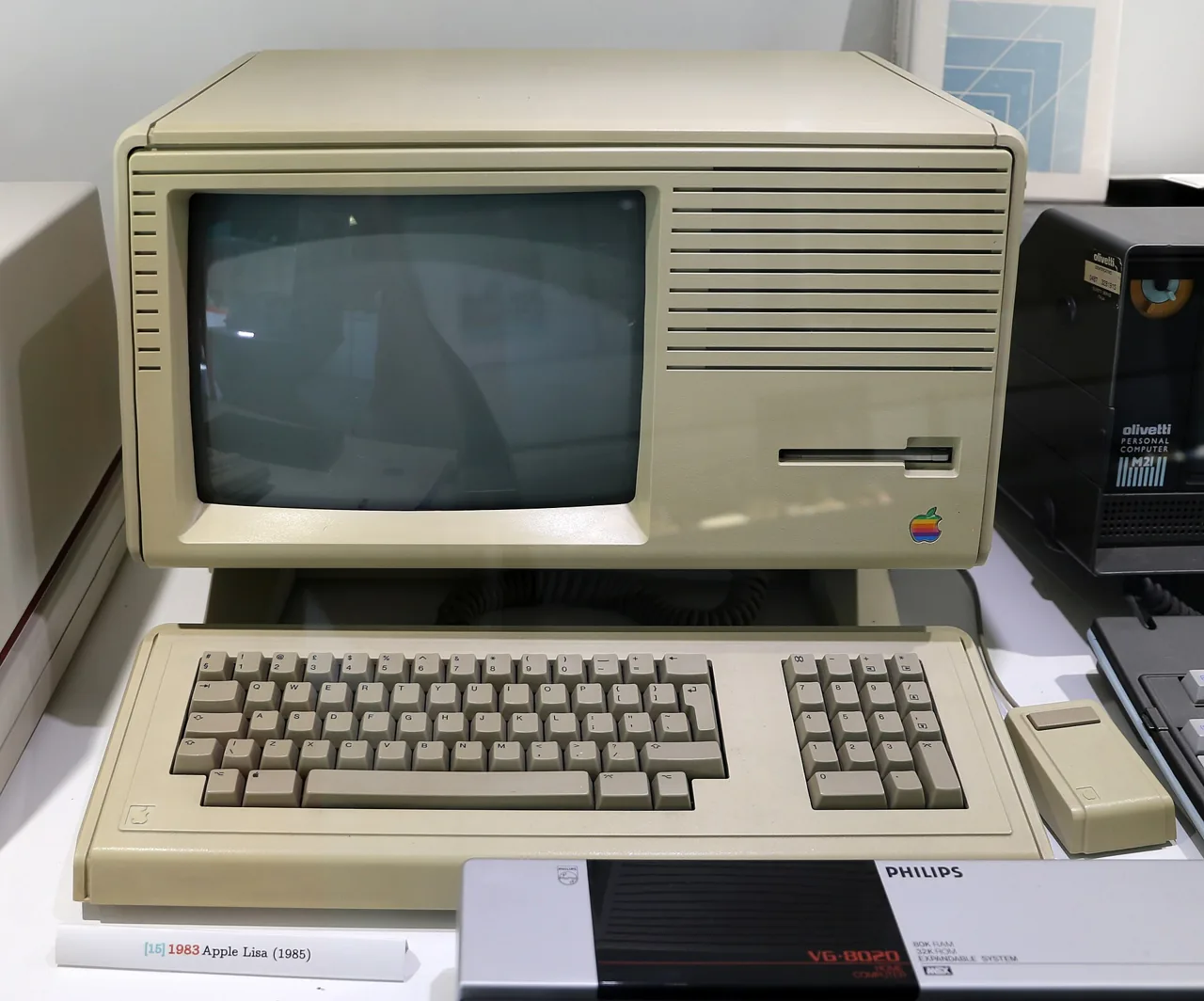
The Lisa arrived with a 32-bit Motorola 68000 processor and 1 megabyte of RAM standard, expandable to 2 megabytes24715. Its display rendered 364 lines by 720 dots per line at a 60 Hz refresh rate, driven by a 20 MHz dot clock and horizontal line rate of 22,900 Hz16. This high-resolution black-and-white 12-inch screen contained more than a quarter million addressable points, enabling the graphical user interface to render windows, icons, and proportional text with unprecedented clarity for a desktop machine215.
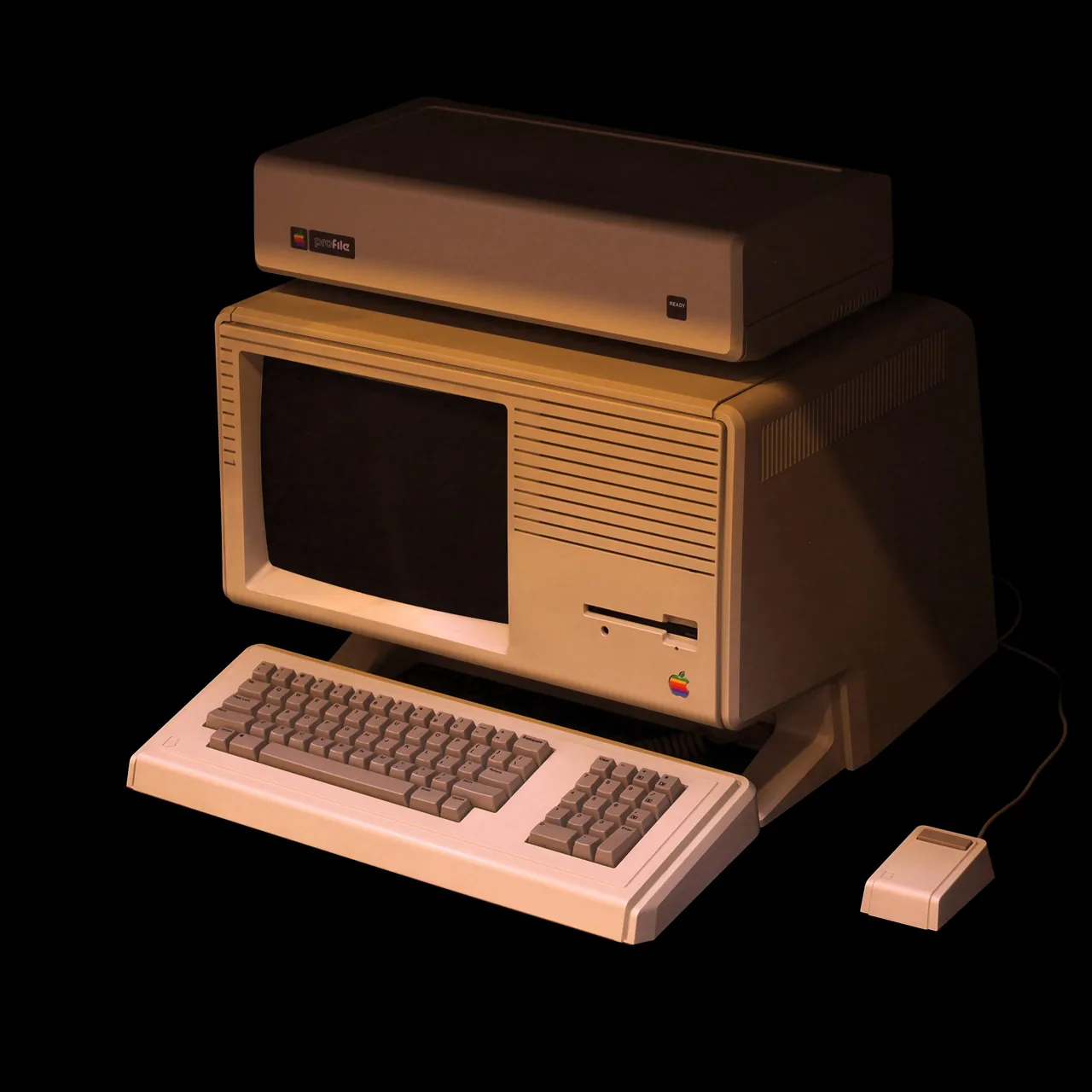
Storage relied initially on two proprietary 5-1/4" "Twiggy" floppy drives, providing a total of 1.7 megabytes of formatted storage capacity2715. These drives, reportedly unreliable, contributed to early criticism8. An external Apple ProFile 5-megabyte hard disk was available as a peripheral37. The machine shipped with a keyboard and mouse, both included in the base configuration2.
The Lisa Operating System was a single-user, multi-process environment written almost entirely in Pascal, approximately 90,000 lines, making it unusually accessible to developers for its time123. Each core application in the Lisa Office System (later branded Lisa 7/7) contained roughly 50,000 lines of code12. The suite included LisaWrite, LisaDraw, LisaCalc, LisaGraph, LisaProject, LisaList, and LisaTerminal1. Development tools such as Lisa Pascal ($595), Lisa Workshop, and the Lisa Monitor environment supported third-party work, and 165 developers were reportedly active in the ecosystem by late 198425. The LisaGuide interactive tutorial, included with each unit, functioned as an "interactive manual" to onboard users16.
Hardware design emphasized multitasking capability through a memory management unit and specialized support circuitry34. The system’s architecture, officially an acronym for "Local Integrated Software Architecture," was described internally as exceptional for its integration and ease of use47. Expansion was possible via at least one slot, with documentation referencing an Expansion Slot Configuration Status Check10.
Despite a development effort costing $50 million and consuming 200 man-years of labor, nearly all of Apple’s resources at the time, the Lisa struggled in the market12. Priced at $9,995, it sold approximately $100 million worth in its first year128. A user report in 1985 stated that Apple had sold approximately three quarters of a billion dollars worth of Lisas and XLs12. International distribution began in October 1984, with units shipped from a new manufacturing plant in Cork, Ireland to Australia, New Zealand, France, Germany, and Britain5.
Its commercial failure stemmed from multiple factors: the high price, persistent disk drive issues, and Steve Jobs’ premature public promotion of the Macintosh, which cannibalized Lisa sales8. Jobs had also insisted on using Apple’s flawed in-house floppy drive design, rejecting more reliable alternatives8. By April 1985, Apple discontinued the Lisa in favor of the Macintosh, folding the Lisa team into the Mac division a year after the Mac’s introduction128. One internal assessment later called the Macintosh "version 2.0 of these ideas"8.
Plans to support a laser printer were abandoned despite Apple possessing a $30,000 laser printer used internally by Lisa developers12. Third-party support faltered, and users expressed frustration at Apple’s waning commitment: "What has been so terribly hard to handle is the refusal of third party software and hardware developers (Apple, especially!) to take the Lisa seriously"12. Migration kits were offered, such as the Microsoft+ kit including Word, File, Excel, and MacTerminal, for $450, suggesting an official pivot toward Mac transition5.
Though commercially unsuccessful, the Lisa’s technical legacy was foundational. Its user interface development predated the Macintosh, and future Apple products were expected to benefit from its 200 man-years of investment through document compatibility and emulation413. One engineer noted, "Without the early work done by the Lisa team, there would not be the Macintosh we know today"13. The machine supported CP/M, Xenix, and projected Unix-type operating systems, with MS-DOS and Concurrent CP/M expected by 198434. It could exchange text files with Apple II and Apple /// systems, maintaining some cross-platform utility4.
References
- Craig - The Legacy of the Apple Lisa Personal Computer - An Outsiders View 199302 (1993)
- Craig - The Lisa Computer a Retrospective CHAC V2N1 199407 (1994)
- Lisa Sales Marketing Binder Feb84
- Lisa Dealer Presentation 1983 (1983)
- The LisaTalk Report V01 N02 1985 Winter (1985)
- Lisa 2 Owners Guide 1983 (1983)
- Dines - The Lisa A Case History 1985 (1985)
- Hawkins - Lisa History 19940207 (1994)
- The LisaTalk Report V02 N02 1986 Summer (1986)
- Lisa 2 Owners Guide 1984 (1984)
- The LisaTalk Report V02 N01 1986 Spring (1986)
- The LisaTalk Report Sample 198510 (1985)
- Perkins - Inventing Lisa Interface CPSR email 199606 (1996)
- The LisaTalk Report V01 N01 198509 (1985)
- Lisa System Hardware Brochure May83
- Lisa Owners Guide 1983 (1983)