Motorola 68000
The Motorola 68000 was a 16/32-bit microprocessor introduced in the early 1980s that became central to high-end personal computing and workstation design, notable for its expandable architecture and adoption in systems requiring multitasking and graphical interfaces.
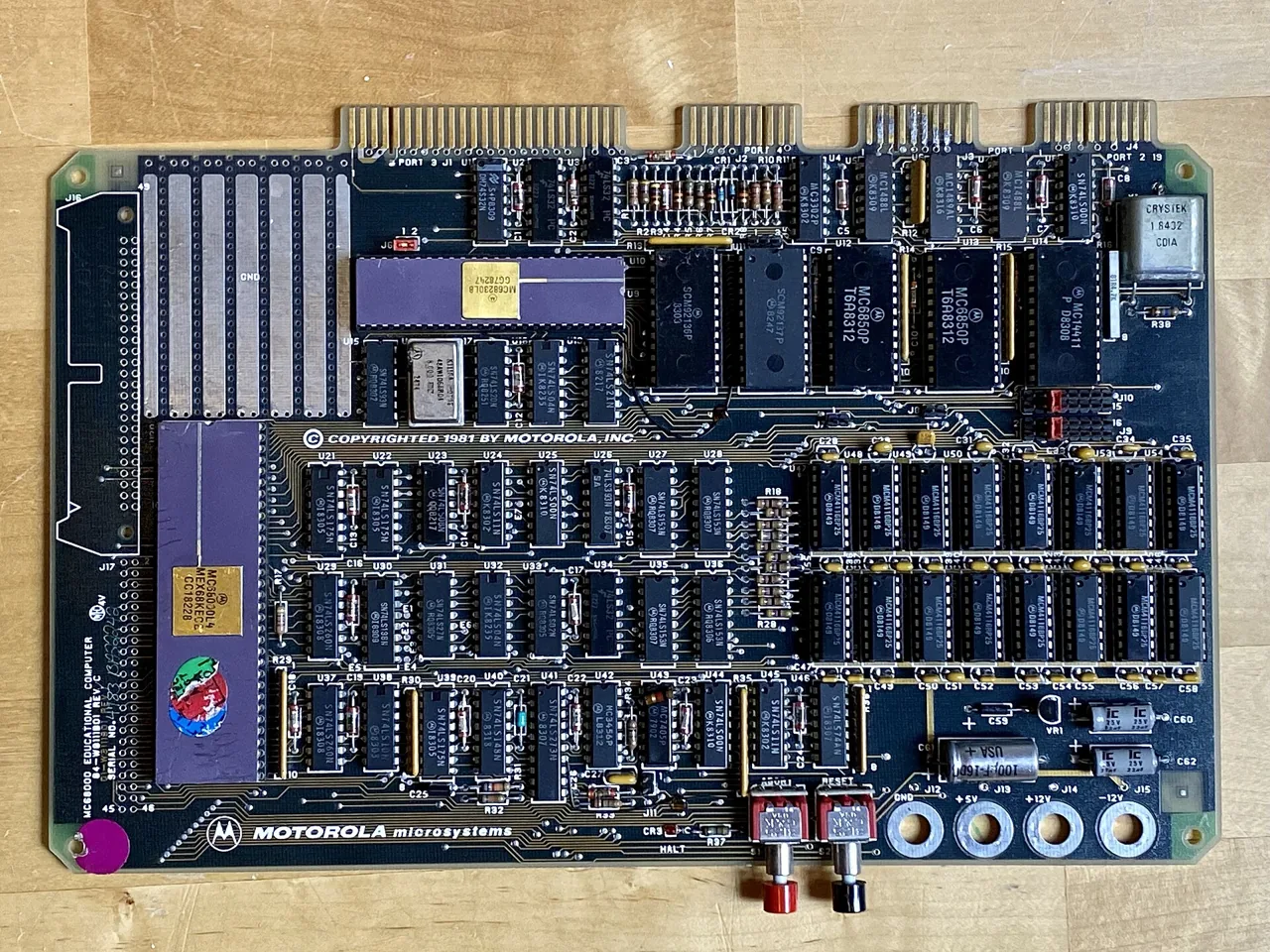
Motorola designed the 68000 with a deliberate philosophy: a simple instruction set paired with flexible addressing modes, compatibility with existing 6800-series peripheral hardware, and a suite of programming features meant to ease migration for engineers familiar with earlier Motorola chips34. This approach paid immediate dividends. The chip’s instruction set, though compact, included special instructions unique to the 68000, such as those enabling dual processing states and data movement from 6800 peripherals, giving it an edge in system integration34. Its microprogrammed architecture allowed Motorola to refine behavior at the firmware level, a flexibility uncommon in contemporary designs34.
At the hardware level, the 68000 featured a 16-bit data bus34 and operated at a clock speed of 7.16 MHz in at least one documented configuration16. Though marketed as a 16-bit processor, it earned the designation of a 16/32-bit CPU16. The chip was explicitly designed to be expandable. Motorola stated that future expandable features would be defined by the company itself, suggesting a roadmap baked into the silicon from the start34.
Motorola’s promotional stance framed the 68000 as a processor exclusively for "large, complex systems"67891213, and indeed it powered machines demanding such capabilities. It supported multitasking environments through companion chips like the MC68451 MMU11, and ran high-level languages including FORTRAN, UNIX, LISP, PASCAL, and SMALLTALK6789. AT&T and Motorola jointly marketed a version of UNIX System V for the platform, known as System V/68, which ran on 68000-based EXORmacs development systems5. Motorola provided both source and object code support for this operating system, signaling a commitment to developer accessibility5.
Yet this positioning created a perceptual distortion. While the 68000 did function well as the heart of big systems67891213, critics noted that Motorola’s literature implied it was only suitable for such uses; in the opinion of at least one contemporary review, that implication was "dead wrong"67891213. The public perception, shaped by Motorola’s messaging, became narrowly fixed on complexity and scale, obscuring its potential in more compact or cost-sensitive applications.
The processor’s influence extended beyond standalone systems. Apple engineers visited Xerox PARC shortly after the 68000’s announcement, and the chip’s performance directly enabled the Lisa project’s evolution, replacing custom microprocessors and expanding what was thought possible in personal computing14. The Macintosh, too, was based on the 68000 microprocessor family10, leveraging its ability to support high-resolution bitmap displays and interactive user interfaces14. Motorola’s own MacsBug monitor was included on a CPU-68000 board11.
To ensure supply and ecosystem growth, Motorola licensed the 68000 to both Mostek in Carrolton, Texas, and N.V. Philips/Signetics in Sunnyvale, California, for second sourcing and co-development of support chips15. This move helped stabilize availability during periods of high demand. Engineers at Motorola’s European Microsystems group in Munich, including Max Loesel and Sven Rau, later used the 68000 to prototype a Eurocard-based bus system they called VERSAbus-E, demonstrating its utility in modular industrial computing15.
Motorola positioned the 68000 as the foundation of a broader family. Advance publicity mentioned successors including the 68010 and 680201, indicating a roadmap that would extend the architecture’s life well into the next decade. The chip’s rich instruction set, numerous addressing modes, and unified address space made it a durable platform for software development10. Its legacy was technical and cultural: it helped shift expectations of what a microprocessor could enable, even as its manufacturer struggled to control the narrative around its applicability.
References
- Programming The M68000 1983 Addison-Wesley Publishing Company (1983)
- M68KMASM D7 M68000Asm Jul83
- micro 52 sep 1982[ocr] (1982)
- MICRO Vol52-09 82
- AUUGN-V05.4
- micro 56 jan 1983[ocr] (1983)
- micro 60 may 1983[ocr] (1983)
- micro 59 apr 1983[ocr] (1983)
- MICRO Vol59-04 83
- Macintosh Hardware Overview Feb91
- 1985 07 BYTE 10-07 Computers and Space (1985)
- MICRO Vol60-05 83
- MICRO Vol56-01 83
- Perkins - Inventing Lisa Interface CPSR email 199606 (1996)
- Micrology VMEbus Specification Manual RevC.1 Oct1985 (1985)
- Amiga500glossy1989-12 (1989)