Motorola 6800
Motorola's eight-bit microprocessor introduced in the mid-1970s, notable for its clean architecture, thorough documentation, and role in seeding both industrial control systems and early personal computing through second sourcing and accessible development tools.
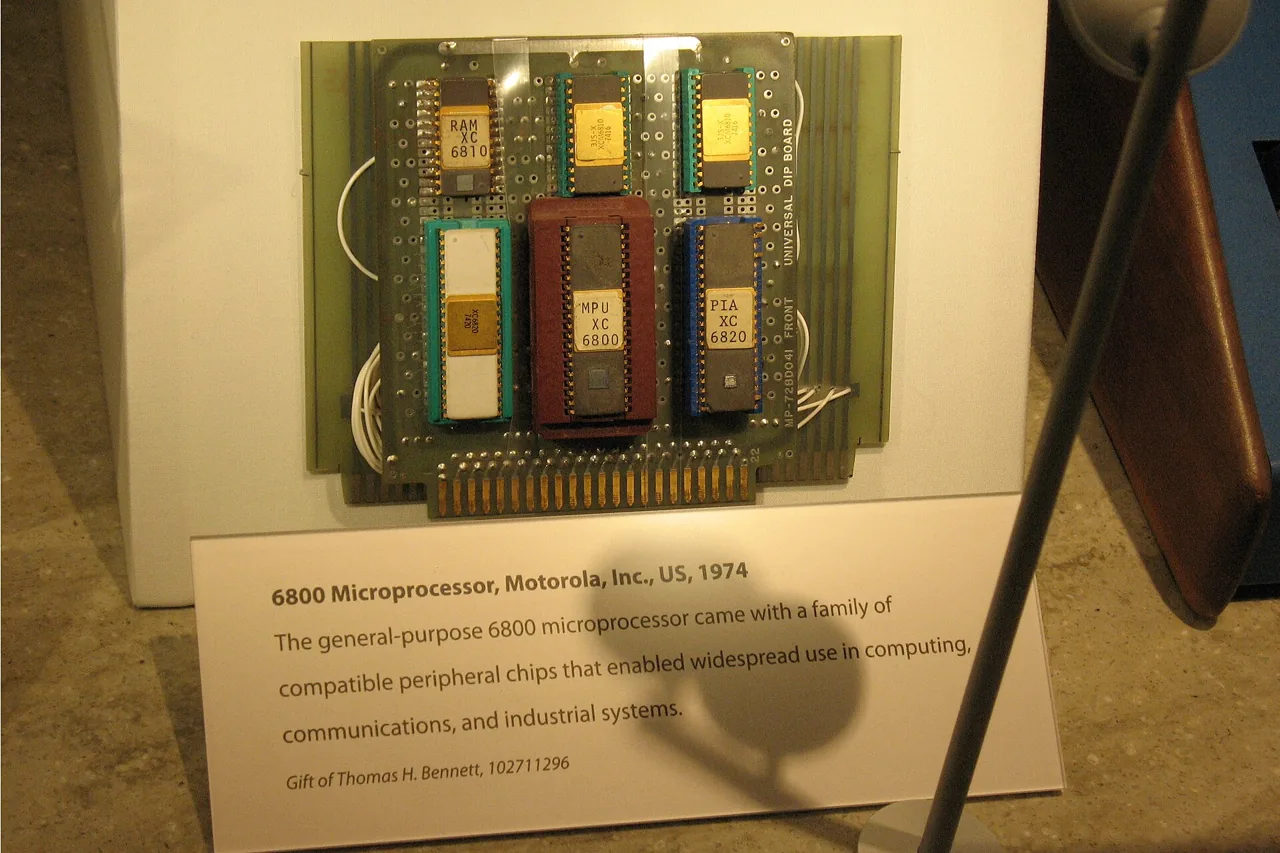
The Motorola 6800 was an eight-bit parallel microprocessor with an 8-bit data width and a 16-bit address bus, capable of accessing up to 65,536 bytes of memory6. It operated on a single five-volt power supply and was TTL compatible, interfacing system devices via an 8-bit bi-directional data bus6. The MC6800CQCS variant ran at 1MHz, meeting MIL-STD-883C standards for military applications3. Other variants included the MC6800L, S6800C, and S6800IC, with S6800C and S6800IC designated as 8-bit central control microprocessors within the 6800 family3. At introduction, the chip carried a price of $3008.
One architectural constraint was notable: the absence of a Ready line, a feature present in the MOS Technology 6500 series that allowed synchronization with slower memory2. To compensate, designers could stretch one phase of the clock signal to as long as five microseconds, effectively inserting wait states manually2. This workaround, while functional, added complexity to system design compared to contemporaries with built-in bus-hold capability.
Motorola supported the 6800 with an unusually complete documentation suite, described in one contemporary source as “one of the most complete set of documentation yet made available for a microprocessor system”6. Development was aided by the EXORcisor® prototyping system, a registered trademark of Motorola Inc., whose software environment showed significant compatibility with other 6800-based systems2. The ROM on Motorola’s Microprocessor/System Board used the MC6830L7, the same component found in the company’s Evaluation Module and Integrated Circuit Evaluation Kit, suggesting a standardized firmware approach across development platforms2.
Software support was both broad and structured. A wide variety of software had been developed for the 6800 by 1978, and much of it was widely available to users4. Southwest Technical Products 6800 Computer System customers could obtain access to this library, and buyers could join the Motorola 6800 User's Group for two years, receiving not only existing programs but also updates2. Most software written for the Evaluation Module would run on compatible 6800 systems, easing portability2. The Motorola M6800 CROSS ASSEMBLER, Release 1.2, was available for development work, with copyright held by Motorola SPD, Inc. from 1974 to 197512. Assembly language programming for the 6800 assumed a minimum of 340 bytes of memory available for program storage12. Example programs distributed included a DEC .LDA format binary loader (LOADER), an I/O handler for the Motorola 6821 PIA (6821A), and a serial-port handler for the National INS8250 ACE (8250A)7. The single software interrupt (SWI) on the 6800 was heavily utilized by support software for breakpoints and disk operating system calls, a constraint that shaped early development practices14.
The 6800 found adoption across both commercial and hobbyist domains. Its popularity was evident in the number of personal computer manufacturers incorporating it, including Southwest Technical Products (SwTPC 6800), Wavemate, Electronic Products Associates, MITS (Altair 680b), Digital Group, MSI, and Heath Company4. Motorola itself used the processor in its own systems, reinforcing its role as both designer and customer4. Second-source manufacturing was established with American Micro Systems Inc., Fairchild, and Hitachi, increasing availability and fostering competition4.
The chip’s legacy was shaped in part by internal conflict. Chuck Peddle, who served as a key salesman for the 6800, demonstrated it to major clients including Hewlett-Packard, Ford Motor Company, and Remington8. When Motorola ordered him to cease work on a proposed low-cost version, Peddle responded by asserting ownership of his prior work under the doctrine of project abandonment, then departed to develop the concept independently, leading directly to the MOS 6502, a chip that would undercut the 6800’s market position8. This moment altered the trajectory of microprocessor history, though the 6800 remained a respected design for its symmetry and clarity.
Despite Motorola’s announcement of improved versions with on-chip clock generation, memory, and higher speeds, the 6800 did not offer upward compatibility with later architectures at the time of its peak use, limiting its long-term evolution path4. The surviving documentation is silent on transistor count, process technology, package type, and physical dimensions.
References
- Programming The M68000 1983 Addison-Wesley Publishing Company (1983)
- Best of Byte Volume 1 June 1977 (1977)
- Towers International Microprocessor Selector
- 1978 07 BYTE 03-07 How To Get Your Tarbell Going (1978)
- Sega Saturn Magazine 1997-03-07 1997n06 (1997)
- SWTPC ComputerProductsCatalogue
- Mini-Tasker March1984 (1984)
- Computers that made Britain v1
- 1976 09 BYTE 00-13 Bicentennial (1976)
- AUUGN-V05.4
- Sega Saturn Magazine 1997-09-05 1997n30 (1997)
- 1981 06 BYTE 06-06 Operating Systems (1981)
- MICRO Vol64-09 83
- 1979 01 BYTE 04-01 Life Algorithms (1979)
- micro 61 jun 1983[ocr] (1983)
- micro 59 apr 1983[ocr] (1983)