RCA 1802
The RCA 1802 was an 8-bit CMOS microprocessor notable for its extremely low power dissipation and use in experimental and real-time systems, including amateur radio satellites.
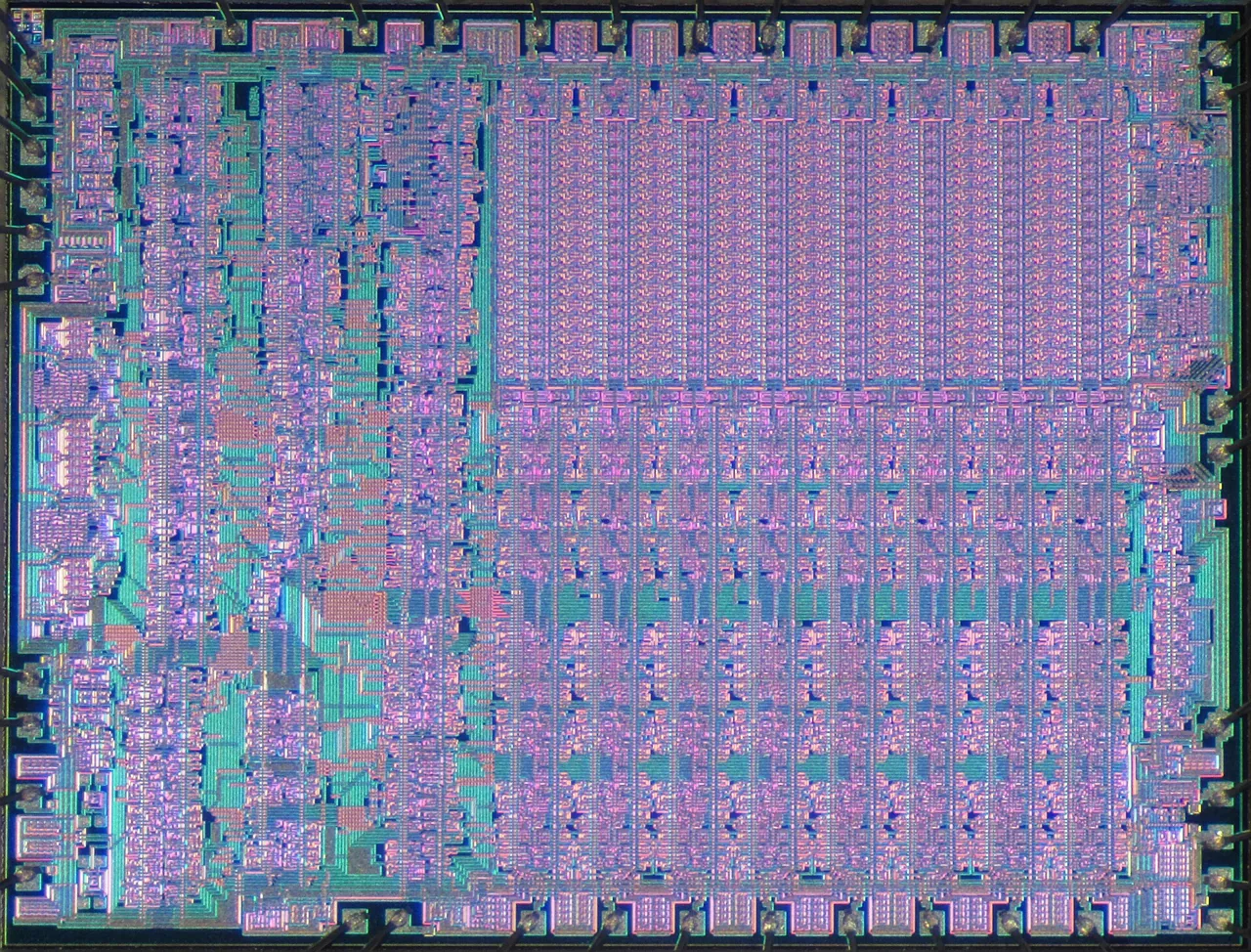
Engineered as a CMOS device, the RCA 1802 drew attention for its "extremely low power dissipation," a trait that made it suitable for applications where thermal and energy constraints were critical3. Its power characteristics were explicitly documented in technical literature, with graphs detailing typical dissipation under BRANCH and IDLE instructions for the CDP1802D variant5. This efficiency reportedly contributed to its selection in the AMSAT radio amateur satellite series, a high-visibility application where reliability and low power were paramount3.
The processor’s clock speed was the subject of a documented revision. An OEM user reported receiving units operating at 3.2 MHz, but RCA later notified customers that the 1802 was only guaranteed for use up to 2.5 MHz, indicating a tightening of specifications after initial release1. This adjustment suggests early units may have been pushed beyond revised thermal or stability margins, a rare public backtrack in microprocessor documentation1.
Its architecture and instruction set were described as "peculiar and thus more difficult to use than other devices," a judgment that appears to have limited broader adoption3. Despite this, the 1802 was also called "relatively easy to use," a contradiction possibly reflecting its straightforward interfacing versus its unconventional programming model3. No hobby or personal computer manufacturer adopted it as the primary processor in a general-purpose machine, a significant omission in an era of explosive home computing growth3.
RCA supported the 1802 with a range of development tools, including the CDP 18S020 Evaluation Kit, which featured 256 bytes of RAM and an LED bus monitor, requiring an external TTY13. The CDP 18S030 COSMAC Micromonitor served as a standalone debugging unit for real-time software development13. The RCA COSMAC ELF II kit was marketed as a low-cost entry point for hobbyists37912, and the RCA COSMAC VIP was another system based on the processor4.
Software support was fragmented. While RCA offered a resident and cross assembler, simulator, firmware debug package, and a floppy-disk-based development system, one 1978 assessment bluntly noted that "little or no software is available"35. High-level languages did exist, including an 1802 dialect of PL-1, ROM-able p-code interpreters (with and without floating point), an Extended BASIC interpreter with microprocessor I/O control, and the CHIP-8 interpretive language2481114. The RCA 1802 User's Manual (MPM-201B) served as the complete reference guide481114.
Peripheral integration was facilitated through COSMAC hardware support, including the 1852 8-bit I/O port and the 1854 CMOS DART, part of RCA's broader CMOS LSI family5. The processor was also known under the name "RCA COSMAC microprocessor," with part numbers including CDP1802 and CDP1802D45. The CDP 18S012 was linked to the COSMAC MICROTUTOR II, though details are absent in the source material13.
Despite its niche status, the 1802 retained a following. A reference notes that Josh is a fan of the RCA 1802 Microprocessor6. Its survival in specialized roles, such as satellites, real-time multi-tasking, and embedded development, speaks to a design optimized for durability and simplicity over mainstream appeal.
References
- Compute2 Issue 3 1980 Aug-Sep (1980)
- 1982 08 BYTE 07-08 Logo (1982)
- 1978 07 BYTE 03-07 How To Get Your Tarbell Going (1978)
- 1980 04 BYTE 05-04 Printed Software Becomes a Reality (1980)
- MicrocomputerInterfacing BruceArtwick
- gccc38 2nl
- 1978 11 BYTE 03-11 The Sky is the Limit (1978)
- 1981 04 BYTE 06-04 Future Computers (1981)
- 1979 01 BYTE 04-01 Life Algorithms (1979)
- BYTE Vol 03-04 1978-04 Robot Simulation (1978)
- 1980 09 BYTE 05-09 Homebrewing (1980)
- 1979 03 BYTE 04-03 Plain Text (1979)
- Towers International Microprocessor Selector
- 1980 08 BYTE 05-08 The Forth Language (1980)