MOS 6502
The MOS 6502 was a microprocessor introduced by MOS Technology in the mid-1970s, notable for its $20 price point and adoption in early personal computing systems.
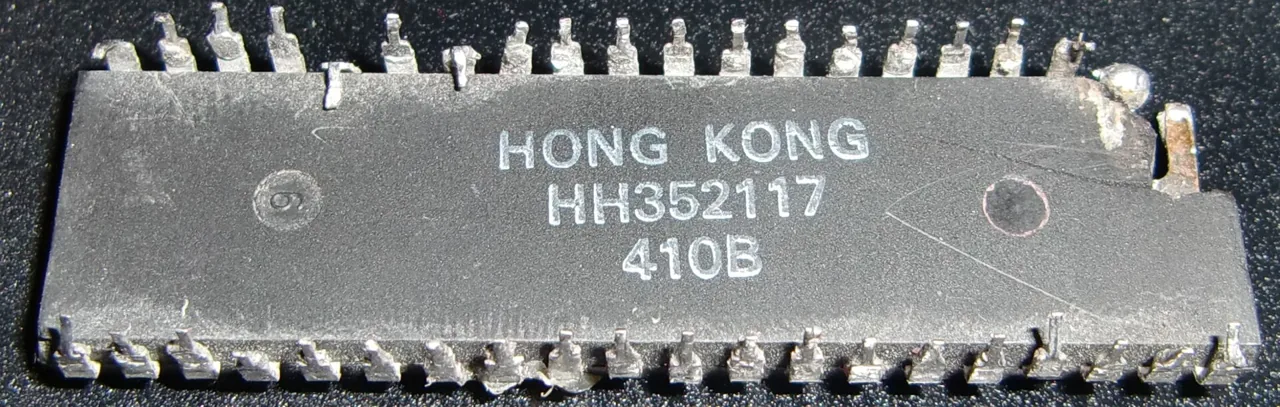
At Wescon 75, the 6502 made its mark not through a polished launch but by sheer audacity of price and accessibility10. Marketed as "the $20 CPU chip" in a November 1975 issue of Byte811, it undercut competitors by an order of magnitude, turning semiconductor economics on its head. The chip arrived in a 40-pin DIP package requiring only 5 V at 140 mA9, a modest power profile that eased integration into hobbyist and commercial designs alike. Its architecture featured 13 addressing modes, a richness uncommon at the price, with syntax influenced by the designers’ prior work on the PDP-11 instruction set during their tenure at Motorola6. Despite that lineage, the 6502 shared no software commonality with Motorola’s 68009. However, MOS Technology soon faced a lawsuit from Motorola10.
The chip supported two interrupt types: an interrupt request (IRQ), which could be masked under software control, and a non-maskable interrupt (NMI), which the processor could never ignore345. Core operations included reading and writing memory or I/O devices, and performing arithmetic and logical operations345. The stack pointer and status register each spanned 8 bits9, a constraint that shaped low-level coding practices but did not prevent broad adoption. Development was supported by tools including the KIM-1 and TIM microcomputer cards for prototyping9, and dedicated systems such as MOS Technology’s MD2 ~50 development terminal and Rockwell’s System 65 with dual floppy drives9. A software ecosystem emerged quickly, featuring editors, assemblers, cross assemblers, a math package, and even a FORTRAN compiler9.
Financial instability nearly derailed the 6502 before it gained traction. In early 1976, Allen-Bradley, MOS Technology’s financial backer, severed ties, returning control to the company’s original founders10. Calculator revenue had collapsed under price competition from Texas Instruments, and the Motorola lawsuit loomed10. Yet demand for the 6502 was undeniable. Chuck Peddle, one of the chip’s architects, reportedly visited the garage housing Apple’s nascent operations to resolve design issues, a visit underscoring the chip’s role in enabling the first wave of personal computers10.
Documentation was commercially available and priced accessibly: the 6500 Programming Manual and 6500 Hardware Manual from MOS each cost $6.5015, while Rodnay Zaks’ widely used Programming the 6502 retailed for $9.9015. A later listing in MICRO magazine priced the MOS Tech Programming Manual (6502) at $12.00, suggesting either a revision or markup over time12. The 6502 was part of the MCS 6500 series of microprocessors811, and a CMOS variant, the R65C02, was later introduced by Rockwell, maintaining pin and software compatibility with the original NMOS design1.
The 6502 succeeded not because it was the fastest or most advanced, but because it was available, affordable, and approachable. Its documentation, development tools, and pricing created a feedback loop that drew engineers, hobbyists, and entrepreneurs into its orbit. The surviving documentation is silent on exact clock speed, transistor count, and bus widths, but those omissions do not diminish its impact. Rather, they reflect the reality of a chip that mattered not for its specs on paper, but for how many could afford to plug it in and make it run.
References
- The CMOS 6502 BYTE Magazine Dec. 1983 (1983)
- AcornUser047-Jun86
- Concise UserGuide-OriginalScan
- Concise UserGuide-OriginalScan
- Concise UserGuide ocr'd
- MICRO Vol04-4 78
- MICRO USER 030
- micro 01 oct 1977[ocr] (1977)
- MicrocomputerInterfacing BruceArtwick
- Computers that made Britain v1
- MICRO Vol1-10 77
- MICRO Vol13-6 79
- 1976 09 BYTE 00-13 Bicentennial (1976)
- full
- micro 13 jun 1979[ocr] (1979)
- Commodore Magazine (Australia) Vol 2 Iss 5 1982 (1982)