Motorola 6809
Motorola's 6809 microprocessor, introduced in the late 1970s, extended the 6800 instruction set with 16-bit operations and advanced addressing modes, gaining a reputation among low-level programmers for its clean, software-friendly design.
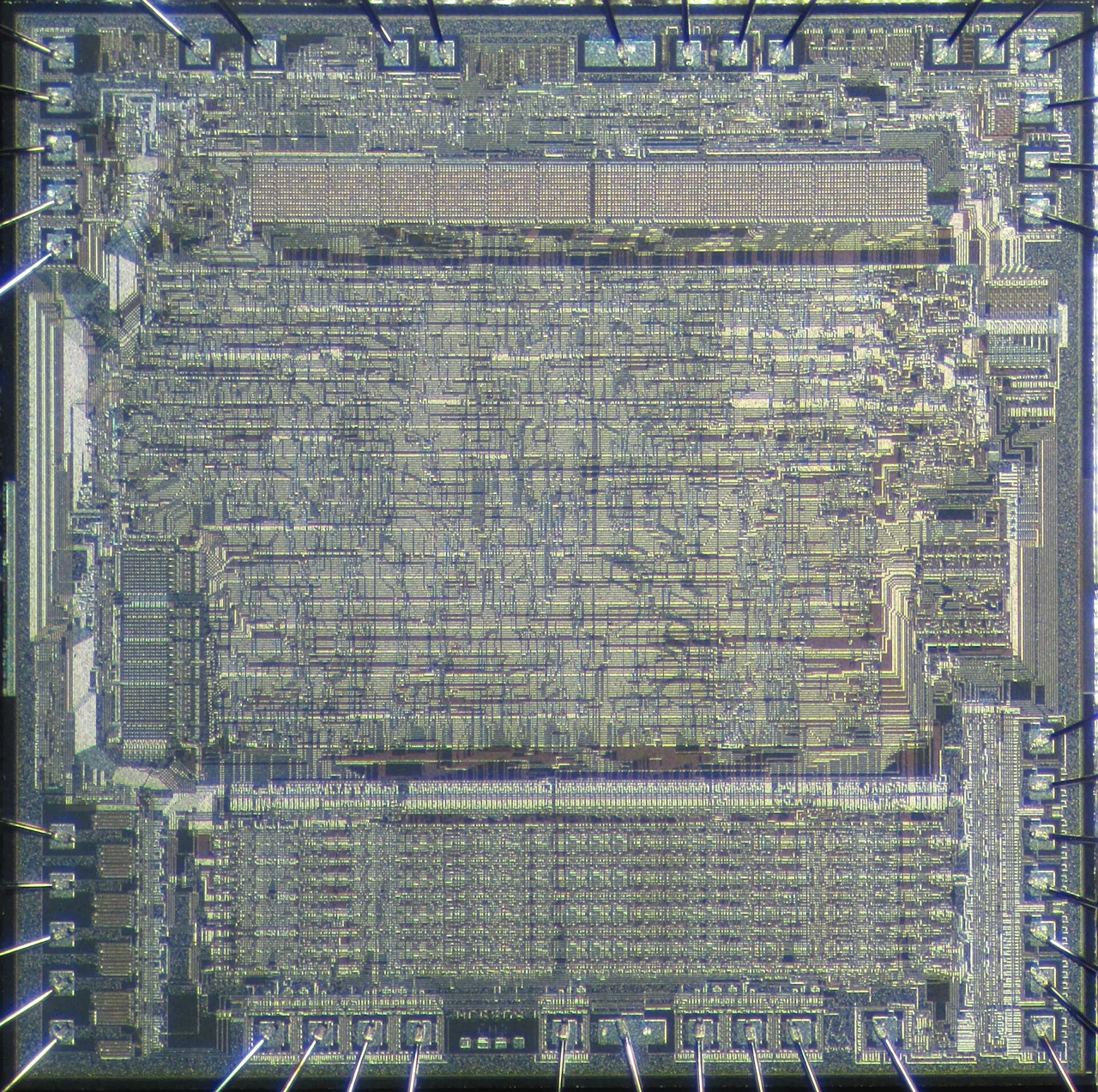
The 6809 emerged from Motorola's effort to refine the 6800 architecture into a more capable processor, described in early reports as an "evolutionary design improvement creating a major new processor architecture" that would be "a joy for both low level programmers and designers of systems programming"5. Unlike contemporaries that leaned on microcode, the 6809 used a hard-wired approach to instruction execution, a design choice that contributed to its efficiency13. It operated at a clock speed of 2MHz in its base form, with the 68B09E variant also running at 2MHz113, and was fabricated using NMOS technology13.
Though marketed as a 16-bit microcomputer, the 6809 provided 16-bit operations through dedicated instructions and register pairs such as the D accumulator512. Key 16-bit operations included ADDD, SUBD, LDD, STD, CMPD, and the load-effective-address variants LEAX, LEAY, LEAU, and LEAS12. These, combined with a full suite of indexed addressing modes, gave the 6809 a significant edge in code density and register flexibility over the 6800512. The instruction set remained upwardly compatible with the 6800 at the source level, allowing existing software to be ported with relative ease78.
Despite sharing a common ancestry with the 6502 in the 6800 instruction set, the 6809 and 6502 evolved in "quite different directions"12. Techniques for translating 6502 programs to the 6809 were documented, reflecting the chip's appeal to developers seeking more expressive power12.
Development tools from Motorola included the 6809 Cross Macro Assembler and Linking Loader, a resident Pascal Interpreter, and the 6809 Realtime Multitasking System78. The Microware OS-9 operating system was specifically designed to exploit the 6809's capabilities1516. Programmers could consult the MC6809 Programming Manual from Motorola or Lance Leventhal's 6809 Assembly Language Programming, a widely used reference10.
Anticipation for the chip was high before its release. In early 1978, Motorola confirmed the design was "currently in progress," with official details expected by mid- to late 19785. By 1979, systems using the 6809 were anticipated in the first part of the year5. One early workaround for hardware unavailability was E6809, a 3 K byte 6800 machine language program that emulated the 6809, complete with a mini-monitor and available on disk or cassette for $49.959.
By 1981, the 6809 was described as "relatively new"78. Subscribers to technical journals reported discovering the chip within the previous year and expressed enthusiasm, with some volunteering to contribute articles611. Interest extended to major industry events: attendees at Applefest in Boston reportedly inquired how the 6809 might influence Apple's product direction611. By 1982, one writer noted that "the 6809 world has expanded and matured in many ways"14.
The 6809's performance reputation was strong. A 2-MHz 68B09E was said to accomplish tasks as quickly as other contemporary processors running at up to eight times the clock speed, a reflection of its efficient architecture13. Nearly a decade after the NMOS 6809's creation, Hitachi developed a CMOS version of the chip13. The 6309 was mentioned as an almost certain successor, though details were incomplete in the source13.
The processor was available in at least two variants: the MC6809 and MC6809E34. The E suffix may have indicated a clock generator configuration, though the surviving documentation does not confirm this.
Despite its technical strengths, the 6809 never achieved the market penetration of the 6502 or Z80. It found a niche in systems that valued structured programming and multitasking, particularly those running OS-9. Its design reflected a philosophy that prioritized programmer convenience and architectural elegance, a rarity in an era increasingly driven by cost and clock speed.
References
- micro 50 jul 1982[ocr] (1982)
- MICRO Vol50-07 82
- micro 40 sep 1981[ocr] (1981)
- MICRO Vol40-9 81
- 1978 01 BYTE 03-01 The Brains of Men and Machines (1978)
- MICRO Vol38-07 81
- micro 37 jun 1981[ocr] (1981)
- MICRO Vol37-06 81
- 1979 03 BYTE 04-03 Plain Text (1979)
- The Rainbow Vol. 05 No. 07 - February 1986 (1986)
- micro 38 jul 1981[ocr] (1981)
- MicrocomputerInterfacing BruceArtwick
- The Rainbow Vol. 12 No. 02 - September 1992 (1992)
- MICRO Vol49-06 82
- MICRO Vol42-11 81
- micro 42 nov 1981[ocr] (1981)