Intel 80386
Intel's first practical 32-bit microprocessor, introduced in 1985, integrated a full 32-bit data and address bus with multitasking support and virtual memory management on a single chip.
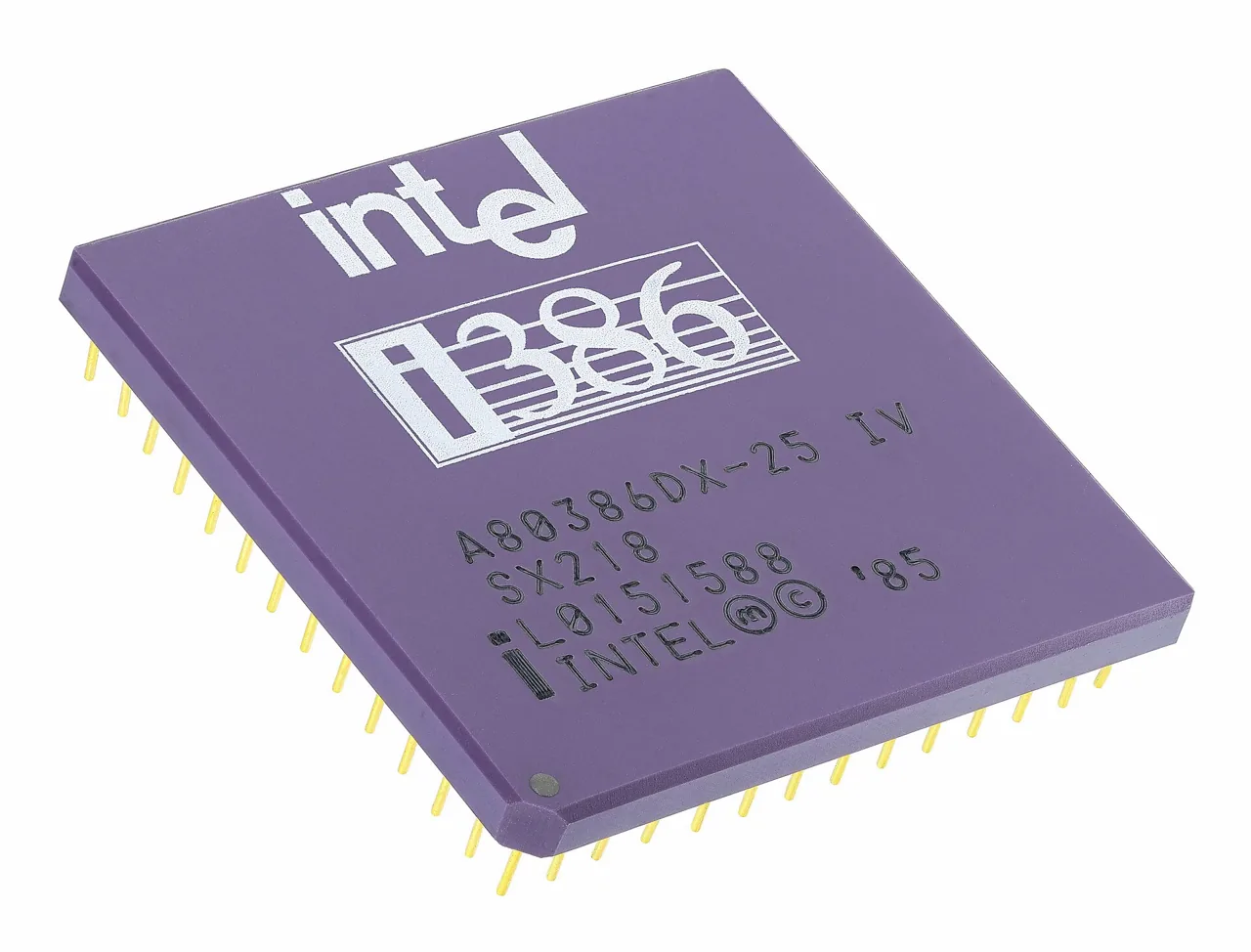
The 80386 represented a major overhaul of the 16-bit 8086–80286 architecture6. Retaining object code compatibility with earlier processors, it introduced a true 32-bit internal and external data path36. Its six dedicated internal units (Bus Interface, Code Prefetch, Instruction Decode, Execution, Segmentation, and Paging) enabled pipelined operation and laid the foundation for modern PC multitasking3.
Intel introduced the chip in 1985416, but it did not appear in commercial systems until late 1986 and 19874. Compaq beat IBM to market with the Deskpro 386, a move that strained relations but ultimately forced IBM’s hand10. Intel, now financially secure by late 1986, refused to license the chip to a second manufacturer but granted IBM rights to produce the 80386 for internal use and to modify it freely10. IBM reportedly attempted two enhanced versions of the 80386 but failed to deliver them on schedule10.
The processor supported up to 4 gigabytes of physical memory and 64 terabytes of virtual memory24. It operated in real mode, which emulated the 8086 and restricted addressing to 1 megabyte, and protected mode, which enabled the full 32-bit address space4. Virtual 8086 mode allowed the processor to emulate 8086 environments8.
The 80386 CPU was not sold as a standalone product in consumer-facing channels, and surviving documentation does not record its original price or transistor count. Clock speeds for the flagship 80386 DX ranged from 16 to 25 MHz, with a full 32-bit data and address bus13. In 1988, Intel introduced the 80386SX, a cost-reduced variant with a 16-bit data bus but retaining 32-bit internal processing16. Other derivatives included the 80386SL and the IBM 80386 SLC, which integrated 8 KB of cache and power management features13.
Performance gains over the 8086 and 8088 were substantial, with internal execution improvements yielding up to an eightfold speed increase for many instructions6. The 80386 incorporated multitasking support and sophisticated memory management, representing a significant improvement over previous generations of Intel microprocessors3. Software written for earlier Intel processors could typically be recompiled for the 80386 with minimal changes, though timing loops and I/O references sometimes required adjustment2.
The 80386’s influence extended beyond its immediate successors. The 80486 implemented a superset of its instruction set, ensuring architectural continuity8. By anchoring high-end PC computing from 1987 onward, the 80386 ceased to be merely a processor. It became the threshold of modernity in x86 computing.
Specifications
| Data bus | 32-bit (DX), 16-bit (SX, SL, SLC) |
| Address bus | 32-bit (DX), 24-bit (SX, SL), 241 Bit (SLC) |
| Physical memory | Up to 4 GB |
| Virtual memory | Up to 64 TB |
| Internal architecture | 32-bit |
| Paging | 4 KB pages |
| Execution modes | Real, protected, virtual 8086 |
| Processor units | Bus Interface, Code Prefetch, Instruction Decode, Execution, Segmentation, Paging |
| Instruction set | Variable-length, double operand |
| Clock rates | 16, 20, 25 MHz (DX); 16, 20 MHz (SX); 25 MHz (SL); 16, 20, 25 MHz (SLC) |
| Compatibility | Object code compatible with 8086, 8088, 80186, 80286 |
| Second-source rights | Granted to IBM for internal use and modification |
References
- ProgrammingThe80386 BudSmithMarkJohnson
- 200409-001 iSBC 386 2x Data Sheet Nov1986 (2004)
- GG24-3730-00 OS2 V2.0 Vol 1 Control Program 199204 (1992)
- URP 1st edition
- 280411-001 iSBC 386 2x Brochure Sep1986 (1986)
- The Intel Microprocessors - Eighth Edition - 2008 (2008)
- Personal System 2 Hardware Interface Technical Reference May88
- GG24-3731-00 OS2 V2.0 Vol 2 DOS and Windows Environment 199204 (1992)
- The 80x86 IBM PC and Compatible Computers - 4th Edition
- BigBluesTheUnmakingIBM PaulCarroll
- 84X1508 PS2 Model 80 Technical Reference 198704 (1987)
- 501329-001 Intel 386 MicroComputer Model 300SX Users Guide 199001 (1990)
- GG24-4002-0 IBM PS 2 and PS ValuePoint Subsystems Dec92
- 1989 12 BYTE 14-12 5 New Laptops and Sound Image Processing and Case Tools (1989)
- Inside Windows 95 Adrian King 1994 (1994)
- TOS 1991-11 (1991)