Intel 8086
A 16-bit foundation stone, architecturally ambitious but shackled by its era’s constraints, the 8086 launched a dynasty through brute-force compatibility rather than elegance.
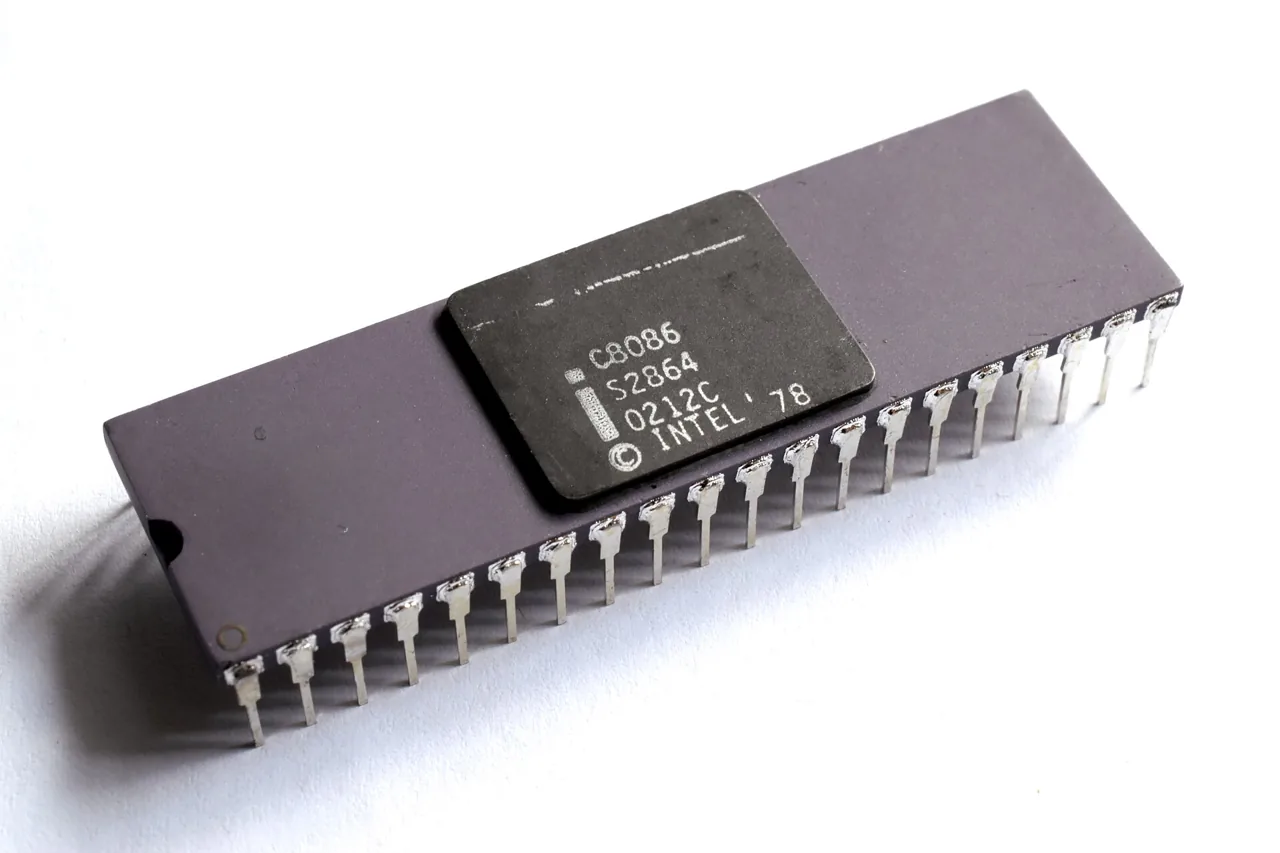
The Intel 8086 emerged not with a market announcement but with the quiet authority of documentation. Its primary hardware and software reference manual, dated February 1979, established the chip’s presence in the engineering record2. This was no consumer launch; it was a signal to designers, a declaration that Intel’s architecture was stepping decisively beyond 8-bit limitations. As a 16-bit microprocessor, the 8086 featured a 16-bit internal register size and a 16-bit data bus, aligning internal and external data paths for coherent processing38. Yet its 20-bit memory address bus—a hybrid solution—allowed access to 1MB of memory, a figure that sounded generous in 1979 but introduced the infamous segmented memory model that would haunt programmers for decades3. The chip operated at 5 volts and contained no level 1 cache, a reflection of both process limitations and the era’s architectural assumptions38.
It ran exclusively in real mode, a constraint that limited multitasking and memory protection, but one that ensured direct, predictable hardware access—critical for embedded and industrial applications. As an HMOS microprocessor, it benefited from higher density and lower power than earlier PMOS designs, though exact clock speed remains undocumented beyond the relative notation "1x"38. Intel claimed it delivered ten times the processing power of the 8080, a bold assertion grounded in architectural leap rather than raw clock, and one that justified the migration for developers willing to wrestle with its complexity12.
The 8086 was never intended to stand alone. Its design anticipated augmentation: the 8087 math coprocessor could be installed in most 8086-based systems, adding over 50 new instructions and dramatically accelerating floating-point operations with superior precision3. Intel provided software tools to harness this ecosystem. ASM86, the official assembler, produced object code capable of embedding 8087 instructions, while E8087 and PE8087 offered emulation and PL/M-86 numeric support where hardware was absent67. Development was supported by Microbench 8086, a suite including a relocating assembler, linking loader, and librarian, notable for enabling memory addressing beyond the 64KB barrier through segmentation tricks2.
Operating systems for the platform were real-time and business-oriented: iRMX-86, CP/M-86, and MS-DOS each carved niches1. iRMX-86, in particular, was marketed as a modular, real-time OS for industrial and communications systems, running on Intel’s own iSBC 86 single-board computers and third-party 8086 hardware5. Its full license carried a $7,500 fee with royalties—a price tag that signaled its targeting of commercial, not hobbyist, markets5. Microsoft’s BASIC-86, priced at $350, offered ANSI compatibility and disk I/O drivers, easing the transition for developers familiar with 8080-based versions2.
The 8086’s legacy was cemented not by its own adoption, but by its derivatives. The 8088, with the same 16-bit internal architecture but an 8-bit external bus, was explicitly designed as a lower-cost alternative, enabling cheaper system designs, most famously in the IBM PC13. Programs written for the 8086 and 8088 could run unmodified on the 80186, which expanded the core design with integrated peripherals, while the 80286 added capabilities aimed at multiuser systems1. The NEC V30 mimicked the 8086 instruction set but executed several instructions more efficiently, offering a quiet upgrade path for existing designs14.
Documentation was extensive: Intel published the Intel 8086 Assembly Language Programming Manual, the MCS-86 User's Manual, and language-specific guides for PL/M-86 and cross-development tools11. Third-party literature, such as Liu and Gibson’s Microcomputer Systems: The 8086/8088 Family and Morse’s The 8086 Primer, helped bridge the knowledge gap for engineers entering the 16-bit world110. These texts did not merely describe—they taught a new way of thinking about memory and performance.
The 8086 was not a clean-slate triumph. Its segmented memory model was a kludge to overcome a 16-bit address limitation, and its real-mode-only operation made it ill-suited for modern multitasking from the start. Yet its instruction set and architectural choices became the foundation of an empire. It was not the fastest, the most elegant, or even the most widely sold chip of its time—but it was the one that refused to die, its compatibility demands shaping the evolution of computing for decades. The dynasty it launched was not by design, but by persistence.
References
- 1983 04 BYTE 08-04 New Chips (1983)
- 1979 10 BYTE 04-10 Genealogy (1979)
- URP 10th edition
- iRMX Field Sales Training
- 121703-003 ASM86 Language Reference Manual Mar85
- 121703-003 ASM86 Language Reference Manual Nov83
- URP 12th edition
- 144044-002 iSBC 8614 and 8630 Single Board Computer Hardware Reference Jan85
- 210620-004 Literature Guide Sep Oct 1984 (1984)
- 9800743A iSBC 957 Intellec-iSBC86-12 Interface Sep78
- 1980 01 BYTE 05-01 Domesticated Computers (1980)
- URP 4th edition
- 144044-001 iSBC 86 14 and 86 30 Hardware Reference Manual Jan82