Apple IIc
Apple Computer, Inc. introduced the Apple IIc in April 1984 as a compact, self-contained personal computer designed to extend the Apple II series with integrated peripherals and portability, though it lacked internal expansion slots.
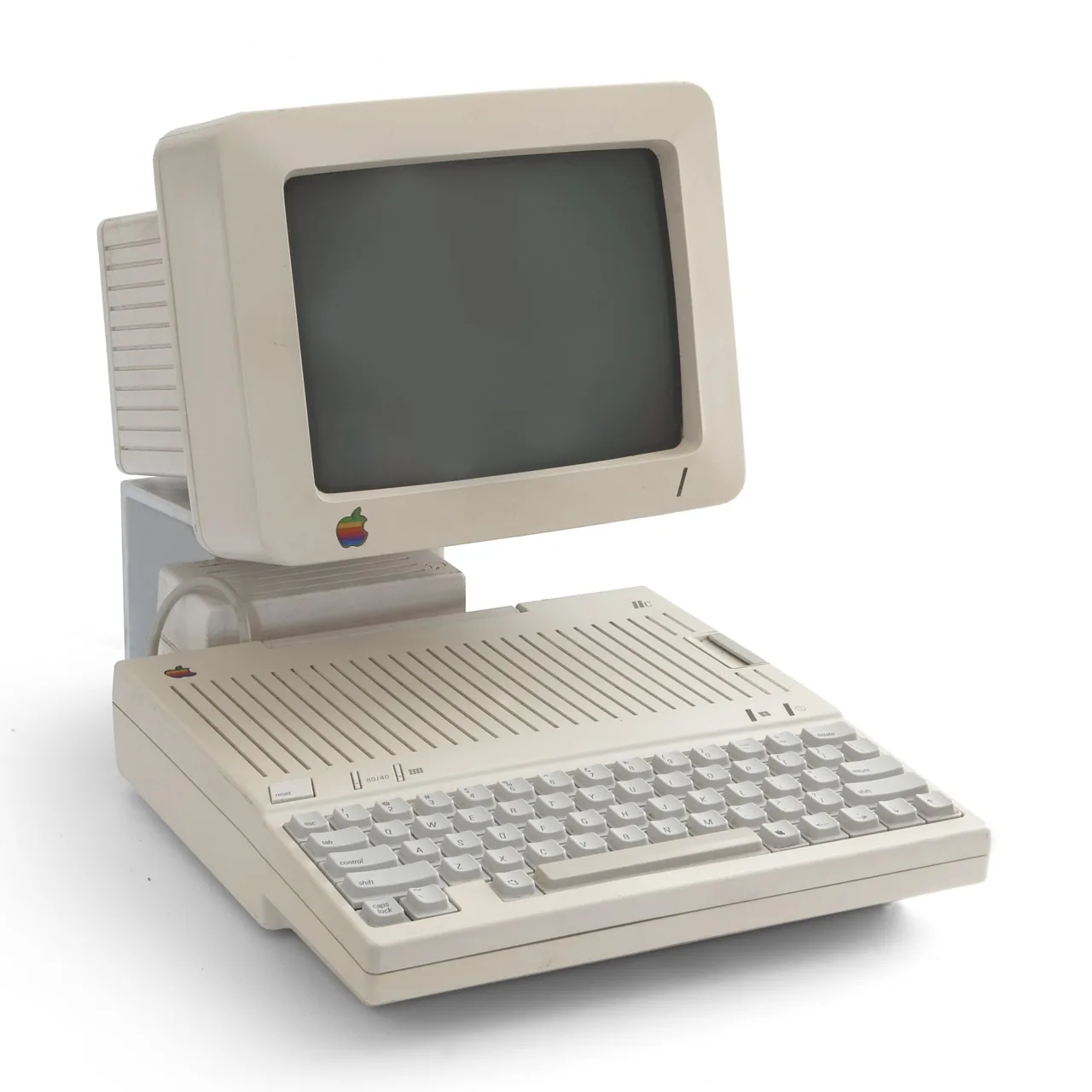
The Apple IIc centered on the 65C02A processor, which had slight differences from the 65025. It shipped with 128K RAM and 16K ROM, the latter housing the system monitor, BASIC interpreter, and I/O routines for mouse and serial devices5. The ROM also implemented bank-switching logic to expand the MPU’s native 64K address space, a technical workaround that preserved compatibility while increasing usable memory5. Despite this, the machine was a closed unit. Apple explicitly designed it without expansion slots, locking users out of the internal logic board5. This decision drew immediate skepticism; as one contemporary noted, “you can’t get inside the computer to add additional boards,” a limitation that would define its market trajectory5.
Storage was handled by a built-in 5.25-inch half-height minifloppy drive with a formatted capacity of 143K5. While the drive was standard, compatibility with external Apple drives required an IIC ADAPTOR CABLE, priced at $10.00 or $19.95 depending on the vendor, to bridge the proprietary 19-pin connector213. Third-party drives advertised “100% APPLE IIc COMPATIBLE” status with shielded cables and molded connectors, underscoring the niche ecosystem that formed around its nonstandard interface13. The IIc ran DOS 3.3 and ProDOS software, with Apple confirming ongoing support for ProDOS 1.1.1 and later ProDOS 8 across the IIe, IIc, and II GS models53. However, CP/M was not available, cutting off a segment of business software14. Software compatibility was otherwise high. Apple claimed 90%, and independent testing suggested about 95% of existing Apple II software ran without issue, though minor incompatibilities could arise from subtle differences between the 65C02A and the original 6502 instruction timing514.
Apple positioned the IIc as a turnkey system. It included a built-in keyboard, monochrome monitor, and a suite of five tutorial disks titled Keyboard Instruction, Getting Down to BASIC, Introduction to Logo, Apples at Work5. At launch, 21 popular software packages were redeveloped to take advantage of the additional memory14. The machine also debuted with the Apple Scribe thermal printer, capable of printing in six colors on plain paper, marking a rare foray into color output for an otherwise monochrome system14. A mouse was available as an option, connected via a single joystick/mouse port. This was a concession to emerging GUI-like interfaces, though the IIc itself ran no windowing environment514.
Peripherals were consolidated on the rear panel: two RS-232 serial ports, an external disk drive port, video extension jack, RCA-type video jack, and a power-connector port5. The inclusion of dual serial ports allowed daisy-chaining of modems, printers, or other accessories, a practical advantage over earlier Apple II models14. Apple emphasized portability, branding the IIc as “small but mighty,” and shipping it as a complete unit with the monitor9. An 80-column by 24-line LCD screen was announced for later in 1984 at a reported price of $50014.
Apple’s commitment to the Apple II line was dramatized in May 1984 with the event title “Apple II Forever,” a public acknowledgment that the II series had survived both the failed Apple III and the emerging Macintosh3. Yet the IIc’s closed design backfired. Despite Apple’s intent to phase out expandable models, the IIe continued to outsell the IIc because users valued expansion slots3. By mid-1985, overall Apple II sales began to decline, though the IIc remained in the lineup3. As late as 1988, it was still sold, albeit in a “minor role” as the Apple IIcs were marketed most heavily12. The Sun Remarketing catalog that year offered refurbished units with the endorsement: “At this price and this quality buy two!”9.
Memory expansion required replacing the logic board. The official Apple IIc Memory Expansion Kit included both a new logic board and the expansion card, a costly and invasive upgrade path16. This approach reflected Apple’s philosophy of controlled evolution, but it alienated hobbyists accustomed to slotting in RAM boards. The IIc Plus, a later model in the Apple IIc family, eventually addressed some limitations, including adding a 3.5-inch 800KB drive, though it was never released outside the U.S. due to lack of a UK keyboard47.
The Apple IIc stands as a paradox: a technically competent, tightly integrated machine that failed to capture the loyalty of its intended base. Its design prioritized simplicity over flexibility, and while it succeeded as a portable Apple II, it faltered in a market that still demanded modularity. The surviving documentation is silent on dimensions, weight, clock speed, and discontinuation date, leaving the IIc shrouded in partial obscurity. It is remembered not for what it became, but for what Apple hoped it would be.
Specifications
| CPU | 65C02A |
| RAM | 128K |
| ROM | 16K |
| Storage | Built-in 5.25-inch minifloppy drive (143K formatted) |
| Display Output | Monochrome monitor included; RCA video jack; video extension jack |
| Keyboard | Built-in |
| Ports | Two RS-232 serial ports, external disk drive port, RCA video jack, video extension jack, single joystick/mouse port, power connector |
| Expansion | No internal slots; memory expansion requires Apple IIc Memory Expansion Kit |
| Software | ProDOS, DOS 3.3, tutorial disks included |
| Compatibility | Approximately 95% of Apple II software; CP/M not available |
| Peripherals | Apple Scribe thermal printer (six-color); optional mouse |
| Price | $995 with monochrome monitor |
References
- BYTE Vol 10-01 1985-01 Through The Hourglass (1985)
- 1985 07 BYTE 10-07 Computers and Space (1985)
- BYTE Vol 11-10 1986-10 Apple II GS (1986)
- APDAlog 199104 (1991)
- Electronic Games Issue 36 Vol 04 01 1985 Mar (1985)
- Fujitsu Sales Prospector 1986 (1986)
- Computers that made Britain v1
- 1986 06 BYTE 11-06 Computers and Music (1986)
- Sun Remarketing Catalog Summer 1988 (1988)
- ComputerPersoenlich 84 15
- VirginMastertroniccatalog-1989 (1989)
- Compute Issue 100 1988 Sep (1988)
- 1986 08 BYTE 11-08 Object-Oriented Languages (1986)
- NZ-bits-and-bytes-issue-2-10
- Computer Gaming World - 198903 - Number 57 (1989)
- DAUG 1987 Vol 01 (1987)