Apple III
Apple Computer Inc. released the Apple III in the early 1980s as a business-oriented successor to the Apple II, featuring a 6502B processor, expandable memory up to 256K, and built-in floppy storage, though its market performance fell short of expectations despite aggressive pricing and software bundling.
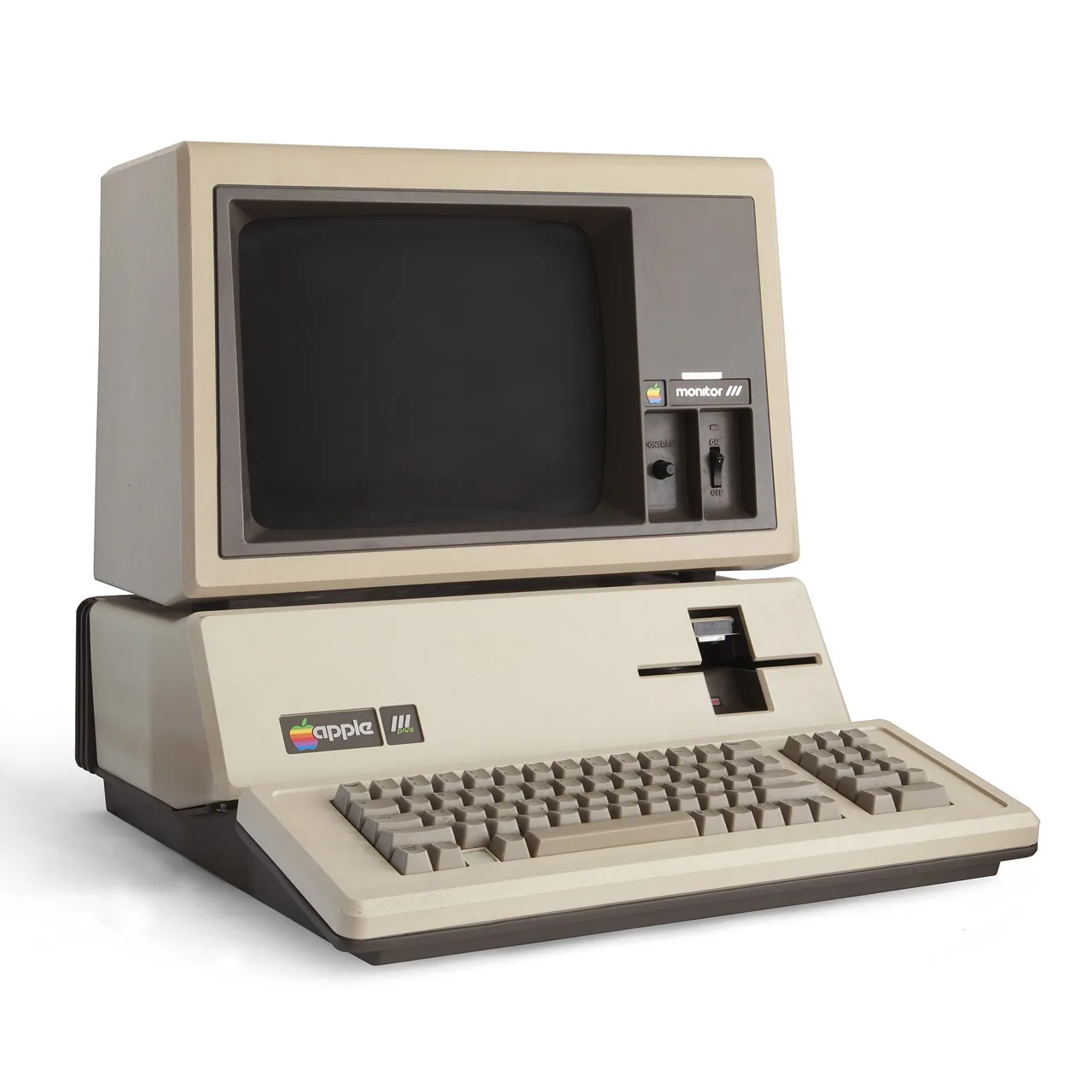
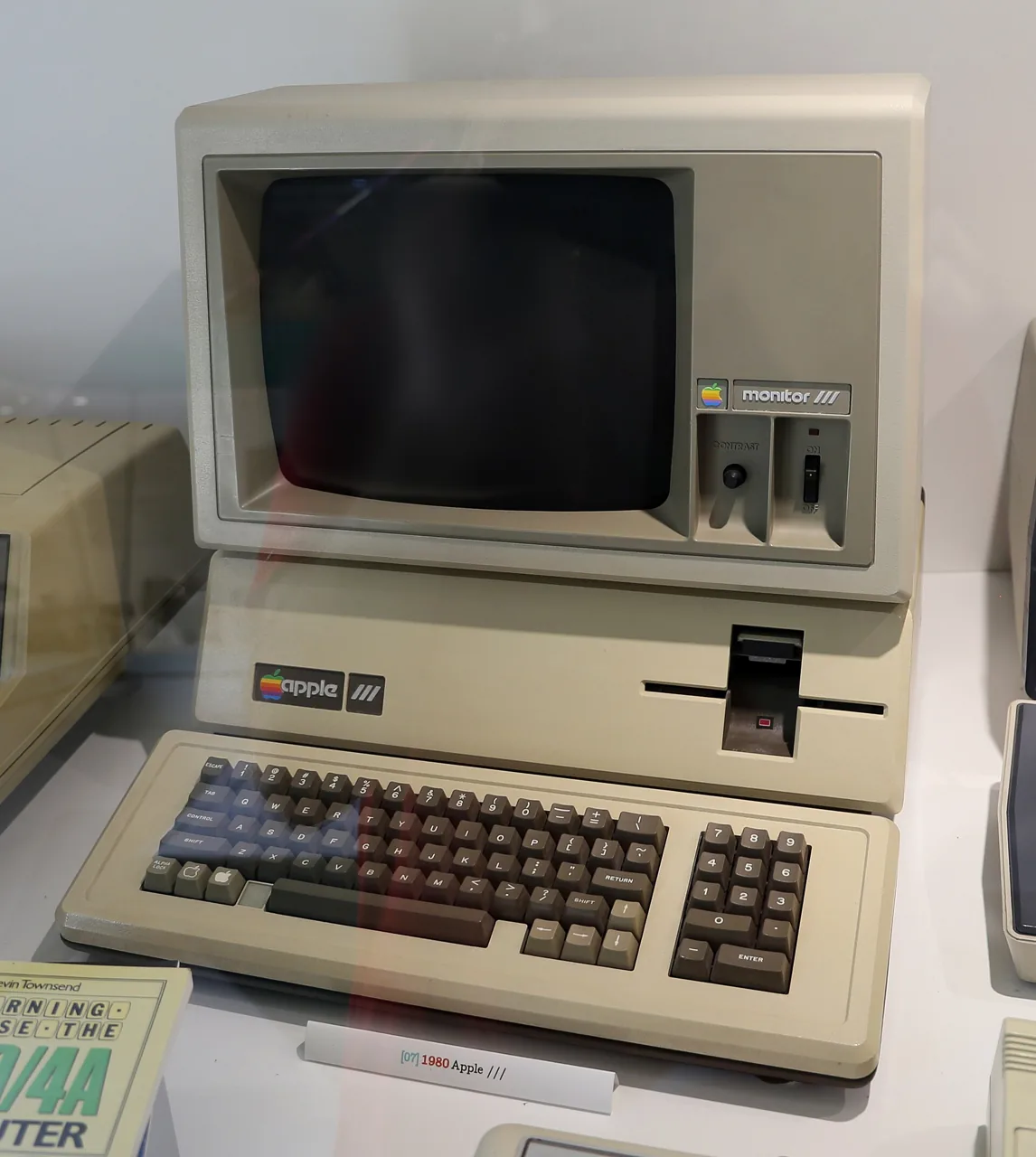
The Apple III shipped with 128K bytes of dynamic RAM, expandable to 256K, and a 4K ROM containing self-test and boot-loader routines9. A 96K configuration was also offered early in its lifecycle1214. The system ran a 6502B processor at 2 MHz, enhanced with bank switching, double stack, and dual zero pages, features intended to support more complex business applications than the Apple II could manage9. Both color and monochrome video outputs were standard, with Apple offering the dedicated green-screen Monitor III for professional environments9.
Storage centered on a built-in floppy-disk drive, with larger-capacity drives available as upgrades515. Additional external drives could be connected, and the system supported file transfer utilities for Apple II disks, including the Transfer 'III tool, which moved DOS text files, Visicalc spreadsheets, and Pascal data between platforms59. That utility retailed for $60 and included a diskette and manual5.
The audio subsystem provided three distinct generators: a fixed-frequency beep, a 1-bit programmable output, and a 6-bit A-D converter, unusual for its time, enabling limited digitized sound input9. I/O included a keyboard interface, RS-232C serial port, two game-paddle connectors, and an optional universal parallel I/O card9. The system weighed 26 pounds (11.8 kg) and measured 17.5 × 18.2 × 4.8 inches (44.45 × 46.23 × 12.19 cm), drawing up to 100 watts from a 107–132 V AC source9.
Software offerings included Business BASIC and Apple Pascal, sold separately at $125 and $250 respectively9. Productivity suites featured Applewriter III ($225), Visicalc III ($250), and Apple III Business Graphics ($175)9. Communications were supported via Apple Access III ($150) and Script III ($125), while the Pascal Utility Library retailed for $759. CP/M compatibility was achieved through the Apple SoftCard III, a Z-80 expansion board bundled with CP/M, Microsoft BASIC, PIP utilities, and four manuals1.
Apple positioned the III as a business machine, and one UK distributor, DEANS, offered a package including the 256K Apple III, Dot Matrix Printer, Apple Writer III, Visicalc III, and Self TRAINING Manual for £2995.0013. The machine could run many Apple II programs, particularly in emulation mode, and certain Apple II interface cards functioned in the Apple III, though their use risked exceeding FCC radio-frequency radiation limits and causing interference on nearby electronics9. Apple provided minimal documentation for writing device drivers to bridge software incompatibilities9.
Despite these capabilities, the Apple III’s market reception was tepid. An estimated 60,000 units sold over its first two years, a figure described as “no doubt a big disappointment” to Apple15. Sales improved in late 1982 after Apple reduced prices, upgraded the system with higher-capacity drives, and added an IBM 3270 terminal emulator and an accounting package15. To push inventory, Apple offered floor salesmen a $100 rebate per unit sold15.
The Apple III also supported the Corvus Constellation II network disk system, allowing shared storage across multiple machines via dedicated Apple III software2. This integration signaled Apple’s early, if limited, foray into networked business environments, though the platform’s overall footprint remained narrow.
References
- A2F0084 AppleAtAGlance 0582
- CorvusSystemGenerationGuideAppleIII 7100-05295
- MICRO Vol49-06 82
- 1982 09 BYTE 07-09 Computers and the Disabled (1982)
- 1981 04 BYTE 06-04 Future Computers (1981)
- Archive item #198308
- 1981 07 BYTE 06-07 Energy Conservation (1981)
- 1983 04 BYTE 08-04 New Chips (1983)