Atari Mega STE
The Atari Mega STE integrated popular ST upgrades into a single desktop unit, combining a 16MHz processor, built-in hard disk, and Appletalk-compatible networking to position itself as a business-ready successor to the 1040STE.
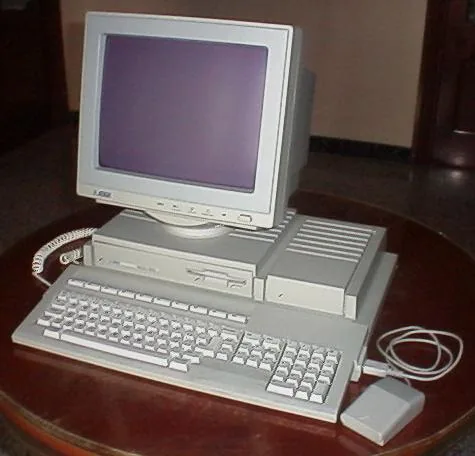
The Mega STE emerged not as a radical departure but as a consolidation. Atari’s answer to a user base that had long patched together expansions to keep the ST platform viable, it packaged what enthusiasts had already been doing: bolting on faster clocks, hard drives, and networking, then selling it as a turnkey system13. The 16MHz processor could switch down to 8MHz, preserving compatibility with legacy 520ST software, a necessity in a market still running older binaries10. Model designations like "MEGA STE 1" and "Mega STE4" indicate tiered memory configurations, with "MEGA STE 1" corresponding to a 1MB RAM system and "Mega STE4" to a 4MB configuration879.
Hard drive integration was central to its appeal. The base model included a built-in hard disk, eliminating the need for external enclosures that had cluttered earlier ST setups13. For users upgrading from disk-based systems, Atari offered an HD Interface for the Mega STE that supported both internal and external 3.5" drives without additional software8. Optional drive kits included a Seagate 48 MB unit, a 105 MB Quantum with 64 KB cache, and a 240 MB Quantum with 256 KB cache and 15 ms access time, representing high-end storage for the era79. A standalone HD-Kit, priced at DM 199,-, included controller, faceplate, and shielding79.
Expansion was taken seriously. The machine featured a built-in VME card slot (a rare inclusion in consumer machines), allowing industrial-grade peripherals to be added13. An Appletalk-compatible LAN connector enabled networking and printer sharing, though it required third-party software to function13. A coprocessor upgrade, available for DM 89,- with installation, was offered as a standalone option for the Mega STE79.
Priced at DM 898,- for the MEGA STE 1 and DM 1698,- for the MEGA STE 1/120 model, it occupied a mid-tier business niche1. In the UK, bundled packages like the "Mega 1ST Pro 24 Pack" were listed at £POA, suggesting dealer-negotiated pricing12. A hard drive kit alone cost £39.00, with a 50MB drive option at £219.00 and a 210MB version at £499.0016. For users wanting more screen real estate, a monochrome SM 144/146 14" flat-screen monitor was offered at DM 299,-79.
The machine was marketed as the logical next step for ST power users, and by early 1993, it was reportedly the only Atari model selling in significant numbers1315. Its industrial case design, distinct from the aging STE chassis, was cited by one dealer as a major selling point, aligning with customer expectations of what a modern computer should look like15. It was positioned alongside the Atari TT and even shared a tower variant, the "Mega STE/TT Tower," available fully assembled from DM 1998,-8.
A graphics card upgrade, priced at DM 550,-, was offered for both the Mega ST and Mega STE, suggesting continued investment in visual performance despite the lack of documented display resolutions23. Software compatibility lists included niche business tools like "AutoKost" and disk utilities such as "Disk V468" and "Unilex 120"147. By the same token, the used market had already formed: buyers sought defective Mega STE units for parts as low as DM 300,-, and broken motherboards from 1040ST or STE models were actively collected23.
References
- Archive item #9207
- Archive item #9212
- Archive item #9212text
- Archive item #9210text
- TOS 1991-11 (1991)
- Archive item #9210
- atari-st-format-issue-024
- STFormat00-Bundled
- Toad Computers Spring Summer 1992 catalog (1992)
- Archive item #9207text
- ST Applications #25, January 1993 (1993)
- atari st review-issue 13