Atari 65XE
Atari released the 65XE as the base model of its new '65' series, a cost-reduced, software-compatible successor to the 800XL built around a 6502C CPU and 64K RAM, priced from $89.99 to £75 in bundled configurations.
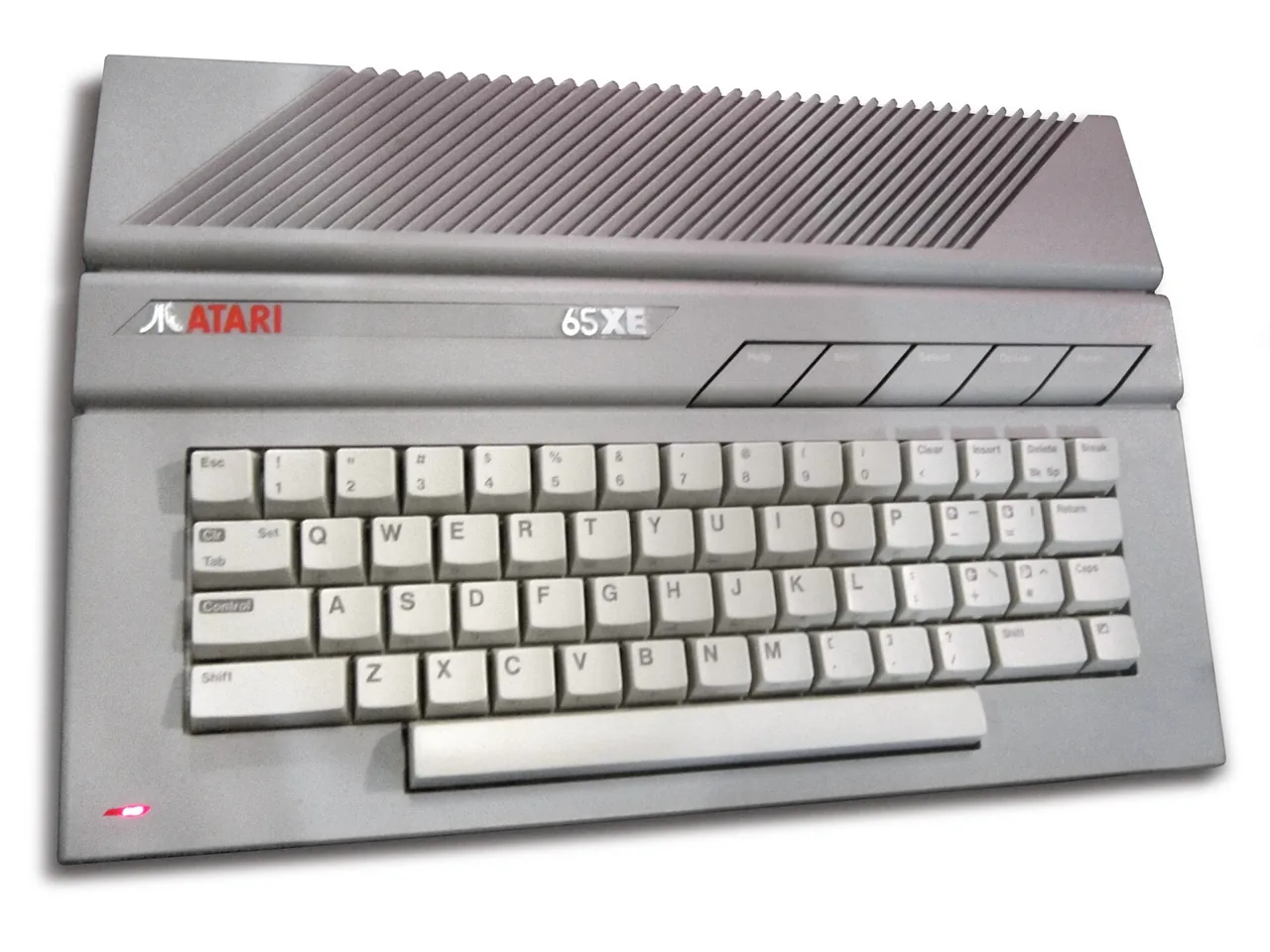
The 65XE emerged from Atari’s January CES showcase of four new '65' models, all leveraging the 800XL’s success111. Marketed as a direct evolution, it retained full software compatibility with the 400/800 series and 1050 disk drive111, running virtually all existing 800XL software without issue2. A minor subset of legacy programs failed due to operating system differences, though public domain patches such as FIX XL were available to resolve incompatibilities26. Titles like Drol and Conan the Barbarian ran without fault10.
Externally, the 65XE bore no resemblance to the 800XL, despite sharing its core architecture1. It was packaged in sturdy dark gray and white plastic, aligning with Atari’s updated industrial design language12. The keyboard featured 57 keys with five special-function keys relocated from the right side to a row above the main typing area91, and included graphic symbols printed directly on the keycaps4. A ROM cartridge slot was mounted at the rear7, but the machine omitted both the parallel bus of the 800XL and the expansion bus of the 130XE7.
Internally, the 65XE centered on a 6502C microprocessor and 64K bytes of RAM, variously described as 65,000 bytes2, with built-in BASIC4. It delivered a maximum graphics resolution of 320×192 pixels1911, supported 22 graphics modes4 (though one source cites 119), and offered five text modes111. Its graphics subsystem included Player Missile Graphics, enabling sprite-like objects91. The sound system provided four independent voices491, though the chip model remains undocumented.
Atari positioned the 65XE as the foundational model in the '65' lineup, with siblings offering targeted enhancements111. The 130XE was functionally identical except for doubling the RAM to 128K14. The 65XEM replaced the standard sound hardware with an eight-voice synthesizer chip, dubbed the Amy chip, enabling hi-fi audio with 64 harmonics149. The 65XEP was a portable variant integrating a 5-inch monochrome monitor and a 3.5-inch Sony microfloppy drive149.
Pricing varied significantly by region and bundle. In the U.S., the base unit sold for $89.99 (No. AA65XE)2 or $99.952, with complete packages reaching $35013. In the UK, the 65XE Console (bundled with software and a joystick) retailed at £7512, while the full computer with lightgun and joystick was priced at £11012. A standalone unit was listed at £997, and £100 with a tape deck3. At £99, one reviewer called it “a very good buy”7, and Antic magazine endorsed it as “a worthy successor” to the 800XL and “a fine choice for first-time computer buyers”2.
References
- Računari U Vašoj Kući 05 (1985) časopis (1985)
- Antic Vol 5-08 1986-12 Shoppers Guide (1986)
- AtariUser38-Jun88
- ZNET9212.TXT.generated
- Antic Vol 5-04 1986-08 Going Online (1986)
- AtariUser35-Mar88
- AtariUser33-Jan88
- ASTUN Atari ST Users Network 1987-05 (1987)
- Byte Magazine Atari Articles
- AtariUser36-Apr88
- Računari U Vašoj Kući 05 (1985) časopis (1985)
- AtariUser32-Dec87
- AtariUser11-Mar86
- AtariUser42-Oct88
- AtariUser24-Apr87
- AtariUser37-May88