VisiCalc
Software Arts, Inc. developed VisiCalc as the first electronic spreadsheet, establishing financial planning software as a primary justification for owning a personal computer.
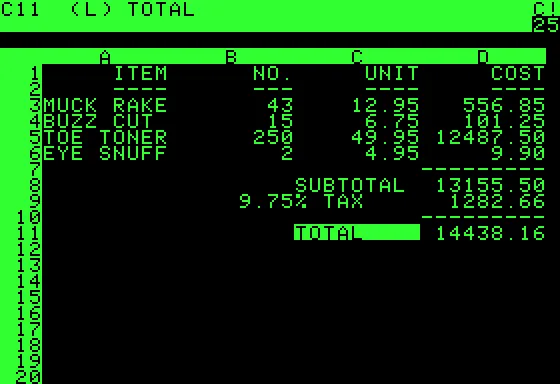
VisiCalc redefined paper spreadsheets through dynamic computation. By allowing users to input formulas that automatically updated all dependent cells upon change, it transformed static accounting into interactive modeling. The program’s responsiveness was its selling point: “VisiCalc responds instantly to show you all the consequences of any change”7. This immediacy made it indispensable in early business computing, where the ability to forecast outcomes from variable adjustments justified the entire cost of a machine. “You might find that VisiCalc alone is reason enough to own a personal computer”7, a claim supported not by marketing, but by observed user behavior.
The software shipped with two diskettes, a Users' Reference Manual, a Quick Reference Card, and a Support Plan Card16. Its manual, officially titled VisiCalc Guide, included a five-lesson tutorial and full command reference5. It supported arithmetic, financial, trigonometric, and logical functions4, and allowed users to insert, delete, and move rows and columns within the worksheet4. These features became standard in all successors, not by coincidence but by imitation: “Since VisiCalc was the first spreadsheet program, and thus the 'one to beat,' most of its outstanding features have been copied extensively”4.
Originally published by Personal Software, Inc.7, later versions were distributed by VisiCorp41115. It ran on Apple II computers with a 32k disk system7, and later versions were adapted for the IBM PC, requiring 64KB of user memory and one diskette drive16. When using DOS 2.00 or 2.10, or when storing data on a fixed disk, 128KB of user memory was required16. For the IBM PCjr, DOS 2.10 and 128KB of RAM were mandatory164. The VisiCalc Advanced Version, introduced to compete with emerging rivals like Multiplan4, exceeded the PCjr’s memory capacity and was therefore unavailable for that platform4.
Pricing varied significantly across platforms and revisions. The original Apple II version retailed for $25011. The IBM PC version launched at $2004, while later consolidated pricing listed VisiCalc at $179.0010. VisiCalc 4 was priced at $159.006. For the Apple IIe, the Enhanced version cost $179 and the Advanced version $21011. A discounted version of VisiCalc 3.3 for the II+ was offered at $16911. The standalone Business Forecasting module sold for $89.0010.
Despite the absence of documented release years or sales figures, VisiCalc’s cultural footprint was immediate and lasting. It was described as “the most popular business software program ever published”4 and “still the standard by which all spreadsheets are measured”4. A cottage industry of third-party literature emerged, including titles such as Doing Business with VisiCalc5, The Power of VisiCalc5, and specialized guides for real estate and engineering5. These books assumed a user base already familiar with the program’s structure, indicating its penetration into professional workflows.
The product line diversified into multiple branded variants: VisiCalc 436, VisiCalc IV4, VisiCalc Advanced468101113, VisiCalc Enhanced11, and VisiCalc Standard13. The Advanced version for Apple III added extended workspace, field protection, consolidation of multiple worksheets, variable column width, and additional mathematical functions8. However, the lack of versioning clarity in surviving documentation suggests a marketing-driven segmentation rather than a coherent technical progression.
VisiCalc’s legacy is not measured in lines of code or units sold (neither of which the record preserves), but in the expectations it set. It was more than a program; it was the reason the spreadsheet existed as a category. Its design constraints, memory demands, and command syntax became the unconscious baseline for every financial application that followed. Later programs improved upon it, but none erased its imprint.
References
- Interface Age-1983-02 (1983)
- PERSONAL COMPUTING JULY 1983 (1983)
- MICRO Vol51-08 82
- Introducing IBM PCjr
- The Complete Guide to Success with the IBM PCjr
- MICRO Vol68-01 84
- 1980 09 BYTE 05-09 Homebrewing (1980)
- ComputerPersoenlich 83 19
- 1982 01 BYTE 07-01 The IBM Personal Computer (1982)
- MICRO Vol60-05 83
- 1984 06 BYTE 09-06 Computers and Education (1984)
- Interface Age-1982-06 (1982)
- ComputerPersoenlich 83 03
- BYTE Vol 07-05 1982-05 Japanese Computers (1982)
- 1982 12 BYTE 07-12 Game Plan 1982 (1982)
- 6936938-1 IBM The Guide Fall83-Winter84 Nov83