WordPerfect
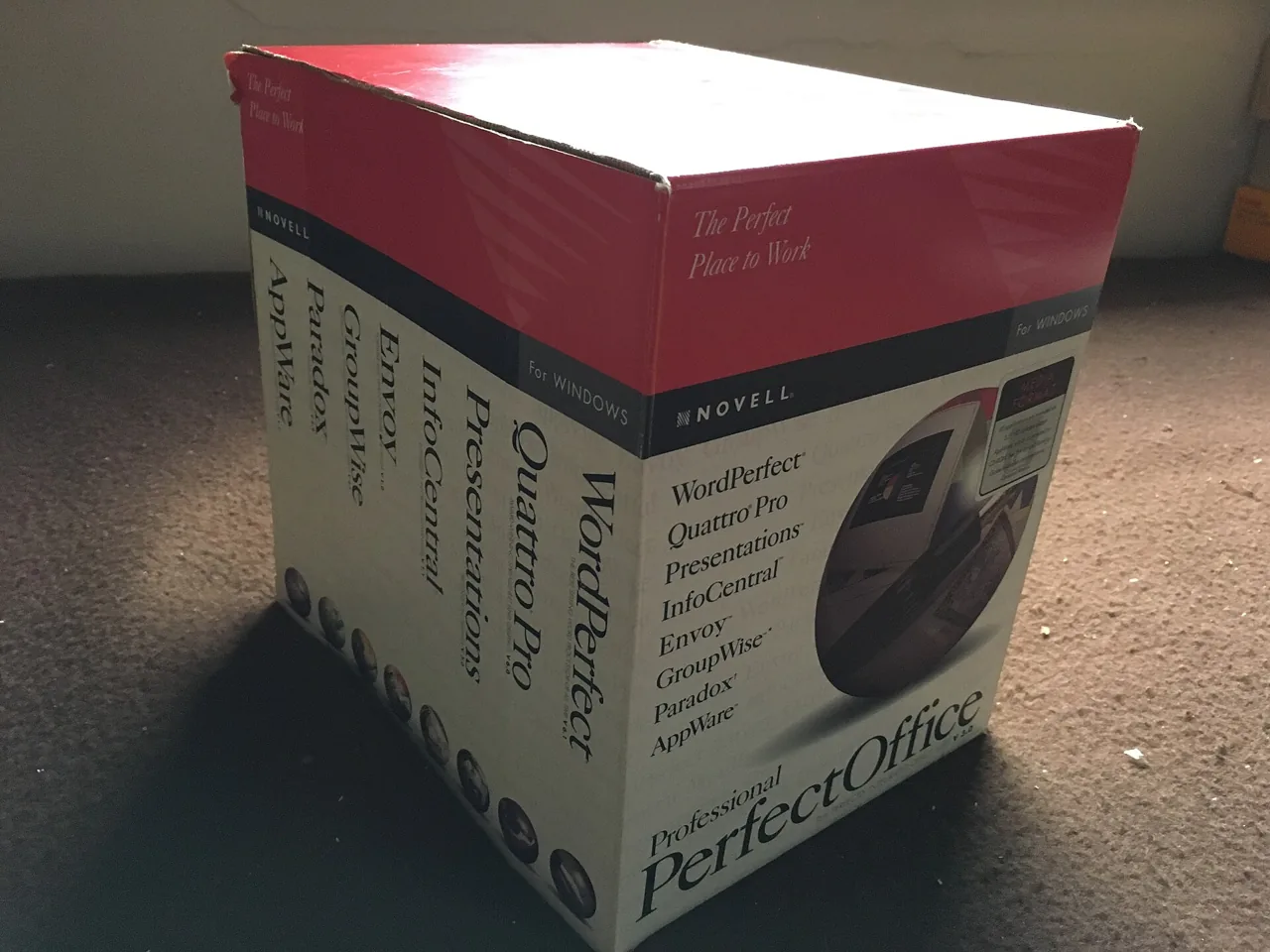
WordPerfect, developed by Satellite Software International of Orem, Utah, became the dominant business word processor of the late 1980s, distinguished by its speed, deep feature set, and obsessive attention to user support. These qualities drove its parent company to rename itself after the product in 19861.
Unlike contemporaries written in higher-level languages, WordPerfect was coded entirely in 8088/8086 assembly language, a decision that paid dividends in performance on the constrained hardware of the era9. It demanded MS/PC-DOS 2.0 and a double-sided, double-density disk system to run, and while the fact sheet is silent on base RAM requirements, later UNIX versions reveal the scale of its ambitions: WordPerfect 5.0 for Silicon Graphics’ IRIX operating system required 3.7MB for the first user and 975K for each additional concurrent user5. The DOS version, released in July 1988, carried a $495 price tag, deemed “equitably priced” by profiles v6n3, and could be installed to hard disk or floppy media1. Its installation was reportedly straightforward, aided by included “Installation Help” papers and a toll-free support line accessible to any registered user1.
The software ran on a broad range of systems beyond the IBM PC, including the Victor 9000, DEC Rainbow 100, Zenith Z-100, and Tandy 2000, with versions later appearing for Amiga, Sun, and multiple UNIX platforms931014. File compatibility across these platforms was a selling point: WordPerfect for Silicon Graphics, for instance, could exchange documents with DOS, Windows, VMS, Macintosh, Data General, and other UNIX variants5. The Amiga version notably embraced the platform’s interface conventions, supporting pull-down menus, mouse control, and multitasking, while maintaining file compatibility with WordPerfect 4.1 for IBM10.
Early versions drew criticism for their complexity. One reviewer found WordPerfect 4.1 “powerful, but burdened with endless menus and very dependent on documentation”1. WordPerfect 4.2 brought only marginal improvements1. But by version 5.0, the interface had matured: menus were no longer a hindrance but a gateway to features the reviewer had “only dreamed of”1. The documentation, bound in a three-ring loose-leaf manual, was lauded as “among the best in the software industry,” though the glossary was noted as a weak point19.
WordPerfect’s command structure permeated its ecosystem. Office LAN, a suite built around the core product, included e-mail, group calendaring, and resource scheduling for up to five users, with a 20-user version available at roughly triple the cost11. Its commands mirrored those of the word processor, easing adoption. The suite’s current version was 3.01 at the time of documentation, and a companion product, WordPerfect Connections, enabled bridging LAN e-mail to external users11.
The product’s fidelity to user needs extended to obscure but practical behaviors. Pressing F3 (Help) displayed the current date in the upper-right corner of the screen7. Headers and footers could include up to four of either, or two of each, with dynamic page numbering achieved by inserting a Control-N character9. Users could bypass expanded memory with the /NE startup parameter, and releases after November 6, 1989, could force EMS 3.2 compliance using /327. However, the Repeat Performance driver could trigger “Insufficient Memory” errors under Windows, a quirk documented in Windows 3.1 Secrets7.
WordPerfect 6.0 for DOS, introduced in 1993, succeeded version 5.1 and added integrated faxing via FaxBIOS technology, shipping with drivers for Class 1, Class 2, and CAS-compliant devices12. This marked a shift toward office integration, aligning with broader corporate strategy. In 1992, WordPerfect Corporation entered a “strategic technology-sharing partnership” with SunSoft, enabling porting of WordPerfect and WordPerfect Office to Solaris 2.0 and leveraging SunSoft’s development resources6. The products already ran on SunSoft’s Interactive UNIX line, and file compatibility with other WordPerfect versions was confirmed614.
Despite its strengths, WordPerfect for Sun faced early criticism: reviewers noted installation and operational roughness, likely due to the company’s newness to UNIX, though these issues were considered transient14. The company maintained active engagement with users through the WordPerfect Users Forum on CompuServe (GO WPUSER), where macros such as Calendar, Addresses, and a pop-up menuing system for WordPerfect 5.1 were shared816.
WordPerfect’s reputation was cemented early. A February 25, 1985 review in InfoWorld awarded WordPerfect 4.0 a rare 4.0 rating, declaring it “a new standard of excellence for microcomputer word processors”3. An advertisement in BYTE magazine promoted WordPerfect as “the critics’ choice,” and quoted List Magazine as saying: “WordPerfect won’t slow you down”4. By version 5.0, one reviewer had switched from WordStar and credited WordPerfect Corporation with having “pushed word processing software forward a generation”1. The sentiment was clear: “Give the folks from Utah a giant gold star”1.
References
- profiles v6n3
- PCMagazine V13N17 19941011 (1994)
- remark-volume7-issue2-1986 (1986)
- BYTE Vol 10-01 1985-01 Through The Hourglass (1985)
- ZNET9201.TXT.generated
- SunExpert-v03n08-1992-08 (1992)
- Windows 3.1 Secrets - Revised and Expanded
- CompuServe Magazine 1993-02 (1993)
- 1984 12 BYTE 09-13 Communications (1984)
- Cursor - Amiga Edition CCUG QLD Vol 5 No 4 Nov 1988 (1988)
- NetWare Lite Made Easy
- ZNET9311.TXT.generated
- SunExpert-v03n11-1992-11 (1992)
- CompuServe Magazine 1992-12 (1992)