Borland Turbo Pascal
Borland International's Turbo Pascal was a single-pass native-code Pascal compiler and integrated development environment released in 1984, notable for its speed, low price, and lack of copy protection, quickly becoming the dominant Pascal system worldwide.
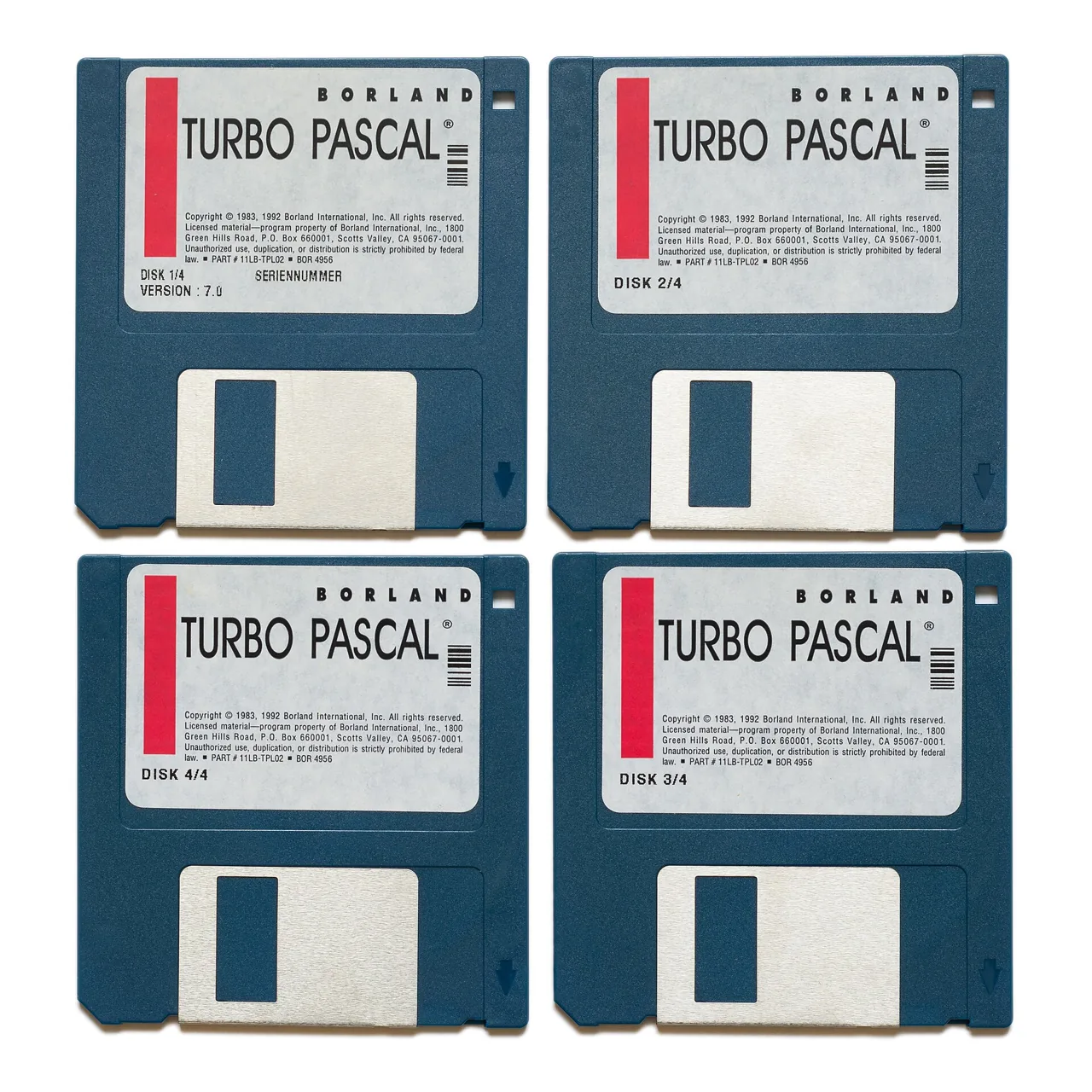
From a rented room above a garage in Scotts Valley, Philippe Kahn launched Borland International and, with Turbo Pascal, upended the software pricing model45. Where competing Pascal compilers sold for hundreds of dollars, Turbo Pascal debuted at $69; one source claims the initial version sold for less than $50, a discrepancy never reconciled in the documentation345. The package included an editor, compiler, and debugging tools in one tightly integrated system, occupying only 33K of memory on the PCjr14. It was a real compiler, not a P-code interpreter, generating native code that ran faster and more compactly than offerings ten times its cost245.
The first version carried a controversial $100 fee for production use, a policy dropped with Version 23. Unlike nearly every other major software package of the era, Turbo Pascal was not copy protected, a deliberate act of trust that reportedly fueled its rapid adoption3. By 1985, Version 3.0 required only 128K of RAM and included MicroCalc, a free spreadsheet with 1,200 lines of annotated source code, encouraging user education and modification8. That version also offered optional support for BCD arithmetic and the 8087 floating-point coprocessor11.
Version 4.0, available by 1988, broke two critical limits: it allowed output files larger than 64K and added support for EGA and VGA graphics, including 43- and 50-line text modes3. Prior versions had supported only CGA with basic line and dot plotting3. The 1988 release of Turbo Pascal 5.0 was bundled with Turbo Debugger and Turbo Assembler in the Turbo Pascal Professional package, positioning it as a full development suite7. Version 5.5 later introduced object-oriented programming, though the fact sheet does not date this release1.
By 1991, Turbo Pascal 6.0 shipped with Turbo Vision, an object-oriented framework for building text-based user interfaces with windows, menus, and dialog boxes. This was sophisticated for DOS but already straddling a divide, as BYTE noted, “between the houses of DOS and Windows”1. Borland was already developing “Turbo Pascal for Windows,” intended to produce native Windows applications, with delivery expected in the first half of 19911. The 6.0 version carried a list price of $149.95, a significant increase from earlier editions15.
Reception bordered on the ecstatic. Jeff Duntemann of PC Magazine called it the “Language deal of the century,” and PC Week’s Gary Ray declared it the benchmark Pascal compiler for the IBM PC12. One reviewer admitted, “I found it very difficult to write this review without sounding like a teenager who just discovered sex”13. The compiler’s manual was praised as “first rate,” and no bugs were reported in early use2. It was estimated that two-thirds of all Pascal systems in use worldwide were Turbo Pascal, and more than 500,000 people around the world were using it by 19864512.
Despite its success, quirks persisted. The EDITOR.PAS source code released by Borland contained a bug preventing use of the numbers 3 through 6; a fix was distributed via the Borland Language Forum on CompuServe15. A person had obtained the rights to Turbo Pascal for MSX from Borland and provided support for it, as Borland no longer supported the MSX version by 1995910. Versions existed for CP/M-80, CP/M-86, MS/DOS, and the IBM PCjr, making it one of the more widely ported development tools of its class614.
Turbo Pascal’s legacy is historical in scope and enduring in impact. It redefined expectations by proving that fast, powerful tools could be affordable and accessible, setting a standard that pressured the entire software industry to justify its pricing. Its integrated environment became the blueprint for modern IDEs, and its absence of copy protection stood as a rare act of faith in the user. The surviving documentation is silent on its discontinuation, but its influence endured long after.
Specifications
| Compiler type | Single-pass native-code compiler |
| Compilation speed | More than 2,000 lines per minute |
| Memory footprint | 33K bytes (PCjr) |
| Minimum memory (Version 3.0) | 128K |
| Output file limit (pre-Version 4) | 64K |
| Graphics support (Version 4+) | CGA, EGA, VGA; 43- and 50-line text modes |
| Language features | Bit/byte manipulation, direct memory access, dynamic strings, include files, random-access files |
| Platforms | CP/M-80, CP/M-86, MS/DOS, IBM PCjr, MSX (rights held) |
| Integrated tools | Editor, compiler, debugger (varies by version) |
| Copy protection | None |
References
- 1991 01 BYTE 16-01 1990 BYTE Award of Excellence (1991)
- profiles v1n5
- remark-volume9-issue11-1988 (1988)
- XIO3 Garden City Atari Computer Enthusiasts Newsletter November-December 1990 (1990)
- XIO3 Garden City Atari Computer Enthusiasts Newsletter November-December 1990 (1990)
- MICRO CORNUCOPIA No.16 Feb 1984 (1984)
- 1989 03 BYTE 14-03 Mac Supplement 286 vs 386sx Object Oriented Programming (1989)
- 1986 04 BYTE 11-04 Number Crunching (1986)
- msx computer club magazine 74
- msx computer magazine 74 mrt apr 1995 (1995)
- 1985 05 Dr Dobbs Journal (1985)
- BYTE Vol 11-10 1986-10 Apple II GS (1986)
- profiles v5n10
- 1984 06 BYTE 09-06 Computers and Education (1984)
- remark-volume13-issue3-1992 (1992)