Atari Portfolio
The Atari Portfolio, released in 1989, was a palmtop computer featuring a ROM-based operating system, an eight-line LCD, and expandable memory up to 640K, marketed as a portable business tool with IBM-compatible software support.
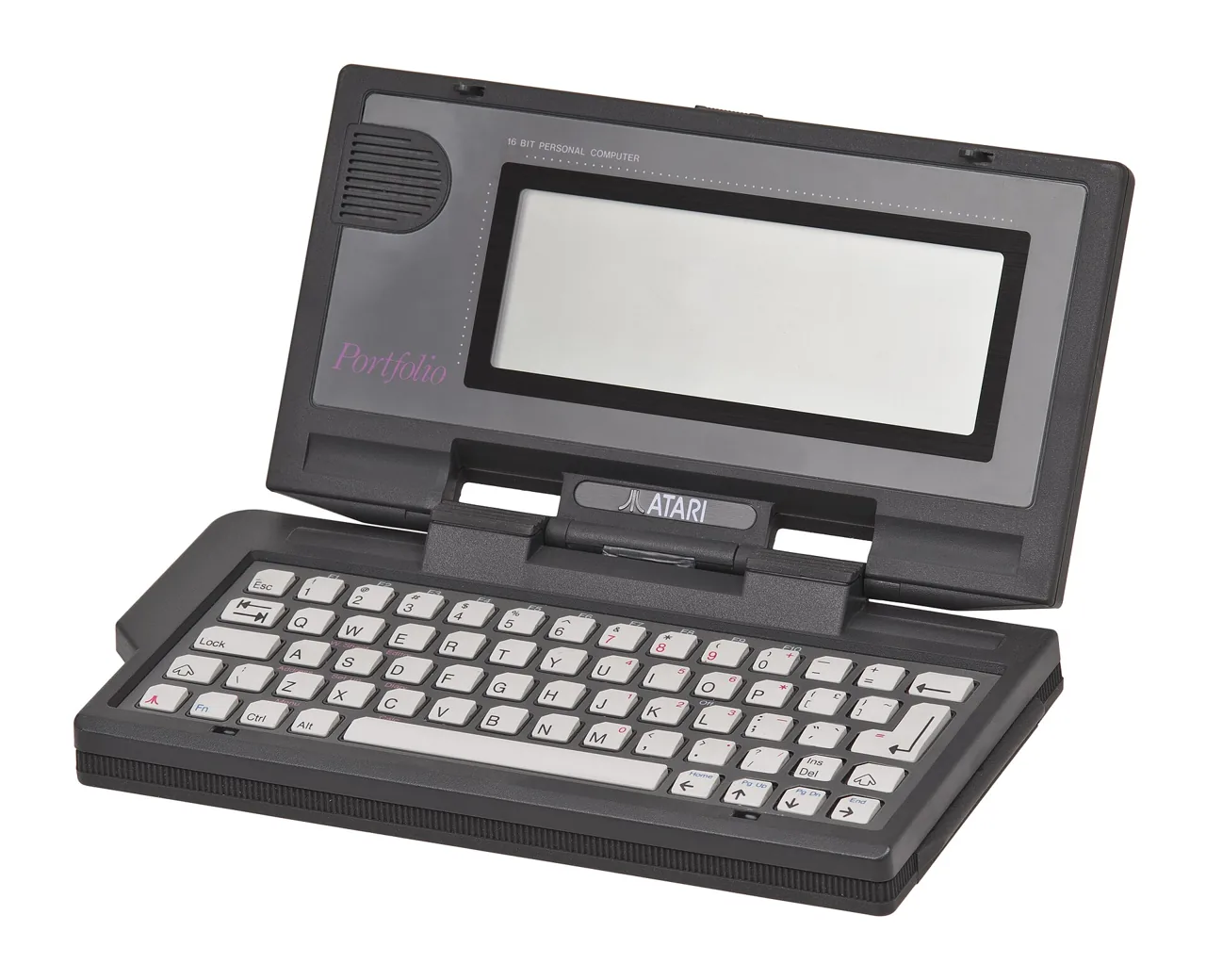
Atari entered the pocket computing market with the Portfolio, a machine designed for mobile productivity1. The device shipped with 128K bytes of RAM, expandable to 640K bytes via external units connected to its system bus1. Memory expansion was available in 128K increments from third parties such as Becker & Partner1. Instead of floppy drives, the Portfolio used battery-backed RAM cards with capacities of 32K or 128K bytes, which doubled as both storage and program media114. Additional software was distributed on ROM cards, including titles like Portfolio Chess, The Instant Speller, and a limited-edition Terminator 2: Judgement Day card9. Colossal Cave also appeared on a ROMCard, adapted for the platform9.
The machine featured an eight-line, 40-character LCD display and a 63-key keyboard described as IBM-compatible14. The keyboard connected via a coil cable, and the device included function keys. The exact layout remains unclear due to OCR corruption in surviving documentation1. The entire operating system resided in ROM, a design choice that minimized boot time but introduced persistent bugs later addressed by a utility called ROM Bug Fixer, installed in AUTOEXEC.BAT15.
Despite its compact form, the Portfolio supported business-grade applications. Atari claimed its built-in spreadsheet handled Lotus-compatible files, and a GWBASIC-compatible interpreter named PBasic was available, supporting standard commands and Portfolio-specific features such as MENUs54. Other software included Extractor, a PKUNZIP-compatible de-archiver, and Graphics Show by Don Messerli, which added rudimentary graphics capabilities4. An included appointment calendar featured automatic alarms, while a phone list card supported automated dialing through a connected modem14.
Expansion options were limited internally but creatively extended externally. The Trans-Drive interface allowed the Portfolio to access a desktop PC’s floppy and RAM disk as if they were local drives1. A forthcoming memory-card drive for PC slots was announced to facilitate file transfers1. Atari also provided serial and parallel interfaces, with third-party alternatives like the MultiPort-Interface from IBP7. BSE Company offered a 20MB hard disk unit connecting via the parallel port for $499, while XoteriX sold a similar $899 model13.
Initial reception was cautiously optimistic. One user acknowledged, “I liked the Portfolio. I really did. But the questions I still have about software compatibility are serious,” citing uncertainty over whether major applications like Lotus 1-2-3, WordPerfect, dBASE III Plus, or SideKick would run1. Others defended its utility: “I use it for heavy-duty business applications, which surprises some people. It is a serious business machine”4. Atari supported the platform through official channels, designating the CompuServe Atari Portfolio Forum as an official support site11, which launched alongside the product4.
In 1992, German publications noted that the Portfolio had “set standards in the Pocket-PC area” and proven its staying power through a growing ecosystem of third-party expansions712. It was priced below $400 in the U.S.14, while in Germany it ranged from 698 to 1,348 Deutsche Marks depending on memory configuration1. Though exact production figures and discontinuation dates remain undocumented, the Portfolio carved a niche as one of the earliest ROM-based palmtops with credible business software integration.
Specifications
| Memory | 128K bytes standard, expandable to 640K bytes via system bus |
| Storage | Battery-backed RAM cards (32K or 128K); ROM cards for software distribution |
| Display | Eight-line, 40-character LCD |
| Keyboard | 63-key, IBM-compatible, with function keys and coil cable |
| Operating System | ROM-based, with bug-fixing utility available via AUTOEXEC.BAT |
| Expansion | Trans-Drive interface for PC connectivity; serial and parallel interfaces; third-party hard drives (e.g., BSE 20MB unit) |
| Software | Lotus-compatible spreadsheet, PBasic (GWBASIC-compatible), Extractor, Graphics Show, appointment calendar with alarm, dialer-enabled phone list |
| Price | Under $400 in U.S.; 698–1,348 DM in Germany |
References
- Byte Magazine Atari Articles
- CompuServe Magazine 1992-03 (1992)
- CompuServe Magazine 1991-08 (1991)
- Archive item #9203
- ZNET9225.TXT.generated
- ZNET9135.TXT.generated
- STR815.TXT.generated
- Archive item #9203text
- ZNET9201.TXT.generated
- Compute Issue 111 1989 Aug (1989)