IMSAI 8080
The IMSAI 8080, sold by IMS Associates, Inc. of San Leandro, was one of the first commercially viable microcomputer systems built around the Intel 8080 and S-100 bus, marketed from 1975 onward as a rugged, expandable alternative to hobbyist kits.
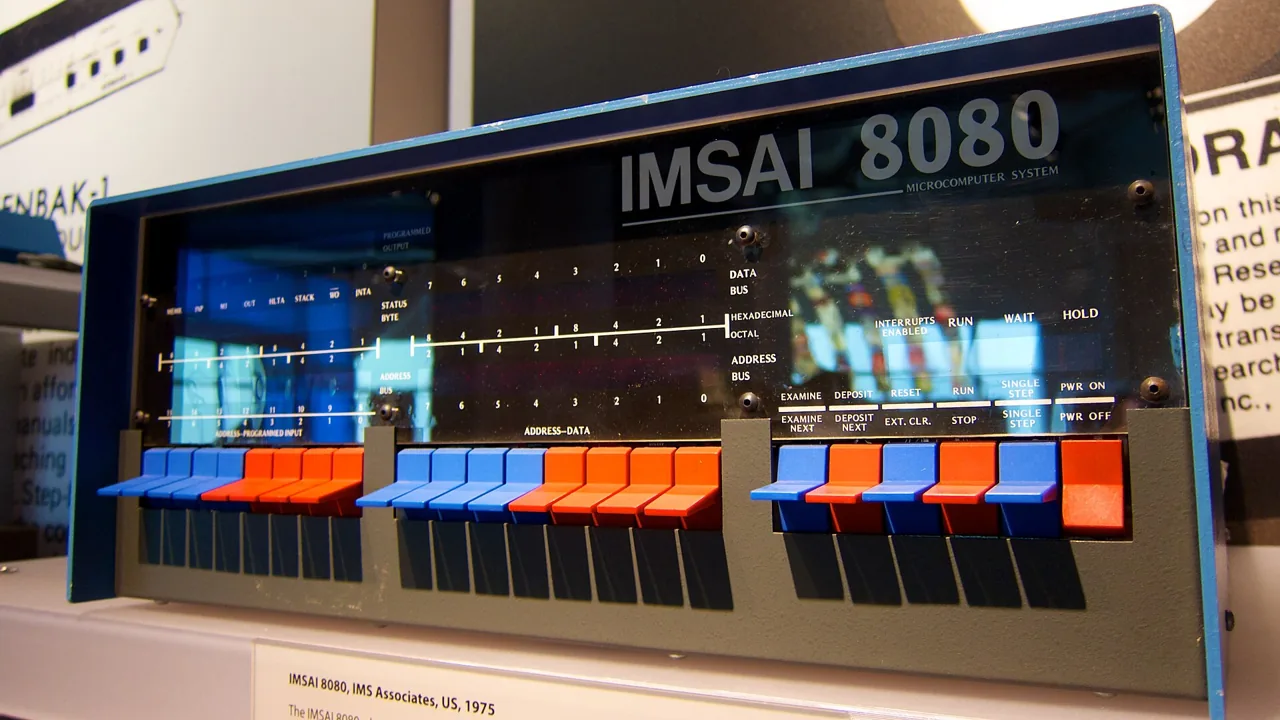
Unlike the flimsy enclosures of contemporaries, the IMSAI 8080 came in a commercial-grade anodized aluminum cabinet, its 22-slot motherboard anchored by a durable card cage that accepted plug-in boards without wire harnesses347. This modularity reduced soldering and sped assembly, which reportedly took 10 to 20 hours for the kit version29. The front panel featured paddle switches and LEDs, backed by debouncing circuits for reliability, plus 8 additional program-controlled LEDs to monitor output ports412. It operated from 120V, 50–60 Hz and included a 28-amp +7V power supply, advertised as a “true 28 amp current,” with 3 amps each at ±15.8V23468.
The system supported up to 64K of memory, though base configurations included either 1K RAM or a 4K RAM board (RAM 4A-4)234712. A $139 4K RAM board with software memory protect was later introduced, reflecting the company’s push for professional reliability34711. IMSAI BASIC was available in 4K, 8K, and 12K versions, offered in PROM and distributed at cost to registered users134711. A disk operating system (DOS) was supported, along with peripherals including floppy disk controllers (each with their own 8080 CPU), tape cassettes, printers, video terminals, and teletypewriters3479.
Priced at $439 as a kit or $621 assembled, the IMSAI 8080 occupied a premium tier; some sources list a $750 kit or a $999 unassembled unit, suggesting configuration-dependent variation412131415. It carried a 90-day warranty29, and was advertised as compatible with the Altair 8800, with interchangeable boards and the ability to link up to three IMSAI or Altair systems for shared memory and multiprocessing12. The system also implemented an 8-level priority interrupt system, a feature emphasized in technical literature as critical for real-time control applications347.
Marketing materials from 1976 positioned the IMSAI 8080 not as a toy but as a “high-quality commercial computer”, superior to OEM systems of the day29. By 1977, it was described as having been “introduced less than two years ago”, placing its debut around 19756. The company claimed it was “acknowledged as the finest personal computer available”, a boast echoed in multiple period sources68. More than 275 dealers worldwide distributed the system, which was part of a broader ecosystem of over 120 integrated components and software packages10.
The IMSAI 8080’s legacy rests on its industrial build and early embrace of open-chassis, S-100-based architecture, yet its pricing and complexity limited mass adoption. Later models, including the PCS-80/10 (a renamed 8080A variant), PCS-80/15 (8085-based), and PCS-80/30 (with integral VDU), extended the line into more specialized niches5. Despite conflicting addresses listed for the manufacturer (14860 Wicks Boulevard in some brochures, 1922 Republic Avenue in others), its documentation remained consistent in tone: technically precise, unapologetically commercial, and aimed squarely at engineers and early adopters who valued durability over convenience3671112.
References
- IMSAI8080 WelcomeLetter
- IMSAI CompleteMicrocomputerSystemBrochure May76
- 1976 11 BYTE 00-15 More Fun than Crayons (1976)
- 1976 09 BYTE 00-13 Bicentennial (1976)
- Towers International Microprocessor Selector
- 1977 03 BYTE 02-03 Inexpensive Joystick Interfaces (1977)
- 1976 06 BYTE 00-10 The Game of LIFE in Color (1976)
- 1978 05 BYTE 03-05 Graphics in Depth (1978)
- The itty bitty machine company Winter 1977 Catalog (1977)
- 1977 11 BYTE 02-11 Memory Mapped IO (1977)
- 1976 07 BYTE 00-11 Core Memories (1976)
- ACS Newsletter 3 7
- 1979 07 BYTE 04-07 Automating Eclipses (1979)
- 1979 12 BYTE 04-12 Numerical Analysis (1979)
- BYTE Vol 03-04 1978-04 Robot Simulation (1978)