Tandy 1000
Tandy’s entry into the IBM PC-compatible market, the Tandy 1000, shipped with 128K of RAM and MS-DOS 2.11, positioning itself as a home-oriented machine with enhanced graphics and sound while diverging from the company’s earlier Tandy 2000 architecture.
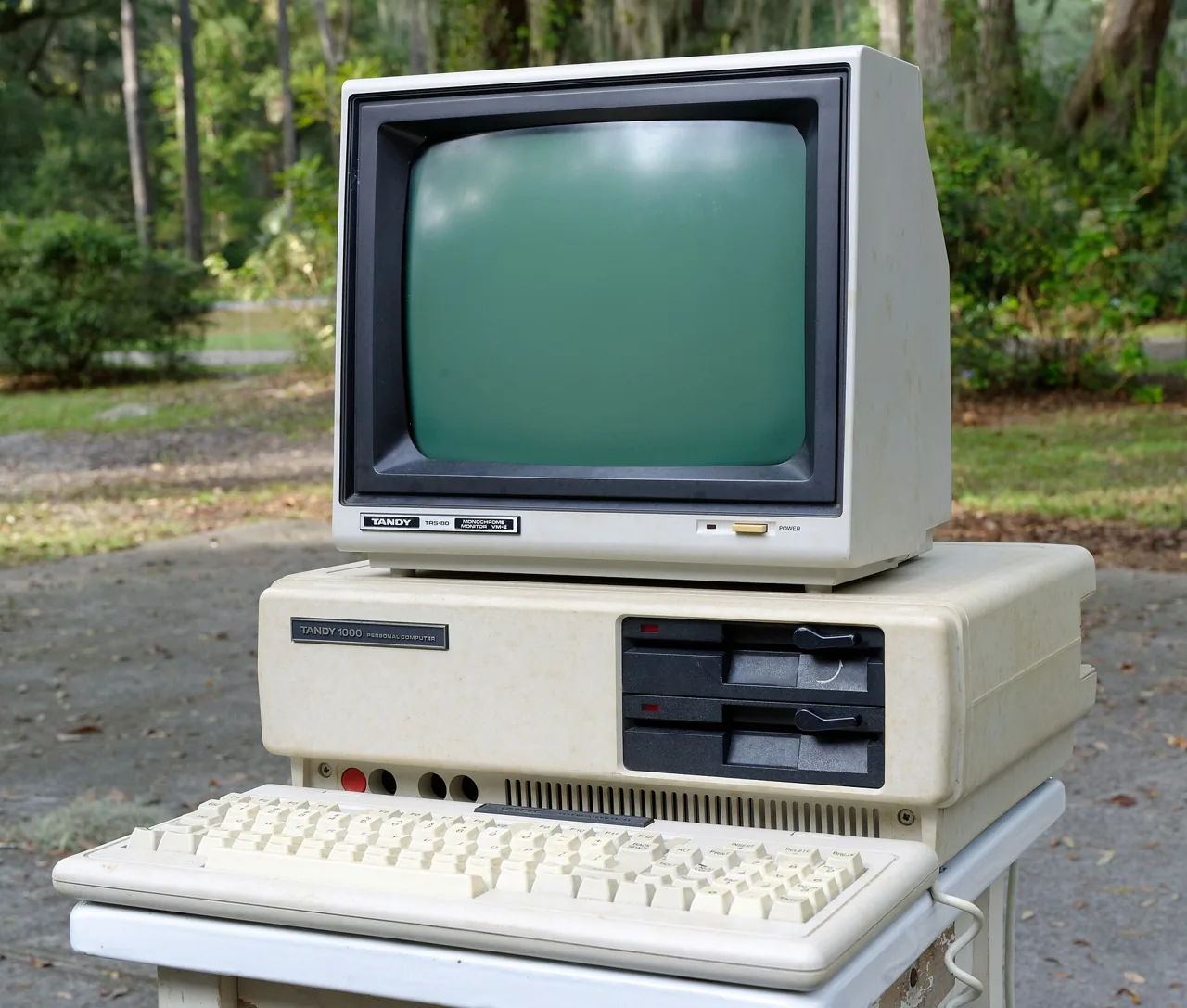
The Tandy 1000 emerged as a deliberate pivot from Tandy’s proprietary Tandy 2000 line, aligning instead with IBM PC standards to capture a broader software ecosystem2. Though physically and architecturally distinct from the Tandy 2000, the 1000 achieved a notable asymmetry in disk compatibility: while the Tandy 2000 could read and write Tandy 1000 disks, the reverse was not possible2. This one-way interoperability highlighted the 1000’s break from prior Tandy-centric design, favoring IBM compatibility as its foundation2.
At launch, the base model included 128K of RAM, expandable in stages, first to 384K via an upgrade kit, then to 512K using an expansion slot, and ultimately to the full 640K IBM PC memory ceiling with the addition of a 256K RAM module1. Crucially, the 128K memory expansion conferred DMA capability, a necessity for software requiring direct access to the floppy-disk controller or serial communication routines2. Without this upgrade, such applications would fail to operate, exposing a hard dependency buried in the machine’s architecture2. The system dispensed with configuration switches altogether; instead, ROM routines auto-detected hardware on boot and stored configuration data in BIOS-known memory locations, a design that broke software relying on direct reads of IBM’s hardware switches2.
Graphics and sound were marketed as differentiators. The machine supported 16-color graphics, a step above the standard CGA palette in both vibrancy and ease of use for home applications13. Sound output was confirmed in promotional materials, though implementation details are absent from surviving documentation13. Joystick support was hybrid: hardware-compatible with the TRS-80 Color Computer, yet software-compatible with PC titles, albeit with a caveat (PC programs relying on software timers often required modification to run)2. There were no dual-mapped I/O ports, and developers were advised to adhere strictly to IBM’s port documentation to ensure compatibility2.
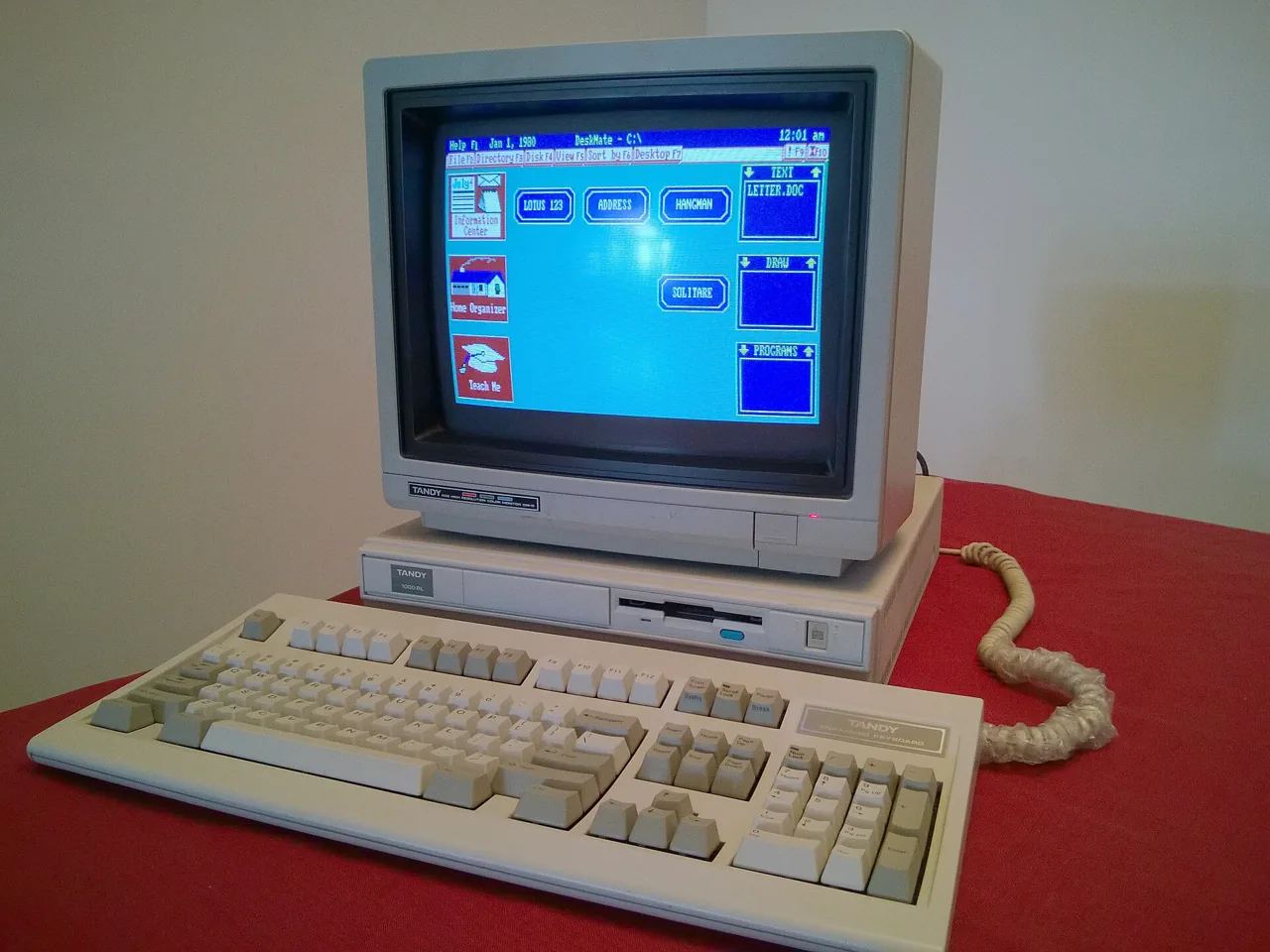
The operating system was MS-DOS 2.11, and Tandy committed to offering approximately 40 initial software packages, including Lotus 1-2-3, Microsoft Word, and the PFS suite2. Bundled with the system was DeskMate, an integrated environment featuring six applications, which became a signature element of the Tandy software experience123. Educational software such as The FUNdamentals used the machine’s multimedia capabilities, offering an interactive introduction to DOS, hardware, and DeskMate with 16-color graphics, sound, and animation13.
Expansion was constrained but thoughtful. The PLUS Expansion Board, supporting RS-232 or mouse functionality, connected via a dedicated port rather than consuming an expansion slot, preserving the limited internal real estate1. Memory upgrades, however, did require slot usage, evidenced by the 512K upgrade occupying one1. A dedicated diagnostic tool, the Tandy 1000 Disk Drive Diagnostic Tester, allowed users to verify drive performance across rotational speed, head alignment, and read/write accuracy, reflecting Tandy’s emphasis on user serviceability13.
Internal storage options included a 5-megabyte internal hard drive configuration, as well as an external 5-megabyte system, both explicitly branded as compatible with the 1000 line6. These were premium additions in an era when floppy-based systems dominated the midrange market.
The product line rapidly expanded beyond the original model. Variants included the Tandy 1000 EX, SX, HX, TX, SL, TL, TL/2, TL/3, RL, RL HD, RLX HD, and others, indicating a sustained commitment through the late 1980s and into the early 1990s13451213141516. The EX and SX models, for instance, required 256K of RAM and a graphics card to run certain software, suggesting segmentation by capability13. Some applications, such as those in DeskMate, supported up to 2048 spreadsheet rows and 2000 database records, figures explicitly cited in promotional literature13.
Despite its IBM PC compatibility, the Tandy 1000 was not a transparent clone. Its ROM routines consumed more memory than the standard PC, leaving less available for applications and requiring users to account for this hidden overhead2. This subtle but persistent memory tax meant that some PC software would run on the 1000 only with additional RAM, a constraint not always obvious to buyers.
References
- 1987.04 Your Computer (1987)
- 1984 12 BYTE 09-13 Communications (1984)
- 1987.04 Your Computer (1987)
- The Rainbow Vol. 07 No. 02 - September 1987 (1987)
- The Rainbow Vol. 07 No. 10 - May 1988 (1988)
- The Rainbow Vol. 06 No. 04 - November 1986 (1986)
- The Rainbow Vol. 11 No. 05 - December 1991 (1991)
- The Rainbow Vol. 11 No. 06 - January 1992 (1992)
- The Rainbow Vol. 11 No. 01 - August 1991 (1991)
- The Rainbow Vol. 10 No. 12 - July 1991 (1991)
- The Rainbow Vol. 11 No. 03 - October 1991 (1991)
- The Rainbow Vol. 07 No. 06 - January 1988 (1988)
- The Rainbow Vol. 09 No. 06 - January 1990 (1990)
- The Rainbow Vol. 08 No. 08 - March 1989 (1989)
- The Rainbow Vol. 08 No. 12 - July 1989 (1989)
- The Rainbow Vol. 08 No. 10 - May 1989 (1989)