Microsoft Mouse
A foundational peripheral that redefined cursor control on IBM PCs, not by invention, but by standardization.
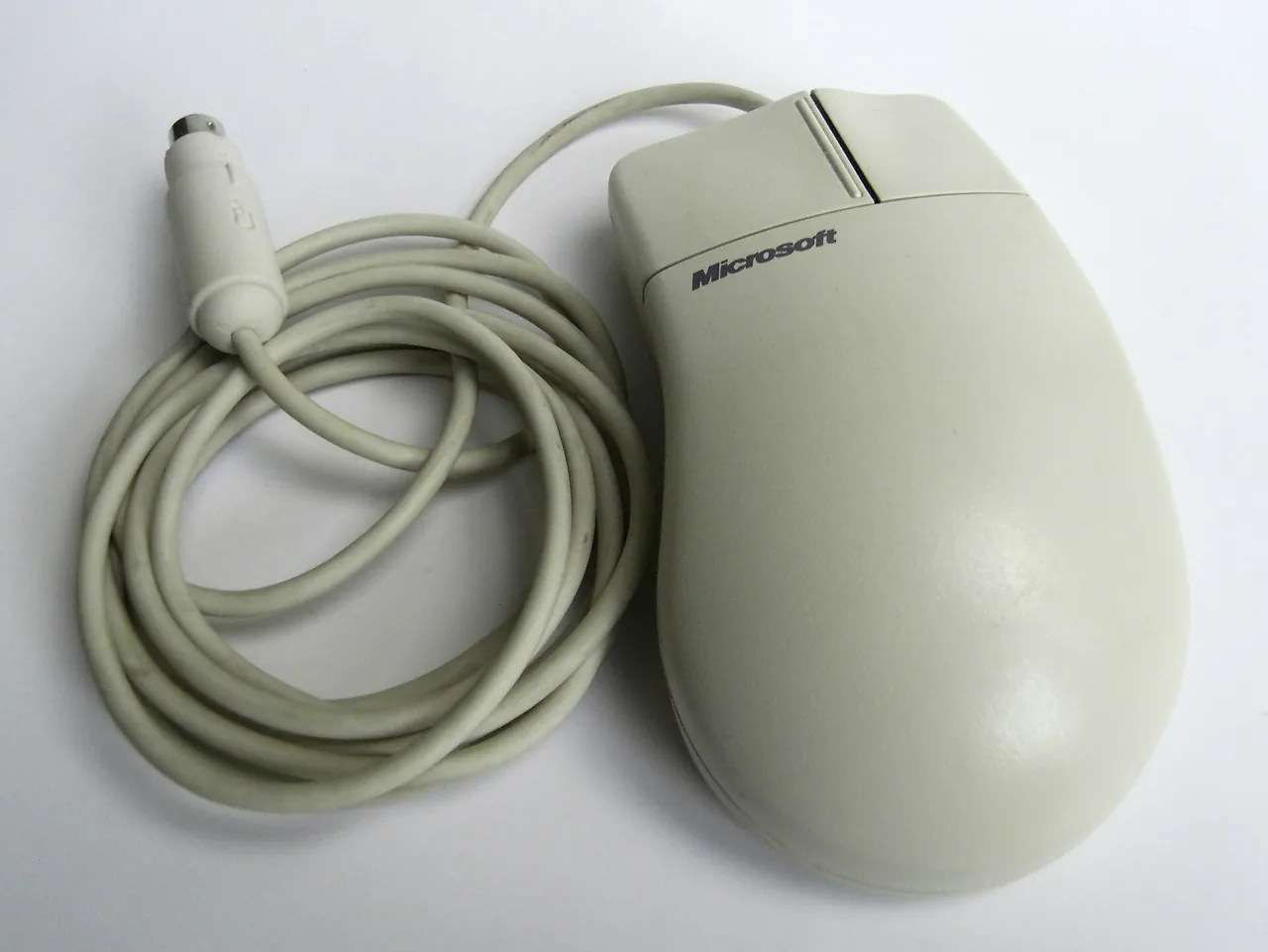
The Microsoft Mouse did not invent the pointing device for personal computers, but it codified it. While other manufacturers offered mice, Microsoft’s entry into the hardware space was less about mechanical novelty and more about creating a de facto interface standard through software dominance48. Released without a documented launch date, the device arrived during the formative years of the IBM PC ecosystem, positioning itself not merely as an accessory but as a complete system. Hardware was paired with a programmable driver that gave applications direct control over cursor behavior48.
Variants were offered for multiple interfaces: serial, bus (parallel), and InPort, each with part numbers indicating resolution and connection type57. The 100ppi and 200ppi tracking options, modest by later standards, were offered for different models57. Compatibility spanned all versions of MS-DOS, including 2.0, and extended into graphical environments like Microsoft Windows 286 and 38642. 910.
What elevated the Microsoft Mouse beyond its hardware was its software interface. Microsoft designed a standardized function call protocol, typically installed via device driver or TSR, that other manufacturers adopted910. This interface became so pervasive that it was effectively the minimum standard for mouse compatibility in DOS and early Windows applications910. Programs like Ventura Publisher® and Microsoft Works® made extensive use of the mouse, reinforcing its necessity910.
Pricing varied across listings and configurations. The serial version was listed at $13512, the bus version at $12512, though other sources cite $1396 or $12915 for the generic "Microsoft Mouse"—a discrepancy suggesting regional pricing, rebates, or bundling61215. By 1994, the mouse was still in circulation, bundled with MS-DOS 6.22 and Windows for Workgroups 3.1111.
The package included more than just hardware: an on-screen tutorial, a practice application, and Multi-Tool Notepad—a mouse-driven text editor—were provided to acclimate users to indirect input48. This educational suite underscored Microsoft’s understanding that the mouse was not self-evident; it required user retraining, a hurdle the company actively addressed.
Despite its influence, the surviving documentation is silent on physical design—dimensions, weight, button count, cable length, or colorGAPS. Internal components, sensor type, and mechanical construction remain unspecified in the source materialGAPS. Later products like the Microsoft BallPoint, Plug-and-Play, and Kids Trackball mice were distinct models, indicating a deliberate product segmentation13.
The Microsoft Mouse’s legacy lies not in engineering breakthroughs, but in ecosystem control. It was a hardware product that succeeded by becoming invisible—its interface absorbed into the fabric of PC software. When a program "supported the mouse," it almost always meant support for the Microsoft standard. That quiet ubiquity, not technical superiority, secured its place in the architecture of personal computing.
References
- 030-31645 Microsoft Windows 3.1 Resource Kit 1992 (1992)
- 1989.01 Your Computer January 1989 (1989)
- URP 11th edition
- PERSONAL COMPUTING JULY 1983 (1983)
- 84X1434 OS2 Technical Reference Volume 1 Sep87
- 1985 07 BYTE 10-07 Computers and Space (1985)
- PC Seminar V05 N05 198705 (1987)
- BYTE Vol 09-01 1984-01 1984 And Beyond (1984)
- Tischer PC System Programming 1991 (1991)
- PC System Programming MichaelTischer
- PCMagazine V13N17 19941011 (1994)
- BYTE Vol 11-10 1986-10 Apple II GS (1986)
- 1986 06 BYTE 11-06 Computers and Music (1986)
- 1986 01 BYTE 11-01 Robotics (1986)